Learn
How used-car prices are measured
Last updated:
Asking price, transaction price and book value measure different things. How listing-based prices work, and how to read a median, a spread and days on market.
A used car has more than one price. The asking price is what a seller advertises. The transaction price is what a buyer actually pays. A book value or valuation is an estimate for one car, usually adjusted for its mileage and condition. Prices built from listings measure the first of these across many comparable cars, so they are reported as a distribution (a median and a range around it) rather than one number, along with how many listings stand behind them and how long those listings have been up.
Written by Cardog. Where we describe a public authority's rules we link its own page, checked on 2026-10-26.
Three kinds of price
Each kind of price answers a different question, and they come from different places.
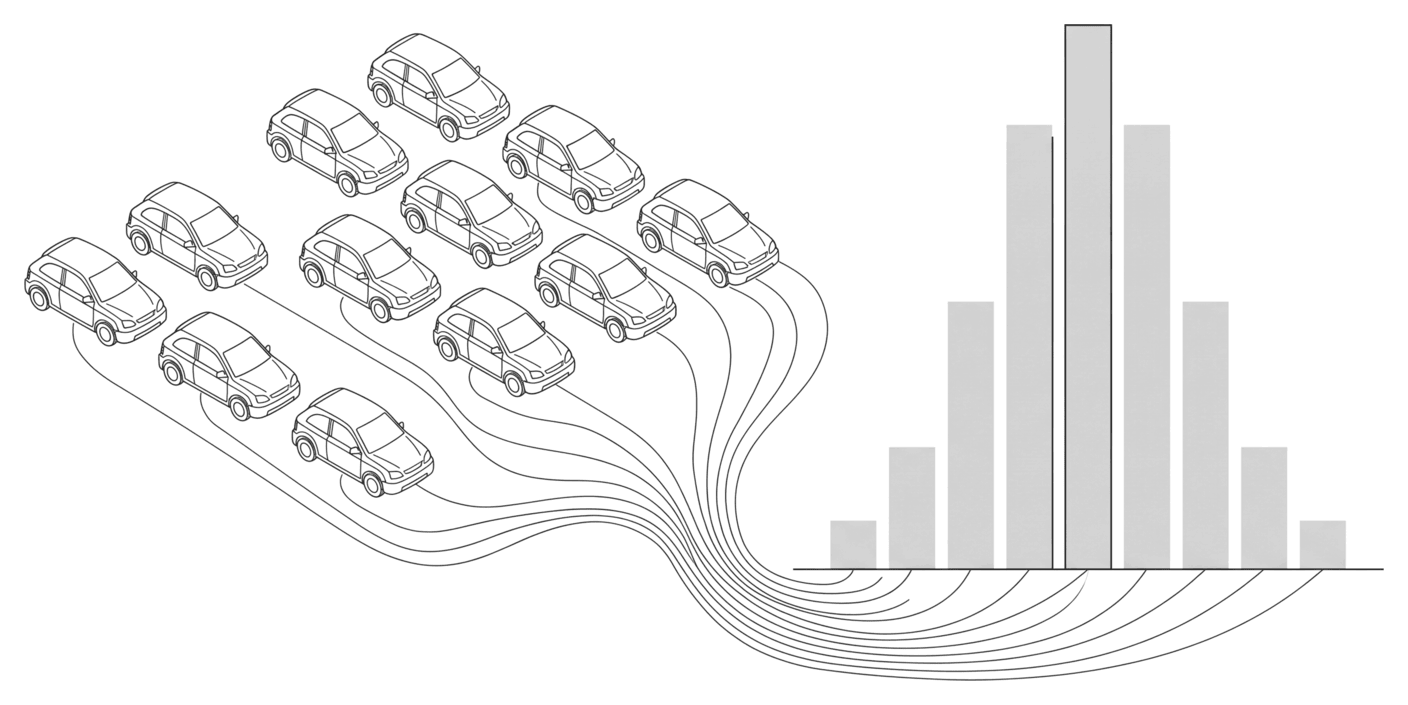
- 1Live listingsEvery live listing for one instrument:
liveCount. - 2The spreadTheir asking prices:
priceP25,priceMedian,priceP75. - 3The quoteOne summary as of
asOf, withbestPriceand days on market.
| Price | What it is | Where it comes from | When you see it |
|---|---|---|---|
| Asking price | What the seller advertises | Dealer and private listings | While the car is for sale |
| Transaction price | What the buyer paid | The bill of sale | After the sale, if it is shared at all |
| Book value or valuation | An estimate for one car | A model applied to that car's details | Any time you ask for it |
Asking prices are public and current, which is why most market data starts from them. They are also an opening position: the final price can be lower after negotiation, or higher once fees and add-ons are counted.
In Ontario, the asking price in a dealer's ad has a defined meaning. The Ontario Motor Vehicle Industry Council (OMVIC) says the advertised price must include all fees and charges the dealer intends to collect, with the exception of HST and licensing, and gives freight, PDI, administration fees and pre-installed products as examples (OMVIC). OMVIC also says it does not regulate manufacturers, so their ads do not have to follow the rule. The practical result: an Ontario dealer's advertised price is close to the amount a buyer pays before HST and licensing.
Why a distribution and not an average
Take every live listing for one model year and the prices spread out. Some cars have low mileage, some are a higher trim, some sellers price to move and some price to test the market, and a few rows are mistakes (a price of 1, or a monthly payment typed into the price field). An average gets pulled around by those extremes. A median does not.
So listing-based prices are reported as percentiles:
- Median (P50): half the listings ask less, half ask more. This is the usual "market price".
- P25 and P75: the 25th and 75th percentiles. Half the listings sit between them, so the gap between the two is a measure of spread.
- Lowest ask: the floor. It is often an outlier, so it is useful as a signal and risky as a benchmark.
- Count: how many listings the numbers come from. A median over a thousand listings is steady; a median over four is not.
Days on market and price cuts
How long cars stay listed tells you how the price is landing. If listings sit for weeks and sellers keep cutting, the asking prices are above what buyers will pay. If they turn over fast with few cuts, asking prices are at or below it.
Two measures capture this: the average time the current listings have been up, and the number and size of recent price cuts. A rising count of cuts is a sign that asking prices are coming down.
Mileage, trim and condition
Two cars of the same make, model and year can be thousands of dollars apart. The usual reasons:
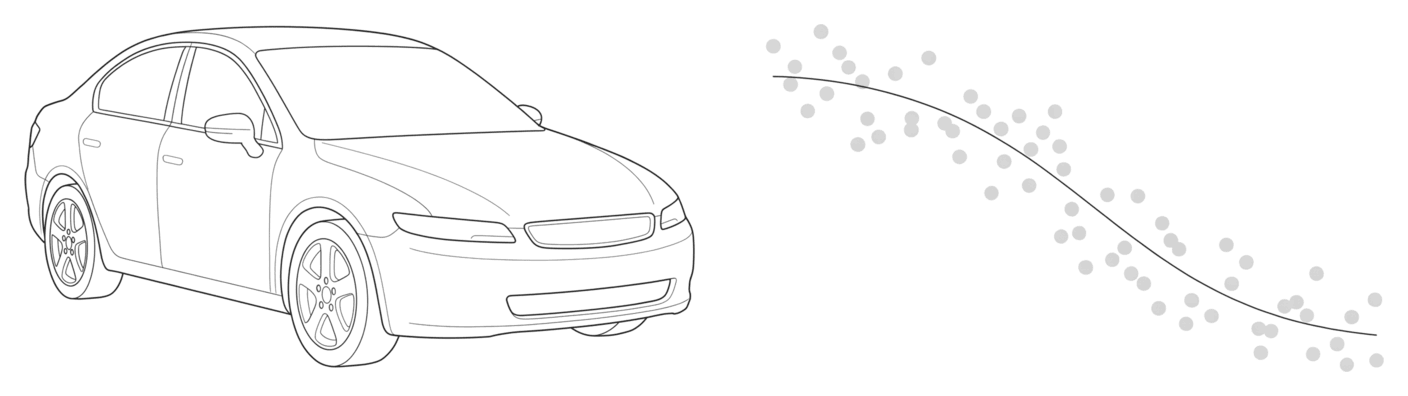
- Mileage. Higher odometer readings ask less.
- Trim and configuration. A top trim, a bigger engine or all-wheel drive can be a different price level from the base car.
- Condition and history. Damage, wear and how the car was kept move the price, and listings describe these unevenly.
- Location. Prices differ by region.
A market price for a model year blends all of these. To get closer to one car, narrow the group: the same configuration rather than the whole model year, a mileage band, a radius around the buyer.
Currency and market
Canadian and US prices are different markets, not one market in two currencies. Taxes, fees, supply, trims sold and buyer demand all differ, so a converted US price is not a Canadian price. Keep CAD and USD figures apart, and compare like with like.
If you do convert, use a published rate and say which. The Bank of Canada publishes daily average exchange rates once each business day by 16:30 ET, expressed as one unit of the foreign currency in Canadian dollars, and describes them as indicative rates (Bank of Canada).
What listing data can and cannot see
Listing data is the right tool for the current asking market, and it has limits worth knowing:
- It sees asks, not sales. A listing that disappears may have sold, or the seller may have given up.
- Fees vary by seller and province. An Ontario dealer's advertised price includes fees by rule; check the rules where the car is listed.
- Condition is self-reported. Two "excellent" cars can be very different.
- Thin groups are noisy. Rare models and new model years have few listings, so check the count before trusting the median.
- Duplicates. The same car can be listed on several sites. A careful count keeps one row per vehicle.
In the API
GET /v2/quotes/{ref} returns the live asking market for one instrument, and GET /v2/quotes?refs=a,b,c returns up to 20 in one call, in request order. Each call costs 5 credits. The guide is Market data.
An instrument is a model year (model-year:honda/cr-v/2026), a model year split by drive, fuel or body, or one configuration of one model year (squish:...; see Squish and nano build codes). Each quote has:
| Field | What it holds |
|---|---|
ref, grain | The instrument and its level: mmy, mmy.drive, mmy.fuel, mmy.body or squish |
liveCount | Number of live listings behind the quote. Treat it as the sample size. |
priceP25, priceMedian, priceP75 | The 25th, 50th and 75th percentiles of live asking prices |
bestPrice | Lowest live asking price, taken from asks of at least 30% of the median so that junk rows cannot set it |
avgDomDays | Average days on market across the live listings, counted from when each listing was first recorded |
cuts30d, avgCutPct30d | Price cuts seen in the trailing 30 days, and their average size in percent |
sightings30d | Listing observations in the trailing 30 days |
asOf | When the quote was computed |
The live set is one row per vehicle, from listings updated in the last three days. Cardog's listing search is built for Canada and its listing prices default to CAD. For a closer look at one car's peers, listing search (GET /v2/listings/search) filters by nanos, trims, an odometer range, price and a radius in km, and GET /v2/tape/history/{ref} returns daily median, P25 and P75 bars over a window.
FAQ
What is the difference between an asking price and a transaction price? The asking price is what the seller advertises. The transaction price is what the buyer paid, after negotiation, fees and any trade-in. Asking prices are public; transaction prices usually are not.
Why use the median instead of the average? A few extreme listings (a typo, a salvage car, a heavily optioned one) move an average a lot and a median very little.
How many listings make a reliable median?
There is no single cut-off, but more is steadier. Look at the count (liveCount in Cardog's quotes) before reading the median, and widen the group if it is small.
Does days on market tell me how fast cars sell? It tells you how long the current listings have been up so far. A high number means cars are sitting; it is a signal about pricing, read alongside price cuts.
Can I compare a Canadian price with a US price? Only with care. Convert at a stated rate, and remember that taxes, fees, trims and demand differ between the two markets.
How do I get closer to one car's price?
Narrow the group: quote the configuration (squish:) rather than the model year, then use listing search with an odometer range and a radius to see the cars most like it.
Related
Sources
Checked on 2026-10-26:
- OMVIC, All-in Price Advertising: https://www.omvic.ca/buying/your-rights/all-in-price-advertising/
- Bank of Canada, Daily exchange rates: https://www.bankofcanada.ca/rates/exchange/daily-exchange-rates/
If something here is wrong, tell us and we will fix it.
Was this helpful?