CarGurus vs Cardog: AI vs Traditional Search - Which Is Better?

CarGurus vs Cardog: AI vs Traditional Search - Which Is Better?
The way we search for cars online is evolving. For years, platforms like CarGurus have dominated by aggregating dealer listings and providing price comparisons. It's familiar, straightforward, and has helped millions of buyers.
But this traditional approach is fundamentally reactive—you search, filter, and compare manually. Cardog represents a different paradigm: AI-powered automotive intelligence that acts as your expert companion throughout the entire vehicle ownership lifecycle, not just during the search phase.
This isn't a simple "marketplace A vs marketplace B" comparison. CarGurus vs Cardog is really about traditional search platforms versus AI-orchestrated automotive intelligence. Understanding the difference matters because it changes how you approach buying, owning, and selling vehicles. Learn how CarGurus works to understand its traditional approach, or explore CarGurus alternatives if you're looking for different options.
Quick Verdict: Different Tools for Different Approaches
Choose CarGurus if: You want a simple, focused platform for comparing dealer prices on specific vehicles you already have in mind. It excels at answering "is this a good deal?" for individual listings.
Choose Cardog if: You want an AI-powered partner that helps you navigate complex decisions across the entire ownership lifecycle—from "what should I buy?" through "when should I sell?" with intelligent recommendations backed by real-time market data and predictive analytics.
The truth is these platforms serve complementary rather than competing purposes. CarGurus is excellent for transactional price comparison when you know what you want. Cardog provides the intelligence layer that helps you figure out what to want, when to buy it, how to maintain it, and when to sell it.
CarGurus: The Established Price Comparison Platform
Founded in 2006 by Langley Steinert (co-founder of TripAdvisor), CarGurus pioneered data analytics for automotive listings. The platform's core innovation was the Deal Rating system—an algorithmic assessment that tells buyers whether a vehicle is priced fairly. Our deep dive into CarGurus accuracy tests how reliable these ratings actually are.
How CarGurus Works
CarGurus aggregates inventory from licensed dealerships across North America. You enter search criteria: make, model, location, price range. The platform returns listings tagged with Deal Rating badges.
The Deal Rating—Great Deal (10%+ below market), Good Deal (5-10% below), Fair Price (within 5%), or High Price (above market)—is CarGurus' signature feature. The algorithm analyzes comparable vehicles, factoring in year, mileage, and regional pricing.
Beyond pricing, CarGurus offers standard marketplace features: saved searches, dealer reviews, listing alerts, and CARFAX integration. Once you identify a vehicle, CarGurus connects you with the dealer to complete the transaction.
CarGurus Strengths
- Price transparency: The Deal Rating system instantly signals whether you're looking at a fair price
- Dealer focus: Exclusively licensed dealers reduces risk compared to private seller platforms
- Clean interface: Minimal clutter and advertising compared to competitors like AutoTrader
- Established reputation: Nearly two decades of operation and millions of users create marketplace liquidity
- Free for buyers: No cost to search, compare, or contact dealers
CarGurus Limitations
- Transactional focus: The platform serves one purpose—helping you find a vehicle to buy now
- Manual comparison: You still need to research, compare listings, and make decisions independently
- Limited lifecycle support: Once you buy, CarGurus offers nothing for ownership, maintenance, or selling
- Dealer dependency: Inventory and experience quality depends entirely on participating dealers
- Static data: Deal ratings based on historical comparisons, not predictive market intelligence
- No AI orchestration: You do all the thinking—the platform just presents sorted data
Cardog: AI-Powered Automotive Intelligence Platform
Cardog launched with a different question: What if your car-buying companion could understand your needs, analyze market dynamics in real-time, predict trends, and guide you through every phase of vehicle ownership?
How Cardog Works
Cardog operates as an AI-orchestrated automotive intelligence platform rather than a traditional marketplace. Instead of manually filtering listings, you interact with Cardog's AI using natural language:
- "What's the best used SUV for a family of four in Toronto under $30,000?"
- "Should I sell my 2018 Honda Civic now or wait until spring?"
- "What maintenance should I expect on a 2020 Toyota RAV4 over the next three years?"
Cardog's AI analyzes your query, evaluates real-time market data across multiple sources, and provides personalized recommendations backed by data. It doesn't just return listings—it explains why specific vehicles match your needs and when to act on market opportunities.
The Cardog Difference: Lifecycle Intelligence
What truly separates Cardog from CarGurus and other marketplaces is its ownership lifecycle approach:
1. Discovery & Research Phase
- AI-powered recommendations based on your needs, not just search terms
- Cross-platform market analysis identifying deals across multiple marketplaces
- Predictive pricing showing whether vehicles are likely to appreciate or depreciate
- VIN-level intelligence including maintenance history, recall status, and ownership cost projections
2. Purchase Phase
- Real-time market intelligence showing optimal timing for purchases
- Negotiation insights based on vehicle-specific data and dealer patterns
- Financing comparison tools integrated with market conditions
- Automated alerts when your ideal vehicle appears at your target price
3. Ownership Phase
- Digital garage management tracking maintenance, expenses, and vehicle value
- Predictive maintenance alerts based on VIN-specific service patterns
- Market value monitoring showing your vehicle's worth in real-time
- Ownership cost tracking and budgeting tools
4. Selling Phase
- AI-powered optimal sell timing recommendations based on market trends
- Instant valuation with comparable listing analysis
- Multi-platform listing assistance maximizing your sale price
- Market positioning guidance showing how to price competitively
Cardog Strengths
- AI orchestration: Intelligent recommendations, not just filtered results
- Lifecycle support: From research through ownership to selling—continuous intelligence
- Cross-platform intelligence: Analyzes listings across multiple marketplaces including CarGurus, AutoTrader, and dealer inventories
- Predictive analytics: Forward-looking insights on pricing trends, depreciation, and market movements
- VIN-level data: Deep vehicle-specific intelligence including maintenance, recalls, and ownership costs
- Natural language queries: Ask questions in plain English and get expert-level answers
- Ownership tracking: Digital garage management with value monitoring and expense tracking
- Mobile-first design: Built for on-the-go intelligence, not just desktop browsing
Cardog Limitations
- Newer platform: CarGurus has nearly 20 years of brand recognition; Cardog is building its reputation
- Learning curve: AI interaction feels different from traditional search—requires slight mental shift
- Premium features: While core features are free, advanced analytics and some premium tools require subscription
- Market coverage: Currently strongest in Canadian and U.S. markets, expanding internationally
Side-by-Side Comparison
| Feature | CarGurus | Cardog |
|---|---|---|
| Platform Type | Dealer listing aggregator | AI-powered intelligence platform |
| Primary Function | Price comparison & deal identification | Lifecycle automotive companion |
| Search Method | Manual filters & sorting | AI-orchestrated natural language queries |
| Listing Sources | Dealers only (aggregated) | Cross-platform (multiple marketplaces) |
| Price Intelligence | Deal Rating (Fair/Good/Great) | Predictive pricing with trend analysis |
| Vehicle Data | Basic specs & CARFAX integration | VIN-level intelligence with predictive insights |
| Market Analysis | Historical comparisons | Real-time + predictive analytics |
| Ownership Support | None (purchase-only) | Full lifecycle tracking & management |
| Maintenance Tracking | Not available | Predictive maintenance with cost projections |
| Selling Support | Limited (Autozen in select markets) | Optimal timing recommendations + valuation |
| Mobile Experience | Mobile-responsive website + app | Mobile-first AI companion app |
| Cost | Free for buyers | Free core features, premium subscription available |
| Best For | Comparing dealer prices on known vehicles | Navigating complex decisions with AI guidance |
Detailed Comparison: What Matters Most?
Search Experience: Filtering vs Intelligence
CarGurus uses traditional search. Select make, model, price range, apply filters. Results appear sorted by Deal Rating. This works well when you know exactly what you want: "Show me 2019-2021 Honda CR-Vs in Toronto under $28,000." CarGurus excels at executing that specific query.
But what if you're not sure? "What's the most reliable SUV I can afford?" or "Should I buy used or certified pre-owned?" CarGurus can't answer these—you need to research independently.
Cardog's AI-orchestrated search flips this model. Ask open-ended questions in natural language:
- "What's the best family vehicle in Vancouver under $35k?"
- "Compare reliability of Honda CR-V vs Toyota RAV4 for 2018-2020"
- "Should I buy a 2021 Ford F-150 now or wait?"
Cardog's AI considers factors you might not have thought about—upcoming recall patterns, seasonal pricing trends, insurance cost variations—and provides recommendations with explanations. It's the difference between using a search engine and consulting an expert.
Price Intelligence: Ratings vs Predictive Analytics
CarGurus' Deal Rating is straightforward. A "Great Deal" badge means the price is 10%+ below market. This transparency helps buyers negotiate confidently.
However, Deal Ratings are backward-looking—they compare prices to recent listings, not whether the market is trending up or down. If prices are about to spike, a "Fair Price" today might be a "Great Deal" next month, but CarGurus doesn't predict this.
Cardog's pricing intelligence combines historical data with predictive analytics:
- Current market value based on real-time comparable listings
- Historical price trends over 3-6 months
- Predicted price trajectory over 30-90 days
- Optimal purchase timing recommendations
- Negotiation range based on vehicle-specific factors
For example, Cardog might flag that Honda Civic prices typically drop 6-8% in January-February due to winter inventory buildup, suggesting you wait. Or alert you that your target model is appreciating due to supply constraints, recommending quick action.
This forward-looking intelligence proved invaluable during market volatility. When used car prices surged 40% during the pandemic, buyers using CarGurus saw "Fair Price" tags on vehicles that would plummet months later. Cardog's predictive models would have flagged these anomalies.
Market Data & Insights: Comparisons vs Intelligence
CarGurus shows comparable listings and dealer ratings. This answers "Is this specific listing a good deal?" effectively. But it doesn't answer broader questions like "Is now a good time to buy?" or "Which sedan depreciates slowest?"
Cardog treats market intelligence as core functionality:
- Market trend analysis: Real-time pricing movements by make, model, and region
- Depreciation projections: AI-powered predictions of value retention
- Ownership cost modeling: 3-5 year estimates including fuel, insurance, maintenance, depreciation
- Recall tracking: Automated safety alerts for your vehicles
- Supply/demand dynamics: Insights into inventory levels affecting pricing
- Seasonal patterns: Historical analysis showing optimal purchase and sale timing
This transforms car buying from a transaction into an informed strategic decision. You're not asking "Is this a good price?"—you're asking "Is this the right vehicle at the right time given my situation and market conditions?"
Ownership Lifecycle Support: None vs Continuous Intelligence
CarGurus ends its relationship when you contact a dealer. Once you've purchased, the platform offers nothing—no maintenance tracking, value monitoring, or guidance on when to sell. You start over three years later as a new buyer with no continuity.
Cardog is built around ownership lifecycle philosophy. After purchase, you can:
- Digital garage: Track all vehicles with automatic VIN data population
- Monitor market value: Real-time valuation updates showing monthly worth changes
- Maintenance alerts: Predictive notifications based on mileage, age, and VIN-specific schedules
- Track expenses: Log fuel, maintenance, repairs, insurance for true ownership costs
- Sell-timing recommendations: AI-powered alerts when market conditions favour selling
For example, if you bought a 2020 Honda CR-V in January 2022 (peak pricing), Cardog's AI would alert you by November 2023 that CR-V prices had dropped 15%, suggesting you hold. By spring 2024, with prices recovering and higher-mileage service approaching, it might recommend selling before depreciation accelerates.
This transforms car ownership from disconnected transactions into an actively managed asset—with AI doing the analytical heavy lifting.
User Experience: Familiar vs Innovative
CarGurus delivers a familiar interface built around traditional search: dropdowns, checkboxes, sorting options. Clean and straightforward, but you're constrained by provided filters—no nuanced questions or custom analyses.
Cardog requires a slight mental shift. Instead of filters and results, you engage with an AI assistant conversationally. Type or speak naturally, and Cardog responds with personalized insights. For users comfortable with AI assistants, this feels intuitive and powerful.
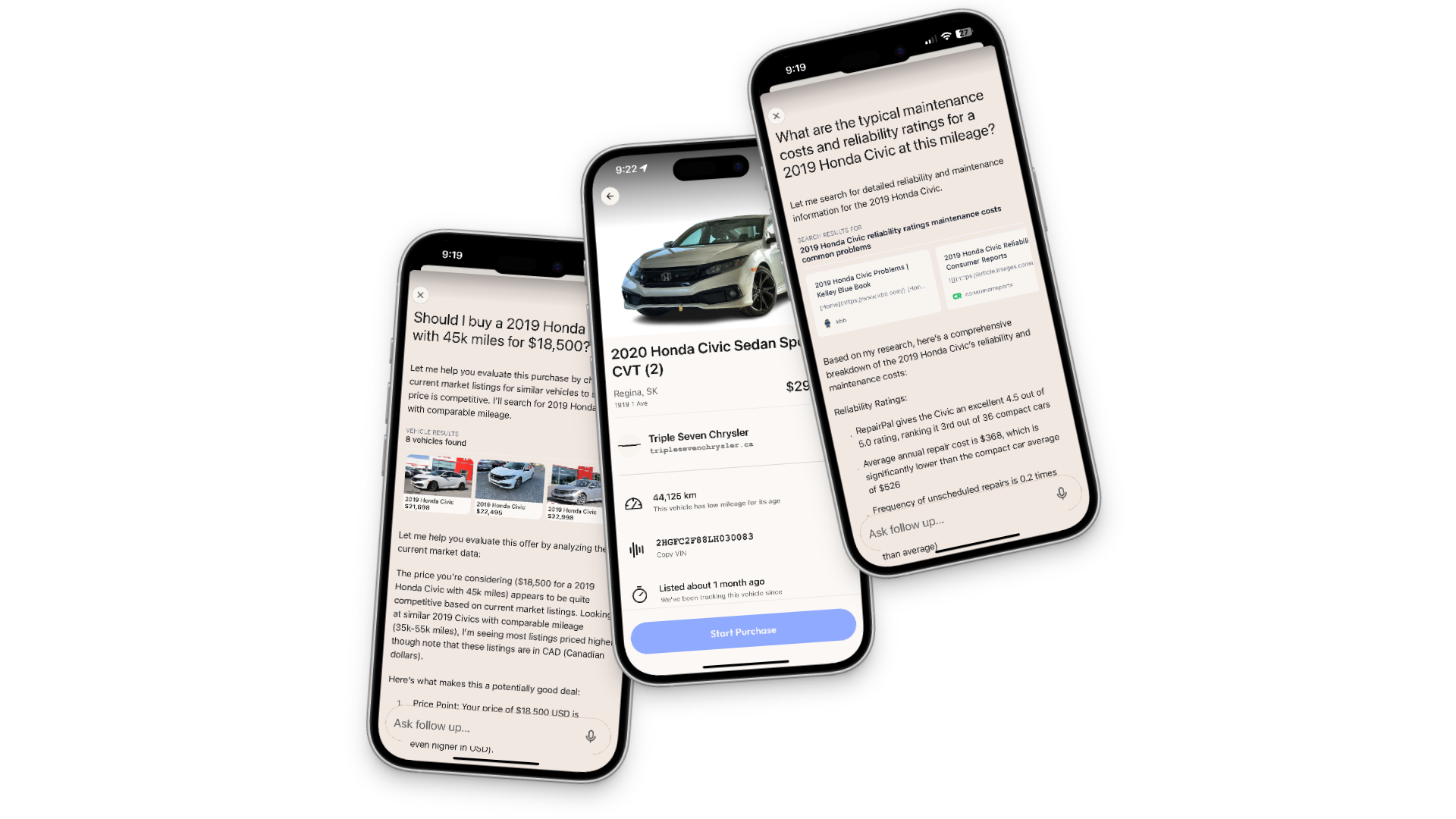
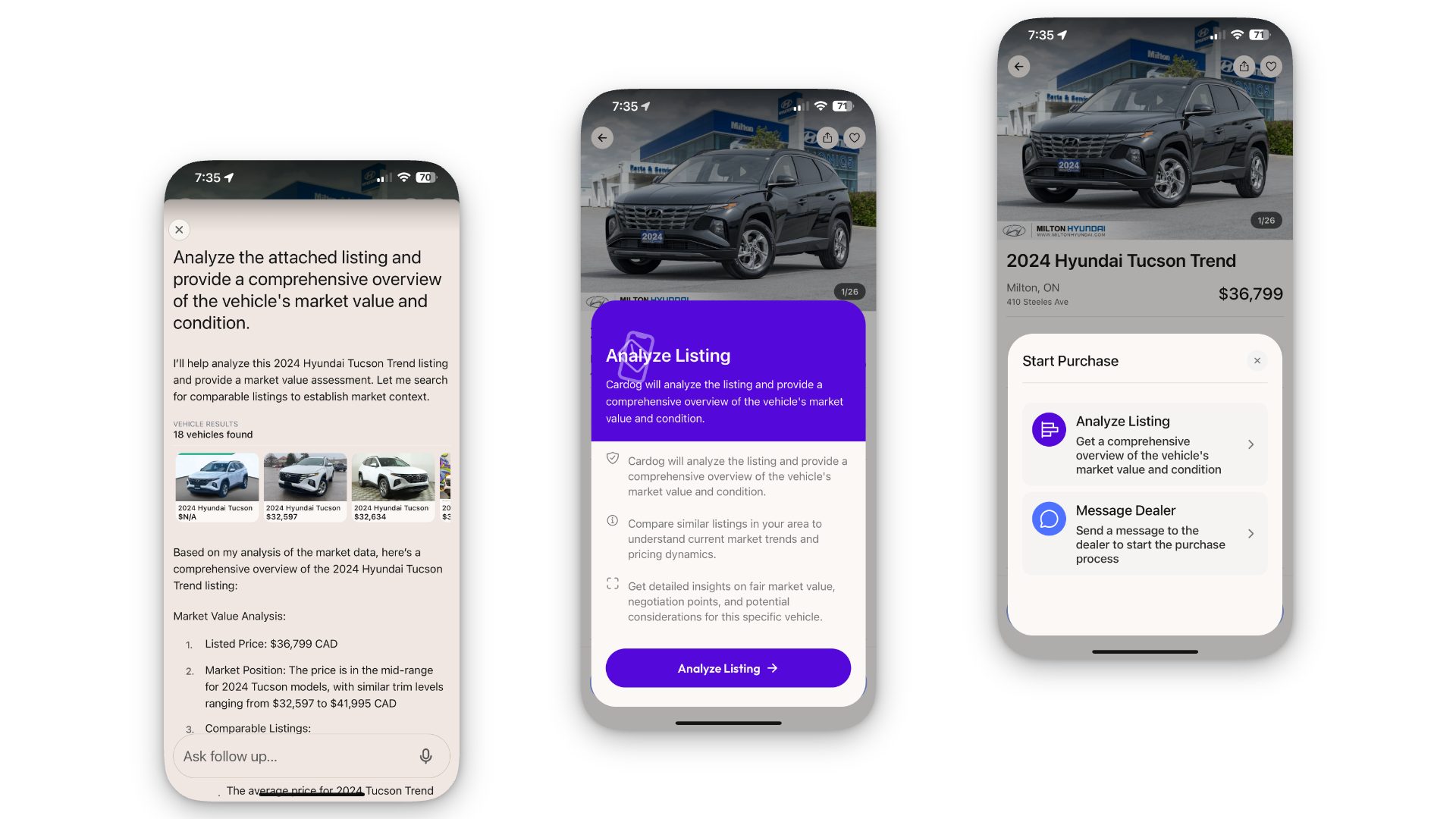
Cardog's mobile app particularly shines. Built around natural language rather than complex filter menus, you can snap a VIN photo, ask "Should I buy this?", and get instant analysis without navigating multiple screens.
Data Depth: Listings vs VIN-Level Intelligence
CarGurus provides standard listing data: price, mileage, features, dealer information, CARFAX links (paid). You're responsible for investigating vehicle history, recalls, and maintenance independently.
Cardog treats data as the intelligence foundation:
- Complete VIN decoding: Specifications, trim levels, original MSRP, factory options
- Recall history: Current and historical recalls from NHTSA and Transport Canada with severity ratings
- Maintenance schedule: VIN-specific service intervals and estimated costs based on regional labour rates
- Common problems: Aggregated data on frequent issues for specific model years
- Ownership cost projections: Multi-year estimates covering depreciation, fuel, insurance, maintenance, repairs
- Market positioning: How this VIN compares to similar vehicles in pricing and condition
Rather than seeing "2019 Honda Civic LX - $21,500 - 65,000 km" and wondering if it's good, you get comprehensive intelligence explaining exactly what you're considering, ownership costs, and how it compares to alternatives.
Which Platform Is Right For You?
Choose CarGurus If:
- You know exactly what you want: Specific make, model, year, and features already decided
- You're focused on price comparison: Your primary goal is identifying below-market dealer listings
- You prefer traditional search: Comfortable with filters, dropdowns, and sorted results
- You're an experienced buyer: Confident conducting independent research and due diligence
- You want simplicity: Need a straightforward tool for one specific task—finding a deal
- You're browsing casually: Looking without urgent need for purchase
Choose Cardog If:
- You need guidance: Unsure what vehicle best fits your needs and budget
- You want comprehensive intelligence: Value data-driven insights beyond basic price comparison
- You think long-term: Interested in ownership costs, depreciation, and lifecycle value
- You're navigating complexity: Comparing multiple options across different categories
- You want continuous support: Looking for ongoing intelligence through ownership, not just purchase
- You value AI assistance: Comfortable with conversational interfaces and appreciate intelligent recommendations
- You're managing multiple vehicles: Need tools to track and optimize a household fleet
- You want timing intelligence: Interested in predictive analytics about when to buy or sell
Use Both If:
Smart buyers leverage both platforms strategically:
- Start with Cardog to understand what to buy, when, and how it fits long-term needs
- Use CarGurus to identify specific dealer listings matching Cardog's recommendations
- Return to Cardog to evaluate specific VINs with detailed intelligence before purchasing
- Rely on Cardog post-purchase for ownership tracking and sell-timing recommendations
This combined approach gives you AI-powered intelligence guiding strategy with traditional marketplace efficiency for execution. Compare with AutoTrader vs Cardog to see how another traditional marketplace stacks up, or explore Edmunds vs KBB for valuation tool comparisons.
The Future of Automotive Search: AI-First Platforms
The comparison between CarGurus and Cardog illustrates a broader shift in consumer technology: the evolution from search platforms to intelligence platforms.
Traditional search tools aggregate information and help execute predefined queries efficiently. But they require you to know what you're looking for and make decisions independently.
AI-powered platforms represent the next generation: tools that actively guide you through complex decisions using real-time data, predictive analytics, and expert-level reasoning. Instead of "Show me what you have," you ask "What should I do?" and receive personalized recommendations.
This isn't about one platform being "better"—it's about different approaches serving different needs. CarGurus excels at helping buyers compare dealer prices. Cardog serves as your automotive intelligence companion throughout the ownership lifecycle.
As AI technology advances and consumers expect personalized assistance across all aspects of life, platforms like Cardog represent where automotive search is heading.
For Canadian car buyers in 2025, you have the luxury of choice: stick with familiar traditional search platforms, embrace next-generation AI intelligence, or strategically use both to maximize your advantage.
Frequently Asked Questions
Ready to experience AI-powered automotive intelligence?
Explore the market with Cardog and see the difference intelligent search makes:
- Honda Civic in Toronto - Compare prices and features on one of Canada's most popular sedans
- Toyota RAV4 in Vancouver - Find the best deals on this reliable compact SUV
- Honda CR-V in Montreal - Discover competitive pricing on family-friendly SUVs
- Ford F-150 in Calgary - Browse Canada's best-selling pickup truck
- Mazda CX-5 in Ottawa - Find value in this sporty compact crossover
- Subaru Outback across Canada - Compare national inventory and pricing trends
Start your intelligent vehicle search on Cardog
Related Reading: