Is CarGurus Accurate? Deal Rating Analysis
Is CarGurus Accurate? Deal Rating Analysis
When you're shopping for a used car, knowing whether you're looking at a fair price can make the difference between a great deal and an expensive mistake. CarGurus has built its reputation on helping buyers answer that question through its colour-coded deal rating system—those "Great Deal," "Good Deal," "Fair Price," and "High Price" badges that appear on every listing.
But is CarGurus accurate? Can you trust these ratings to guide your purchasing decisions, or are they just marketing dressed up as market analysis? Understanding how CarGurus calculates its deal ratings—and where the system falls short—is essential for any informed car buyer.
The used car market is notoriously opaque. Prices for the same make, model, and year can vary by thousands of dollars based on condition, mileage, location, features, and dealer pricing strategies. Without expertise or access to market data, buyers struggle to distinguish between genuinely good deals and vehicles that only appear attractively priced.
In this analysis, we'll examine how CarGurus' deal rating system actually works, what the platform gets right, where it falls short, and how to verify pricing independently.
Quick Answer: Is CarGurus Accurate?
CarGurus is generally accurate for comparing relative pricing across dealer listings within the same market and timeframe. The deal rating system effectively identifies vehicles priced below, at, or above comparable listings based on market data.
However, CarGurus has several important limitations that affect its accuracy:
- Dealer-only data: Only includes dealership inventory, missing the private seller market entirely
- Limited condition assessment: Relies on dealer-reported condition rather than independent inspection
- Geographic constraints: Market comparisons may not account for regional pricing differences adequately
- Lag in data: Pricing analysis reflects recent sales data, which may not capture rapid market shifts
- No maintenance or ownership cost analysis: Focuses purely on purchase price
For buyers, this means CarGurus is a useful starting point but shouldn't be your only pricing verification tool. Cross-reference with additional market data, vehicle history reports, and independent inspections before committing to any purchase.
How CarGurus Deal Ratings Work
CarGurus doesn't publicly disclose the exact formula behind its deal rating algorithm, but the company has shared enough about its methodology to understand the core mechanics. For a deeper dive into the platform's business model and pricing methodology, see our complete guide on how CarGurus works.
The Algorithm Components
CarGurus analyzes each vehicle listing against a database of comparable vehicles to generate its deal ratings. The system considers several key factors:
1. Comparable Vehicle Analysis: The algorithm identifies similar vehicles based on make, model, year, trim level, mileage, and features. It then compares the listing price against this peer group to determine relative positioning.
2. Market Data Integration: CarGurus aggregates pricing data from thousands of dealer listings across its platform, building a statistical baseline for what vehicles typically sell for in specific markets.
3. Geographic Factors: The system accounts for location-based pricing variations, recognizing that a Honda Civic in Toronto may command different pricing than an identical model in rural Saskatchewan.
4. Time-Based Adjustments: CarGurus tracks how long vehicles stay listed, adjusting ratings based on whether dealers are reducing prices over time or maintaining firm pricing.
5. Dealer Reputation: While not explicitly stated as part of the deal rating itself, CarGurus maintains dealer ratings that can influence how prominently listings appear in search results.
The Rating Categories
CarGurus assigns one of four deal ratings to each listing:
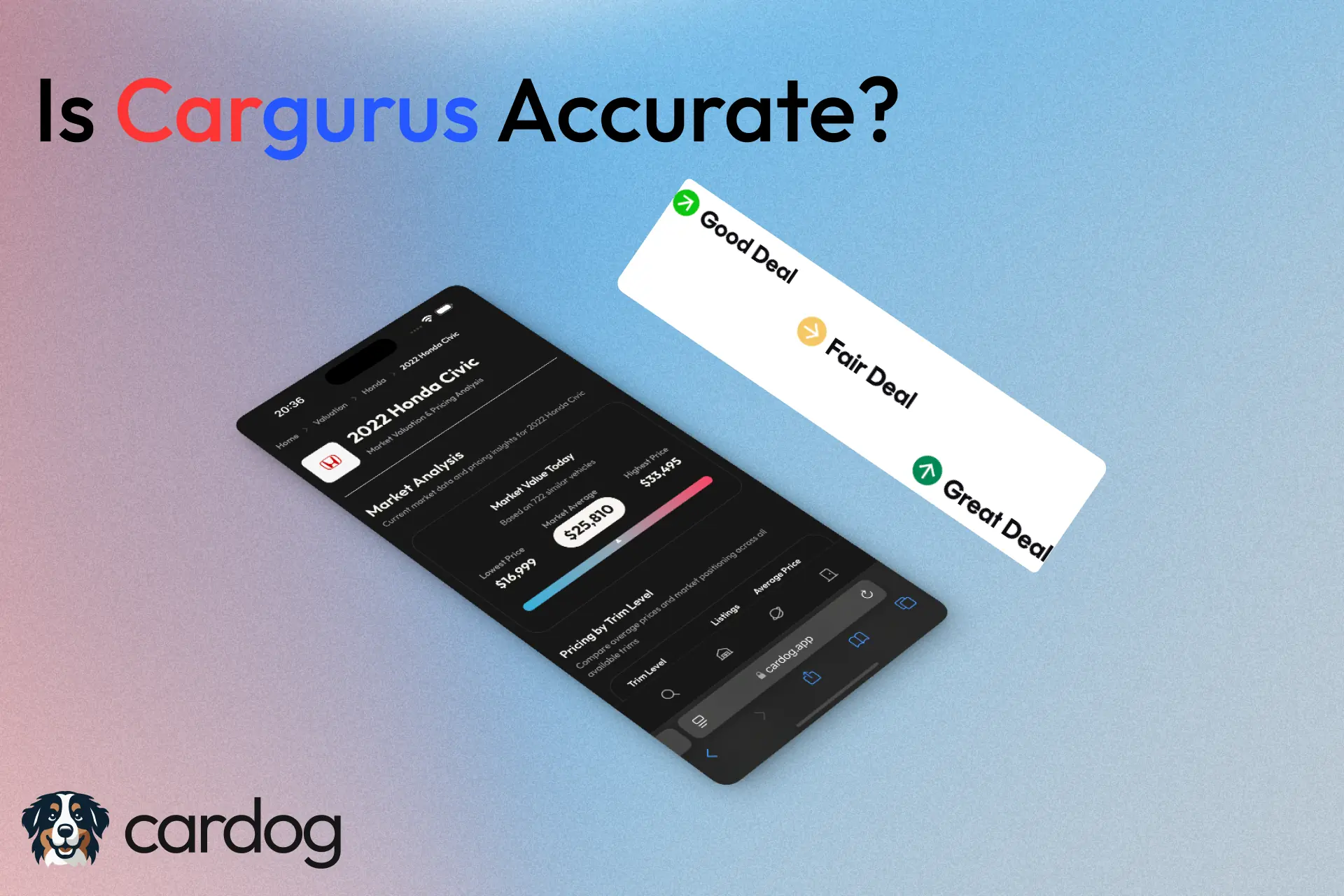
- Great Deal (green): Priced significantly below market average, typically in the bottom 15-20% of comparable listings
- Good Deal (teal): Priced below market average but not exceptionally so, usually in the 20-40% range
- Fair Price (yellow): Priced at or near market average, representing standard dealer pricing
- High Price (orange/red): Priced above market average, in the top 25-30% of comparable listings
The algorithm automatically adjusts these ratings as new listings appear and existing ones are sold or repriced. A "Good Deal" today might become a "Fair Price" tomorrow if several lower-priced comparable vehicles enter the market.
What CarGurus Doesn't Measure
Understanding what CarGurus excludes from its analysis is equally important:
- Actual vehicle condition: The algorithm relies on dealer-reported condition and mileage but doesn't account for maintenance history, accident damage, or mechanical issues
- Private seller pricing: Since CarGurus only lists dealer inventory, its market comparisons exclude potentially lower-priced private sales
- Total ownership cost: The ratings focus solely on purchase price, ignoring fuel economy, insurance costs, maintenance expenses, or depreciation rates
- Local market dynamics: Rapid shifts in local supply and demand may not be reflected immediately in deal ratings
This methodology makes CarGurus effective for answering one specific question: "Is this vehicle priced competitively compared to similar dealer listings?" But it can't answer broader questions about whether the vehicle is actually worth buying, whether it will be reliable, or whether you're getting genuine value over the long term.
Accuracy Analysis: What CarGurus Gets Right
Despite its limitations, CarGurus' deal rating system does several things remarkably well, making it a valuable tool in the car shopping process.
1. Effective Relative Pricing Comparison
CarGurus excels at its core function: comparing vehicles within the same category. When you're evaluating similar vehicles from different dealers—same year, similar mileage, comparable trim levels—CarGurus reliably identifies which one is priced most competitively.
For example, if CarGurus shows one 2020 Honda Civic EX with 65,000 km listed at $22,500 as a "Great Deal" while another with 68,000 km at $25,900 shows "Fair Price," the first vehicle is genuinely priced below comparable listings. Browse Honda Civic inventory to see current market pricing across different model years.
2. Geographic Market Awareness
CarGurus demonstrates solid understanding of regional pricing variations. The platform recognizes that used vehicle prices differ significantly between major urban centres and rural areas, between provinces with different tax structures, and between regions with varying supply and demand dynamics.
For example, the algorithm understands that pickup trucks command premium pricing in Alberta compared to Vancouver, where compact crossovers dominate. Explore current market trends to see how pricing varies by region and vehicle type.
3. Rapid Data Updates
CarGurus updates its deal ratings frequently as new listings appear, existing listings are modified, and vehicles sell. This responsiveness means the ratings reflect current market conditions rather than stale historical data.
During periods of rapid market movement—like the post-pandemic used car price surge—CarGurus adjusted its baseline assumptions relatively quickly. While not instantaneous, the system tracks market shifts more effectively than static pricing guides that update monthly or quarterly.
4. Large Sample Size
With thousands of dealer listings across Canada and the United States, CarGurus has access to substantial market data. This large sample size improves statistical accuracy, reducing the impact of outlier listings on deal ratings.
For popular models like the Toyota RAV4 or Honda Civic, CarGurus might compare a specific listing against hundreds of similar vehicles, providing confidence that the rating reflects genuine market positioning.
5. Dealer Accountability
The public nature of CarGurus' deal ratings creates subtle pressure on dealers to price competitively. Dealers understand that listings marked "High Price" receive less buyer interest, incentivizing them to either adjust pricing or ensure their listings highlight unique features that justify premium pricing.
This transparency benefits buyers by making overpriced vehicles more visible and encouraging competitive pricing across the platform.
Limitations & Blind Spots
While CarGurus provides useful pricing intelligence, several significant limitations affect the accuracy and usefulness of its deal ratings.
1. Dealer-Only Data Creates Incomplete Picture
CarGurus exclusively aggregates dealer listings, completely excluding the private seller market. This creates a fundamental blind spot in pricing accuracy.
Private sellers typically price vehicles 5-15% below comparable dealer listings because they avoid dealer overhead, reconditioning costs, and profit margins. A vehicle marked "Great Deal" on CarGurus might still be overpriced compared to similar cars available from private sellers on platforms like AutoTrader, Kijiji, or Facebook Marketplace.
For buyers willing to purchase from private sellers and conduct their own due diligence, CarGurus provides an incomplete view of true market pricing. The platform effectively answers "Is this a good dealer price?" but not "Is this a good price overall?"
2. Condition Ratings Lack Independent Verification
CarGurus relies entirely on dealer-reported vehicle condition. The platform doesn't conduct independent inspections, review maintenance records, or verify dealer claims about vehicle history.
This creates opportunities for rating inflation. Two vehicles with identical specifications might receive the same deal rating even if one has been meticulously maintained while the other has deferred maintenance issues, previous accident damage, or mechanical problems. The algorithm can't distinguish between a dealer accurately describing a mint-condition vehicle and one glossing over significant issues.
Buyers who trust deal ratings without independent verification risk paying market price for below-market quality vehicles.
3. Missing Critical Ownership Factors
CarGurus' deal ratings focus exclusively on purchase price, ignoring total cost of ownership factors that significantly impact vehicle value:
- Fuel economy: A "Great Deal" on a gas-guzzling SUV might cost substantially more over five years than a "Fair Price" on an efficient hybrid
- Reliability: Some model years have known mechanical issues that create higher maintenance costs despite attractive purchase pricing
- Insurance: Certain vehicles command premium insurance rates that offset initial purchase savings
- Depreciation: Fast-depreciating vehicles might appear attractively priced today but lose value rapidly
Buyers focused solely on deal ratings may end up with vehicles that are expensive to own despite competitive purchase prices.
4. Market Timing and Geographic Limitations
While CarGurus updates more frequently than traditional pricing guides, the system still reflects recent historical data rather than real-time market conditions. During periods of rapid market change—economic downturns, sudden fuel price spikes, or model year transitions—CarGurus' baseline assumptions may lag behind actual market shifts.
Additionally, CarGurus accounts for regional pricing differences but may not capture hyperlocal market dynamics. Buyers in smaller markets or rural areas may find deal ratings less accurate than those in major metropolitan areas where CarGurus has more robust data.
How to Verify Pricing Yourself
Rather than relying exclusively on CarGurus, savvy buyers should verify pricing using multiple sources and methods. Here's how to independently assess whether a vehicle is fairly priced.
1. Cross-Reference Multiple Pricing Sources
Compare the CarGurus listing against several alternative data sources:
- Canadian Black Book: Industry-standard pricing guide used by dealers and lenders, offering wholesale and retail values based on comprehensive market data
- AutoTrader: Search comparable vehicles from both dealers and private sellers to establish broader market baseline
- Kelley Blue Book: While U.S.-focused, KBB provides useful comparison data for cross-border context
- Private seller listings: Check Facebook Marketplace, Kijiji, and Craigslist for similar vehicles to understand the full pricing spectrum
If a vehicle shows "Great Deal" on CarGurus but is priced at or above comparable listings elsewhere, the deal rating may be less reliable. For a comprehensive comparison of pricing platforms, see our guide on CarGurus alternatives.
2. Request Vehicle History Reports
Every serious buyer should obtain comprehensive vehicle history reports before committing to any purchase:
- CARFAX Canada: Provides accident history, ownership records, service history, and potential red flags
- CarProof: Alternative Canadian reporting service with overlapping but sometimes different data
- Provincial lien searches: Verify no outstanding liens exist that could complicate ownership transfer
These reports reveal information CarGurus' algorithm can't see: previous accidents, flood damage, odometer rollback, or salvage titles that should significantly impact pricing.
3. Research Model-Specific Issues
Some model years have known problems that affect long-term value despite competitive pricing. Research Transport Canada recalls, NHTSA complaints, and owner forums to identify which years to avoid. A vehicle might show "Good Deal" on CarGurus because other buyers are avoiding that model year due to known issues.
4. Get Independent Pre-Purchase Inspections
For any serious purchase, invest in professional inspection by a trusted mechanic. Inspection costs ($150-300) are trivial compared to buying a vehicle with hidden problems. Independent inspection reveals condition issues that dealer-reported information and CarGurus ratings completely miss.
5. Calculate Total Ownership Costs
Expand your analysis beyond purchase price to true cost of ownership: fuel costs, insurance quotes, maintenance projections, and depreciation estimates. A vehicle with a "Great Deal" rating but high ownership costs may be less attractive than a "Fair Price" listing on an efficient, reliable model.
Better Alternatives for Price Intelligence
While CarGurus provides useful comparative data for dealer listings, several alternatives offer different perspectives on pricing accuracy and vehicle value. For a detailed comparison of platforms, see our analysis of CarGurus vs Cardog and other pricing tool alternatives.
AI-Powered Market Intelligence: Cardog
Rather than simply comparing dealer listings, Cardog takes a comprehensive approach to pricing intelligence by analyzing market data across multiple platforms, integrating ownership cost projections, and providing personalized recommendations based on your specific needs.
Cardog's AI-driven platform examines over 1.1 million vehicle variations, identifying genuinely good deals by considering factors CarGurus overlooks: maintenance history, reliability by model year, total ownership costs, and market trend analysis that predicts whether prices are rising or falling.
This comprehensive intelligence transforms car shopping from reactive comparison (Is this listing priced well?) to strategic decision-making (Is this the right vehicle at the right time for my needs?). Explore Cardog's market intelligence tools to see how AI-powered analysis goes beyond traditional pricing comparison.
Frequently asked questions