AutoTrader vs Cardog: Which Is Better for Canadian Car Buyers?

AutoTrader vs Cardog: Which Is Better for Canadian Car Buyers?
Shopping for a car has never been more complex. With dozens of online automotive platforms competing for your attention, choosing where to start your search can feel overwhelming. Should you go with the familiar marketplace giant that's been around for decades, or embrace the new AI-powered intelligence platform that promises to revolutionise the buying process?
AutoTrader.ca and Cardog represent fundamentally different approaches to automotive shopping—one is a traditional classified marketplace with maximum inventory, the other is an AI-powered intelligence layer that helps you make smarter decisions wherever you buy. Understanding these differences is critical because choosing the right tool can save you thousands whilst avoiding costly mistakes.
Whether you're hunting for your first vehicle or your fifth, understanding how these platforms work together (or independently) helps you navigate today's complex automotive marketplace with confidence. Let's break down what each platform offers and how they serve complementary roles in your car buying journey.
Quick Verdict: AutoTrader vs Cardog
AutoTrader: Canada's largest automotive marketplace, connecting you with over 100,000 dealer and private seller listings. Best for browsing maximum inventory, comparing similar vehicles across multiple sellers, and traditional marketplace shopping. Use AutoTrader when you want to see everything available in the Canadian market.
Cardog: AI-powered automotive intelligence platform analysing 1.1 million+ vehicle variations to provide market insights, pricing intelligence, and personalised recommendations. Best for understanding fair value, researching specific makes and models, and making data-driven buying decisions. Use Cardog when you want to understand which vehicle to buy and whether a specific deal is fair.
The reality: These platforms aren't direct competitors—they're complementary tools. AutoTrader provides access to inventory, whilst Cardog provides the intelligence to evaluate that inventory. Smart buyers use both: Cardog to research and identify target vehicles, AutoTrader to find specific listings, then Cardog again to verify fair pricing before purchasing.
AutoTrader: Canada's Automotive Marketplace Giant
AutoTrader.ca has dominated Canadian online automotive shopping for over two decades, evolving from print classifieds to become the country's most-visited automotive marketplace. If you're searching for a vehicle in Canada, you've almost certainly used AutoTrader.
How AutoTrader Works
AutoTrader functions as a digital classified platform connecting buyers with sellers. Dealerships and private sellers pay to list their vehicles, and buyers browse these listings for free. The platform aggregates inventory from thousands of sources, creating a centralized marketplace where you can search by make, model, year, price range, location, and dozens of other criteria.
The inventory advantage is undeniable: With over 100,000 active listings spanning new cars, used cars, certified pre-owned vehicles, motorcycles, RVs, boats, and commercial vehicles, AutoTrader casts the widest net in the Canadian market. If a vehicle is for sale in Canada, there's a strong chance it's listed on AutoTrader.
AutoTrader's Strengths
Maximum inventory access: AutoTrader's primary value proposition is simple—maximum selection. Whether you're searching for a specific trim level of a Honda Civic in Toronto or exploring SUVs under $30,000, AutoTrader's inventory depth increases your chances of finding exactly what you want.
Dealer and private seller variety: Unlike platforms limited to dealerships, AutoTrader accommodates both business and individual sellers. This flexibility means you can compare dealer certified pre-owned vehicles against private sales, potentially saving thousands.
Established trust and recognition: Decades of market presence have built consumer trust. Canadian buyers know AutoTrader, understand how it works, and feel comfortable using the platform—a significant advantage in an industry where unfamiliar platforms face skepticism.
AutoTrader's Limitations
Information overload: With over 100,000 listings, finding the right vehicle becomes a data management challenge. Sorting through hundreds of results, comparing similar vehicles across different sellers, and identifying fair pricing requires significant time and automotive knowledge.
Limited pricing intelligence: AutoTrader displays asking prices but provides minimal context about whether those prices are fair. Some dealers inflate prices expecting negotiation, whilst others price competitively from the start. Without external research tools, buyers struggle to distinguish between fair deals and overpriced listings.
No AI-powered guidance: AutoTrader functions as a catalog—it shows you what's available but doesn't help you decide what to buy. Should you choose a 2019 Honda CR-V at $24,000 or a 2021 Toyota RAV4 at $28,000? AutoTrader presents both options but provides no intelligence about which represents better value for your specific needs.
Advertising noise: The platform includes sponsored listings and featured dealers that can obscure organic search results. Distinguishing between genuinely good deals and paid promotional placements requires careful attention.
Cardog: The AI-Powered Automotive Intelligence Platform
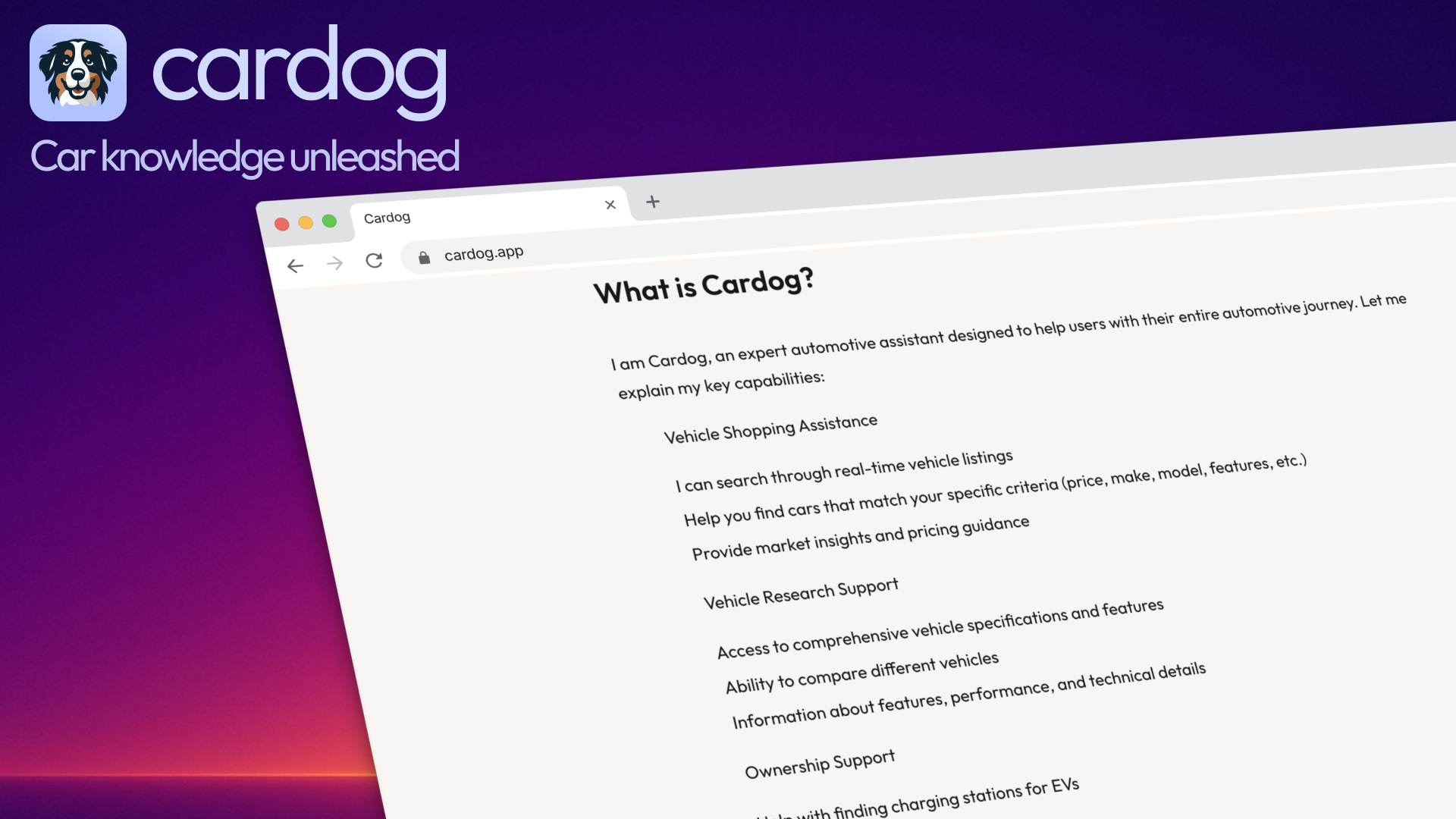
Cardog represents a fundamentally different approach to automotive shopping. Rather than functioning as a marketplace connecting buyers and sellers, Cardog operates as an intelligence layer—analysing real-time market data to help you make informed decisions about which vehicle to buy, where to buy it, and whether a specific price is fair.
How Cardog Works
Cardog's AI analyses 1.1 million+ vehicle variations across Canadian and American markets, aggregating listing data, pricing trends, reliability information, recall histories, and market movements into actionable intelligence. Instead of browsing individual listings manually, you ask natural questions and receive personalised recommendations backed by comprehensive data analysis.
The intelligence advantage: Where traditional marketplaces simply display listings, Cardog interprets them. Ask "What's the most reliable used SUV under $25,000 in Toronto?" and Cardog's AI analyses thousands of vehicles, factors in reliability ratings, current market pricing, common problems by model year, and local inventory to provide specific recommendations with justification.
Market transparency: Cardog provides context traditional marketplaces can't. You'll see how a specific vehicle's price compares to similar models in your region, understand whether a listing is fairly priced or inflated, and get alerts when new inventory matching your criteria hits the market.
Beyond initial purchase: Unlike marketplaces that disappear once you buy, Cardog continues providing value throughout ownership. Track your vehicle's current market value, receive maintenance reminders, get alerts about recalls affecting your VIN, and know the optimal time to sell based on market conditions.
Cardog's Strengths
AI-orchestrated decision making: Rather than manually comparing specifications across dozens of listings, Cardog's AI does the work instantly. It identifies vehicles matching your requirements, ranks them by value proposition, flags potential problems (like model years with known issues), and recommends specific listings worth investigating further. Whether you're searching for Toyota RAV4s or electric vehicles, Cardog provides intelligent recommendations based on your specific needs.
Market intelligence at scale: Cardog analyses pricing data across all major marketplaces simultaneously. If a 2020 Honda Civic is listed for $22,000 on AutoTrader whilst similar examples average $24,500, Cardog identifies this immediately and flags it as a potential deal—intelligence manual research would take hours to uncover.
VIN-level insights: Enter any Vehicle Identification Number and Cardog provides comprehensive analysis: full specifications, recall history, estimated market value, maintenance cost projections, fuel economy data, and common problems for that specific year and trim. This transforms generic listings into data-rich evaluations.
Personalised to your situation: Cardog doesn't just recommend "good cars"—it recommends good cars for you. Whether you're looking for affordable sedans or family SUVs, Cardog factors in total ownership costs (purchase price, fuel economy, insurance, maintenance, depreciation) specific to your circumstances.
Cross-platform intelligence: Cardog doesn't limit analysis to one marketplace. It monitors AutoTrader, dealer websites, auction results, and other data sources to provide comprehensive market visibility. You get intelligence about vehicles regardless of where they're listed.
Cardog's Limitations
Not a marketplace: Cardog doesn't sell cars or host listings. Once you identify a target vehicle through Cardog's intelligence, you complete the transaction elsewhere (directly with dealers, through AutoTrader, via private sale, etc.). However, this separation ensures Cardog remains objective—recommendations are based purely on data analysis rather than sales incentives.
Requires different thinking: Most buyers are conditioned to browse listings until something catches their attention. Cardog works differently—you articulate what you need, and the AI recommends specific options. This consultative approach is more efficient but requires a shift from passive browsing to active criteria definition.
Side-by-Side Comparison
| Feature | AutoTrader | Cardog |
|---|---|---|
| Primary Function | Marketplace (connects buyers/sellers) | Intelligence Platform (data analysis & recommendations) |
| Inventory Access | 100,000+ listings (direct) | 1.1M+ vehicle variations (analysed) |
| Listing Type | Dealers + Private Sellers | Intelligence layer (not a marketplace) |
| Pricing Tools | Basic filters & sort | AI-powered fair value analysis |
| Decision Support | None (catalogue only) | AI recommendations with justification |
| Search Method | Manual browse & filter | Natural language queries |
| Market Intelligence | Limited (asking prices only) | Comprehensive (pricing trends, value analysis) |
| VIN Analysis | Basic (link to external reports) | Deep intelligence (specs, recalls, value, problems) |
| Ongoing Value | Ends after purchase | Tracks value, maintenance, resale timing |
| Best For | Browsing maximum inventory | Understanding fair value & making informed decisions |
| User Experience | Traditional classified ads | AI-powered consultation |
| Regional Coverage | Canada | Canada + USA |
Detailed Comparison: What Matters Most?
Inventory & Selection
Winner: AutoTrader (for direct access), Cardog (for intelligent filtering)
AutoTrader's strength is undeniable when measuring pure inventory volume. With over 100,000 active listings from dealerships and private sellers across Canada, you'll find virtually any make, model, year, or configuration available in the Canadian market.
Cardog doesn't host listings but analyses 1.1 million+ vehicle variations across multiple platforms. The AI identifies specific vehicles matching your criteria from various sources—including AutoTrader, dealer websites, and auction data. For buyers who find browsing 100,000 listings overwhelming, Cardog's intelligent filtering delivers better practical access than AutoTrader's manual search.
The practical difference: AutoTrader shows you everything; Cardog shows you what matters. If you enjoy browsing and have time to evaluate dozens of options, AutoTrader's breadth is an advantage. If you want recommendations focused on value and suitability, Cardog's intelligence is more efficient.
Search & Discovery
Winner: Cardog (for intelligence), AutoTrader (for manual control)
AutoTrader provides extensive filtering options—make, model, year range, price range, mileage, transmission, fuel type, body style, and dozens of other parameters. These filters work well if you know exactly what you're searching for but become overwhelming when researching broadly or comparing multiple vehicle types.
Cardog transforms search through natural language processing. Rather than defining filters manually, you ask questions: "What's the best used family SUV under $30,000 in Vancouver with third-row seating and good fuel economy?" Cardog's AI interprets this query, analyses relevant inventory, factors in reliability ratings and common problems, and recommends specific vehicles with justification for each recommendation.
Search efficiency example: Finding a reliable used compact SUV under $25,000 using AutoTrader requires manually filtering by vehicle type, setting price ranges, browsing through 400+ results, researching reliability for each model year externally, comparing pricing across similar vehicles, and investigating common problems for finalists.
Using Cardog: Ask "What's the most reliable compact SUV under $25,000 in my area?" and review AI-generated recommendations with reliability data included, then click through to specific listings meeting criteria.
The time savings are substantial, and Cardog's recommendations factor in information (reliability, common problems, fair pricing) that requires extensive external research when using traditional marketplaces.
Pricing & Transparency
Winner: Cardog (for intelligence), AutoTrader (for market breadth)
AutoTrader displays asking prices set by sellers. These vary significantly—some dealers price competitively, others inflate prices expecting negotiation, and private sellers often misunderstand market value. AutoTrader provides basic comparison tools (sort by price, view similar vehicles) but offers no intelligence about whether a specific price is fair.
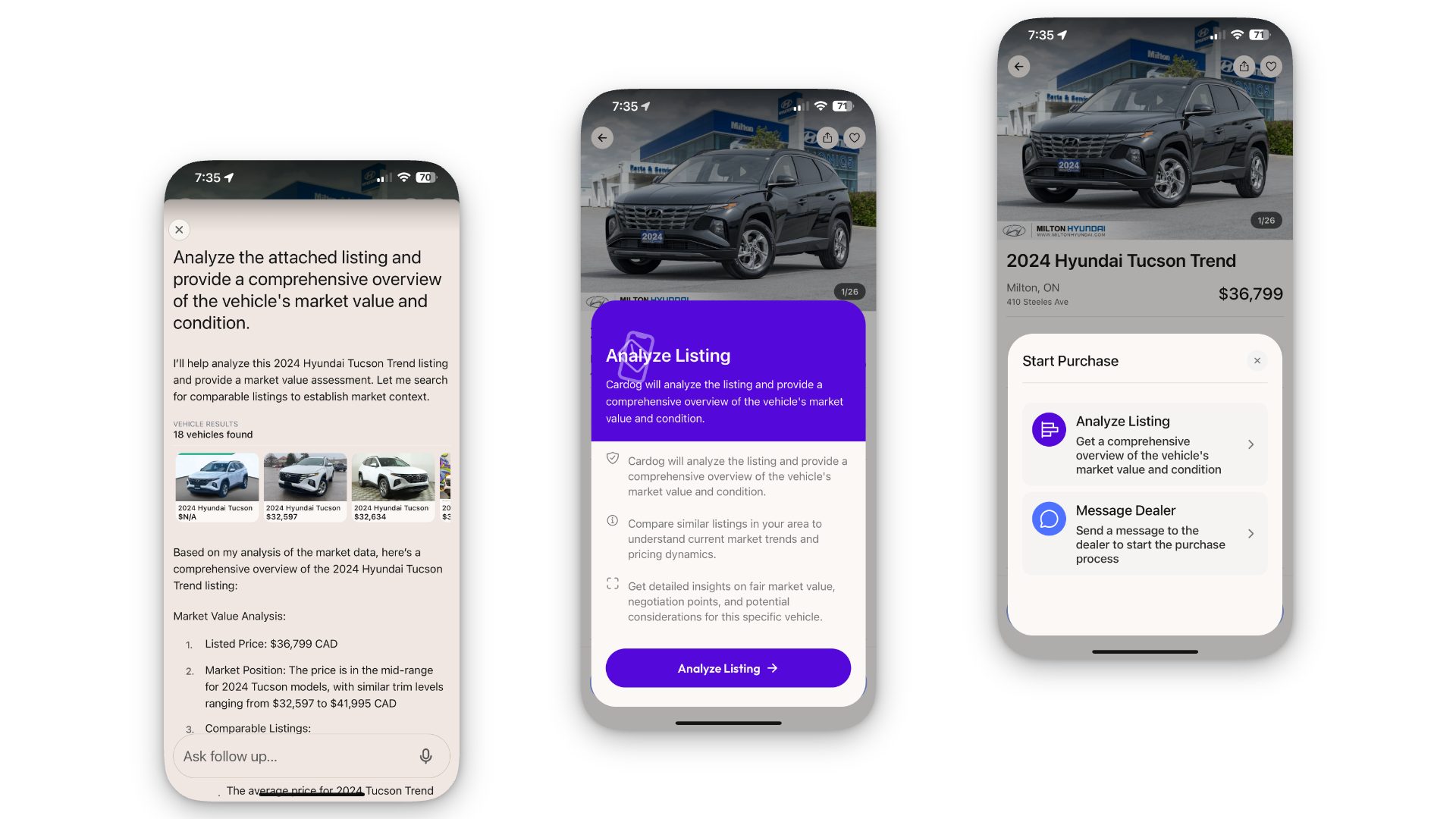
Cardog analyses pricing across thousands of similar vehicles to determine fair market value. Enter a VIN or specific listing, and Cardog shows:
- How this price compares to similar vehicles regionally
- Whether this represents good, fair, or poor value
- Historical pricing trends (are prices rising or falling?)
- Projected depreciation (what will this vehicle be worth in 1-3 years?)
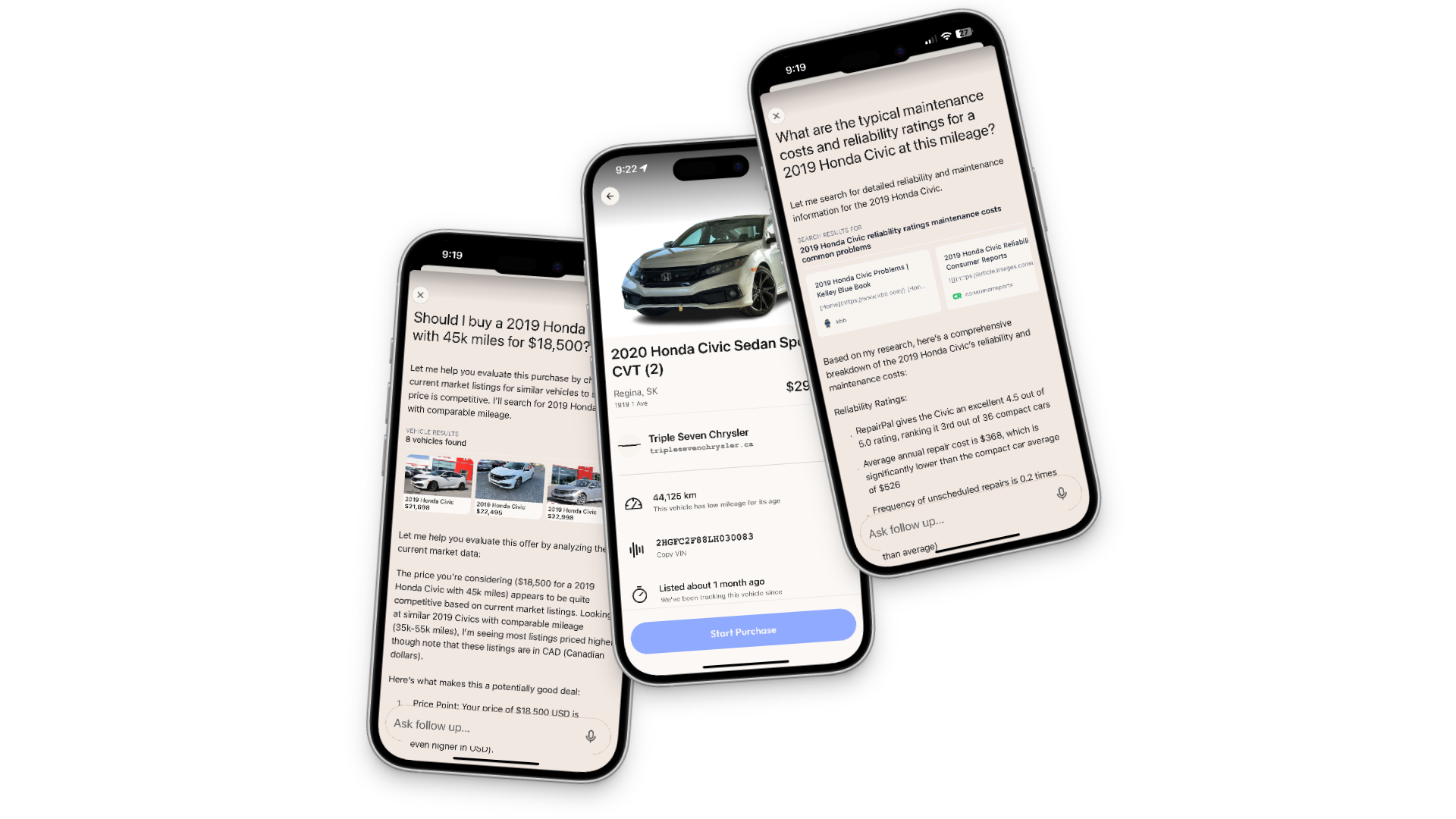
Real-world example: A 2019 Honda Civic LX with 85,000 km is listed on AutoTrader for $19,995. Is this fair? AutoTrader shows the asking price but provides no context. Cardog analyses 200+ comparable Civics and determines this specific vehicle is priced 8% above regional average, suggesting room for negotiation or considering alternative listings offering better value.
This intelligence transforms negotiations. Armed with data showing comparable vehicles sell for $18,500-$19,200, you negotiate from a position of knowledge rather than guessing whether the seller's price is reasonable.
User Experience
Winner: AutoTrader (for familiarity), Cardog (for efficiency)
AutoTrader provides a familiar classified ad experience. Buyers understand how it works—browse listings, click on interesting vehicles, view photos and details, contact sellers. This traditional approach requires no learning curve and feels comfortable to buyers accustomed to online marketplaces.
The trade-off is inefficiency. Browsing hundreds of listings, researching reliability externally, comparing pricing manually, and verifying fair value requires hours of work. For casual buyers shopping occasionally, this investment is manageable. For buyers unfamiliar with automotive markets, it's overwhelming.
Cardog's AI-first approach requires different thinking. Rather than passive browsing, you articulate requirements and receive recommendations. This consultative experience is more efficient but less familiar to buyers conditioned by traditional marketplaces.
The learning curve: AutoTrader requires no learning—if you've used Kijiji, Facebook Marketplace, or any classified platform, you understand AutoTrader immediately. Cardog requires understanding that the AI provides recommendations based on your input—a shift from browsing to consultation. For buyers willing to invest 10 minutes understanding this approach, efficiency gains are substantial.
Trust & Quality
Winner: Cardog (for data verification), AutoTrader (for listing volume)
AutoTrader's quality depends entirely on sellers. Dealership listings generally include professional photos, detailed specifications, and vehicle history reports. Private seller listings range from comprehensive to minimal. Buyers bear full responsibility for due diligence—inspecting vehicles, verifying history, confirming mechanical condition, and evaluating fair pricing.
Cardog doesn't sell vehicles but verifies data about them. When Cardog analyses a specific VIN, you receive:
- Complete recall history from NHTSA and Transport Canada
- Known common problems for that model year
- Estimated maintenance costs based on actual service data
- Fair market value analysis showing whether asking price is reasonable
- Specification verification (confirming advertised features match actual build)
The practical difference: AutoTrader shows you listings; Cardog verifies those listings. A dealer might advertise a "clean" vehicle whilst omitting three outstanding recalls. AutoTrader displays the dealer's description; Cardog flags the recalls immediately. This verification layer doesn't replace mechanical inspections but identifies red flags before you invest time viewing vehicles in person.
Selling Your Car
Winner: AutoTrader (for traditional sales), Cardog (for market intelligence)
AutoTrader excels as a selling platform. List your vehicle, set your price, upload photos, and wait for buyer inquiries. With millions of monthly visitors, AutoTrader provides maximum exposure to potential buyers.
Cardog doesn't host listings but provides intelligence that helps you sell strategically. Before listing, Cardog analyses comparable vehicles to determine optimal pricing. Cardog also identifies the best time to sell based on seasonal trends and market conditions.
The complementary approach: Smart sellers use Cardog to determine fair pricing and optimal timing, then list on AutoTrader to access maximum buyer exposure. This combination leverages each platform's strengths—Cardog's intelligence and AutoTrader's marketplace.
Which Platform Is Right For You?
Choose AutoTrader If:
- You want to browse maximum inventory and prefer manual control over automated recommendations
- You're searching for something very specific that may require viewing hundreds of listings
- You're comfortable performing your own research about fair pricing, reliability, and common problems
- You're selling your vehicle and need access to Canada's largest buyer audience
- You prefer traditional classified experiences over AI-powered consultation
- You're open to both dealer and private sales and want to compare options from all sellers
Choose Cardog If:
- You want AI-powered recommendations based on your specific needs and priorities
- You need pricing intelligence to verify whether a listing represents fair value
- You're overwhelmed by options and want curated recommendations rather than browsing thousands of listings
- You value efficiency and want research completed in minutes rather than hours
- You need VIN-level insights about recalls, common problems, and maintenance costs
- You want ongoing value tracking to know optimal selling timing after purchase
- You're researching before buying and need data-driven guidance about which vehicle to choose
Use Both When:
The reality is these platforms serve complementary purposes. The most effective approach combines Cardog's intelligence with AutoTrader's inventory access:
-
Start with Cardog to understand which vehicles offer the best value for your needs. Use the AI to identify target makes, models, and model years that match your requirements whilst avoiding vehicles with known problems.
-
Search AutoTrader for specific listings matching Cardog's recommendations. Use AutoTrader's inventory depth to find available vehicles in your region at various price points.
-
Verify with Cardog before committing. When you find a promising listing on AutoTrader, run the VIN through Cardog to verify fair pricing, check recall history, identify common problems, and ensure you're paying appropriate market value.
-
Complete the transaction through AutoTrader, dealer websites, or private sale, confident you've made a data-informed decision.
This hybrid approach leverages the best of both worlds—Cardog's intelligence and AutoTrader's marketplace access—resulting in better decisions and better deals than using either platform independently.
The AI-Powered Future: Where Cardog Differs
Understanding what makes Cardog fundamentally different from traditional marketplaces helps clarify when and how to use it effectively. AutoTrader, CarGurus, and similar platforms evolved from classified advertising—they're fundamentally catalogs connecting buyers with sellers. Cardog was built from the ground up as an AI-powered intelligence platform.
Market Intelligence vs. Market Access
Traditional marketplaces provide access but limited intelligence. They show you what's available but offer minimal guidance about whether a specific vehicle represents a smart purchase. You see asking prices but not whether those prices are fair. You see specifications but not which model years have problematic transmissions or electrical systems.
Cardog inverts this model. Instead of showing you everything and expecting you to research independently, Cardog analyses everything and shows you what matters. The AI monitors 1.1 million+ vehicle variations continuously, tracking pricing movements, identifying market trends, flagging recalls, and analysing reliability data to provide recommendations backed by comprehensive analysis.
Whether you're searching for Honda vehicles, trucks under $40,000, or fuel-efficient sedans, Cardog's intelligence layer helps you make informed decisions about which listings deserve your attention.
Lifecycle Companionship
Traditional marketplaces serve a single purpose—facilitating initial purchase. Once you buy, their utility ends. Cardog continues providing value throughout ownership:
- Value tracking: Monitor your vehicle's current market value monthly to understand optimal selling timing
- Maintenance intelligence: Receive reminders for scheduled maintenance based on your specific VIN and current odometer
- Recall alerts: Get notifications immediately when recalls affect your vehicle
- Market movement: Understand how market changes affect your vehicle's value (used car prices rising? your vehicle is worth more)
- Resale timing: Know when to sell based on projected depreciation and market trends
This transforms Cardog from a purchase tool into an ownership companion—providing intelligence from initial research through eventual resale.
Cross-Platform Intelligence
AutoTrader analyses AutoTrader inventory. CarGurus analyses inventory from dealers who pay for listings. Marketplace platforms are inherently limited to their own ecosystems.
Cardog's AI monitors multiple data sources simultaneously—AutoTrader, dealer websites, auction results, insurance data, manufacturer specifications, recall databases, and reliability reporting. This comprehensive visibility means Cardog identifies opportunities regardless of where vehicles are listed, providing intelligence that single-marketplace approaches can't match.
Practical example: You're researching 2020 Honda CR-Vs. AutoTrader shows you CR-Vs listed on their platform. Cardog shows you:
- All CR-Vs across multiple platforms including AutoTrader
- Fair market value based on comprehensive pricing analysis
- Known problems for 2020 CR-Vs (oil dilution issues resolved but verify TSB completion)
- Typical maintenance costs for this model year
- Projected depreciation over the next 3 years
- Comparison with alternative vehicles (2020 Toyota RAV4, Mazda CX-5) including total ownership cost analysis
This intelligence doesn't replace marketplace access—it makes marketplace access dramatically more valuable by helping you understand what you're looking at.
Frequently Asked Questions
Is Cardog a marketplace like AutoTrader?
No, Cardog is an AI-powered intelligence platform, not a marketplace. AutoTrader hosts listings and facilitates connections between buyers and sellers. Cardog analyses vehicles across multiple marketplaces (including AutoTrader) to provide recommendations, pricing intelligence, and market insights. Think of AutoTrader as a catalog showing what's available, and Cardog as an expert consultant helping you understand which options represent the best value for your specific needs.
Can I buy cars directly through Cardog?
No, Cardog doesn't sell vehicles or facilitate transactions. Instead, Cardog helps you identify which vehicles to buy and where to find them. When Cardog recommends a specific vehicle, it provides links to the actual listing (on AutoTrader, dealer websites, etc.) where you complete the purchase. This separation allows Cardog to remain objective—the platform earns nothing from steering you toward particular sellers, so recommendations are based purely on data analysis rather than sales incentives.
Does Cardog have as many listings as AutoTrader?
Cardog doesn't host listings—it analyses vehicles across multiple platforms. Whilst AutoTrader has 100,000+ direct listings, Cardog's AI monitors 1.1 million+ vehicle variations across Canadian and American markets including AutoTrader, dealer inventories, auction data, and other sources. In practice, this means Cardog provides intelligence about more vehicles than any single marketplace hosts, though you access those vehicles through their original listing platforms rather than directly through Cardog.
Which is better for finding specific cars?
Both excel but serve different purposes. AutoTrader is better for browsing maximum inventory when you want manual control and enjoy evaluating options yourself. Cardog is better for getting AI-powered recommendations based on your requirements, especially when you're overwhelmed by options or want data-driven guidance. Smart buyers use both: Cardog to identify target vehicles and verify fair pricing, AutoTrader to access available inventory and complete purchases.
How does Cardog's pricing intelligence work?
Cardog's AI analyses thousands of similar vehicles across multiple platforms to determine fair market value. When you query a specific vehicle or VIN, Cardog compares it against comparable vehicles (same make, model, year, similar mileage and condition) in your region and shows where the asking price falls on the spectrum. If a vehicle is priced below regional average, Cardog flags it as potential value. If priced significantly above average, Cardog alerts you to negotiate or consider alternatives. This intelligence is based on real-time market data, not subjective algorithms or dealer ratings.
Can I use Cardog to sell my car?
Cardog doesn't host seller listings but provides market intelligence that helps you sell strategically. Before listing, use Cardog to analyse comparable vehicles and determine optimal pricing. Cardog also identifies the best time to sell based on seasonal trends and market conditions. Once you have this intelligence, list on AutoTrader (or other marketplaces) to access maximum buyer exposure. This approach combines Cardog's data-driven pricing guidance with AutoTrader's marketplace reach.
Does Cardog work in my province?
Cardog provides intelligence for vehicles across Canada and the United States. The platform's AI analyses inventory regardless of province, though availability varies by region. Major markets (Ontario, Quebec, British Columbia, Alberta) have the most comprehensive data due to higher inventory volumes. If you're in a smaller market, Cardog still provides value but may include recommendations from neighbouring regions or provinces if local inventory is limited.
Is Cardog free to use?
Cardog offers both free and premium features. Basic search, recommendations, and market intelligence are available without cost. Premium features (detailed VIN analysis, ongoing value tracking, recall monitoring, personalised alerts) require a subscription. Check Cardog's pricing for current plans and features. Even the free tier provides significantly more intelligence than traditional marketplaces, making it valuable for any car buyer regardless of subscription status.