Build guides
Revalue a lease portfolio
Last updated:
Build Orvanne Credit's portfolio desk on Next.js and better-auth: import a lease book, batch-decode it, mark every unit against the market, track drift between runs, and show each lessee their lease end. See the use case.
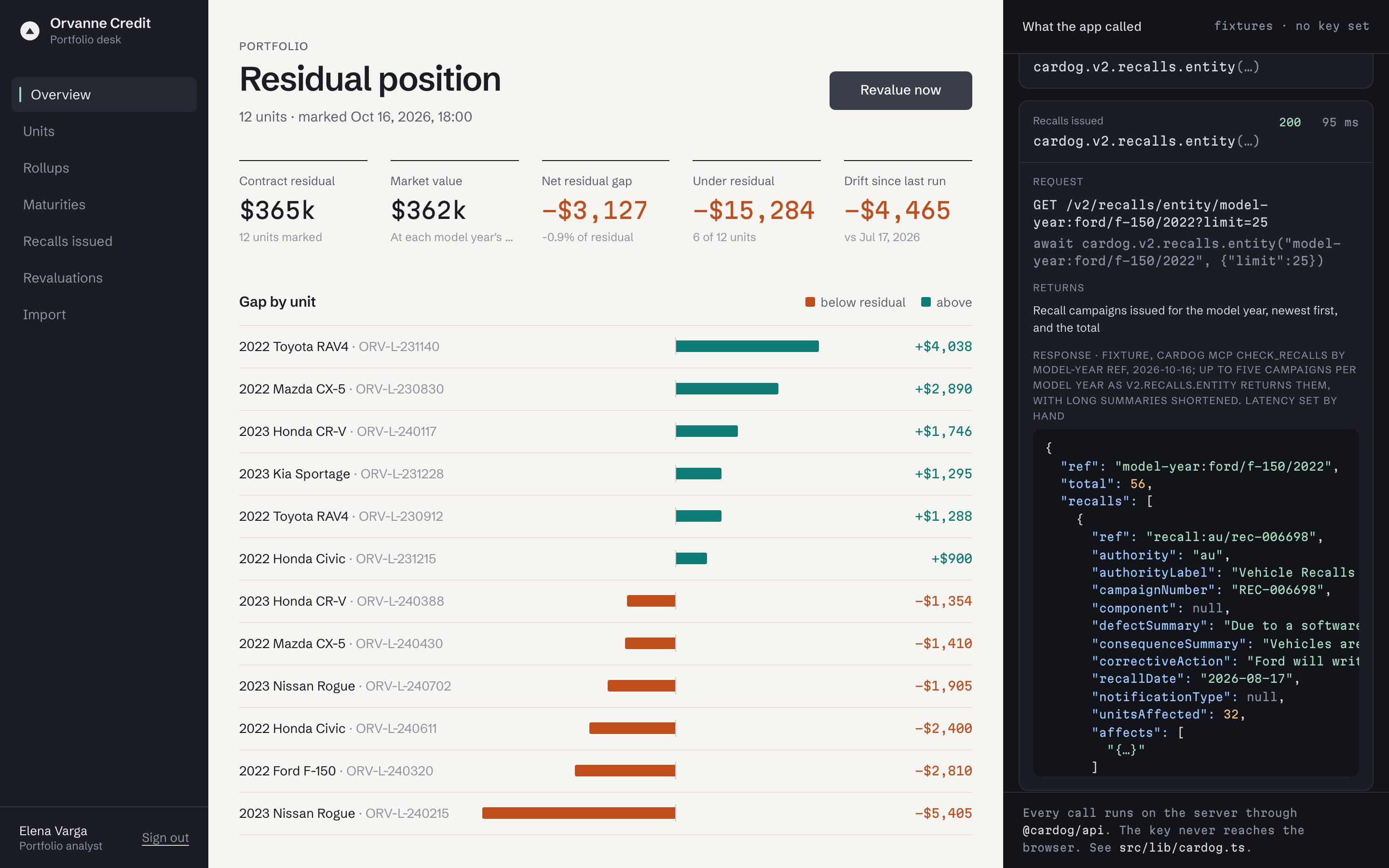
You'll build Orvanne Credit, a vehicle lender's app: import the lease book, revalue every unit, and see where residuals sit. See what it does.
- Time: About 45 minutes, or 5 to clone and run.
- You need: Node 20 or later and pnpm, A Cardog API key, Some Next.js
- Cardog SDK:
cardog.v2.vin.batch,cardog.v2.quotes.getMany,cardog.v2.recalls.entity - Clone the finished app: cardog-ai/example-portfolio-revaluation, or build it step by step below.
git clone https://github.com/cardog-ai/example-portfolio-revaluation.git1. Get an API key
Every request to Cardog carries a key. Create one under Account → API, then copy .env.example to .env.local. The app reads the key on the server; the browser never sees it.
The example values run as shipped. Without a key the app runs on responses recorded for the twelve VINs in the sample book and their seven model years.
BETTER_AUTH_SECRET ships as a development placeholder, so a fresh clone builds and runs. Replace it with your own (openssl rand -base64 32) before you deploy: a production server will not start without one, and warns on every start while the placeholder is set.
.env.example
# Copy to .env.local. With these values the app runs on recorded fixtures
# and a development auth secret.

# Your Cardog API key (https://cardog.app/account/api). Server-side only; it
# never reaches the browser. Leave empty for fixture mode.
CARDOG_API_KEY=

# Signs sessions. This value is a DEVELOPMENT PLACEHOLDER so a fresh clone
# builds and runs; the app warns on every production start while it is set.
# Replace it before deploying: openssl rand -base64 32
BETTER_AUTH_SECRET=orvanne-portfolio-dev-only-secret-replace-before-deploying

# Where the app is served. Needed when it is not http://localhost:3027.
BETTER_AUTH_URL=http://localhost:3027

# SQLite file. Created on first run.
DATABASE_PATH=data/orvanne.db

# Seeded review logins (created by `pnpm db:setup` on an empty database) are
# listed in the README.
2. Create the Next.js app
The portfolio desk is one Next.js app: the analyst's desk, the lessee's lease end, and the server code that talks to Cardog. SQLite holds the book, every revaluation run and every mark. better-sqlite3 is a native module, so the config loads it at runtime.
terminal
pnpm create next-app@latest orvanne-portfolio --ts --app --tailwind --src-dir
cd orvanne-portfolio
pnpm add @cardog/api better-auth better-sqlite3 drizzle-orm server-only
pnpm add -D drizzle-kit tsx @types/better-sqlite3
next.config.ts
import type { NextConfig } from "next";

const nextConfig: NextConfig = {
  // better-sqlite3 is a native module: load it from node_modules at runtime.
  serverExternalPackages: ["better-sqlite3"],
  // This app is its own root, even when it sits inside another repository.
  outputFileTracingRoot: process.cwd(),
};

export default nextConfig;
3. Add sign-in with better-auth
Analysts and lessees sign in with email and password. role is a user field sign-up cannot set, so everyone who signs up is a lessee, and a lessee sees a lease only when its lessee_email matches their own.
authSecret() picks the secret that signs sessions: yours whenever BETTER_AUTH_SECRET is set, and the development placeholder only on your machine and during next build. A production server with no secret stops, and one still on the placeholder logs a warning.
src/lib/auth.ts
function authSecret(): string {
  const set = process.env.BETTER_AUTH_SECRET?.trim();
  const production = process.env.NODE_ENV === "production" && process.env.NEXT_PHASE !== "phase-production-build";
  if (set) {
    if (production && set === DEV_SECRET) {
      console.warn("[orvanne-portfolio] BETTER_AUTH_SECRET is the development placeholder. Replace it before deploying.");
    }
    return set;
  }
  if (!production) return DEV_SECRET;
  throw new Error("[orvanne-portfolio] BETTER_AUTH_SECRET is not set. Generate one with `openssl rand -base64 32`.");
}
src/lib/auth.ts
export const auth = betterAuth({
  appName: "Orvanne Credit",
  baseURL: process.env.BETTER_AUTH_URL || "http://localhost:3027",
  secret: authSecret(),
  database: drizzleAdapter(db, {
    provider: "sqlite",
    schema: { user: schema.user, session: schema.session, account: schema.account, verification: schema.verification },
  }),
  emailAndPassword: { enabled: true, minPasswordLength: 8, autoSignIn: true },
  user: {
    additionalFields: {
      role: { type: "string", required: false, defaultValue: "lessee", input: false },
    },
  },
  plugins: [nextCookies()],
});
src/app/api/auth/[...all]/route.ts
import { toNextJsHandler } from "better-auth/next-js";
import { auth } from "@/lib/auth";

export const { GET, POST } = toNextJsHandler(auth);
4. Construct the Cardog client on the server
One file holds every Cardog call. The client is built once from the key, and the server-only import fails the build if a browser bundle reaches for it. Each call is timed and logged, which is what the app's "What the app called" pane shows.
SDK call: new CardogClient({ apiKey, appId })
src/lib/cardog.ts
const apiKey = process.env.CARDOG_API_KEY?.trim();

/** The one Cardog client. Server-side only. */
export const cardog: CardogClient | null = apiKey
  ? new CardogClient({ apiKey, appId: "orvanne-portfolio", baseUrl: process.env.CARDOG_BASE_URL || undefined })
  : null;

export const dataMode: "live" | "fixture" = cardog ? "live" : "fixture";

// The v2 response types, read off the client's own method signatures.
type V2 = CardogClient["v2"];
export type VinBatch = Awaited<ReturnType<V2["vin"]["batch"]>>;
export type VinBatchItem = VinBatch["results"][number];
export type VinIdentity = Extract<VinBatchItem, { ok: true }>["identity"];
export type MultiQuote = Awaited<ReturnType<V2["quotes"]["getMany"]>>;
export type Quote = MultiQuote["quotes"][number];
export type ModelYearRecalls = Awaited<ReturnType<V2["recalls"]["entity"]>>;
export type Recall = ModelYearRecalls["recalls"][number];

export interface Result<T> {
  data: T | null;
  call: CallRecord;
  error: string | null;
}
5. Parse the portfolio file
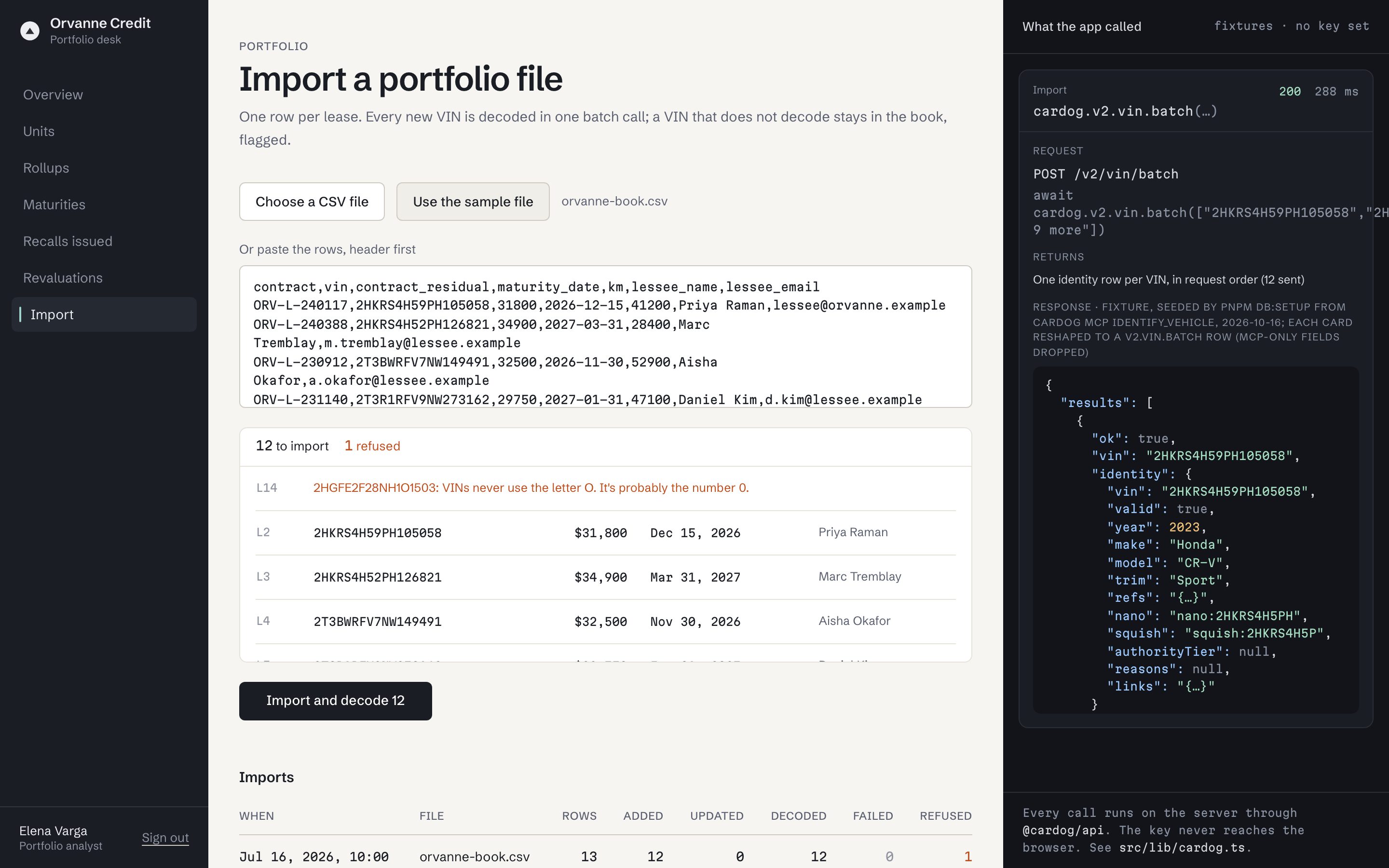
One row per lease: the VIN, the contract residual, the maturity date and the km, with the contract number and the lessee optional. Headers are matched loosely. The parser is pure, so it runs in the browser for a preview and again on the server; a row with a malformed VIN, amount or date is refused before any call, with the reason.
src/lib/csv.ts
export function parsePortfolio(text: string): ParsedFile {
  const table = splitCsv(text);
  if (table.length === 0) return { rows: [], rejected: [], missingColumns: [...REQUIRED] };
  const header = table[0].map(norm);
  const col = {} as Record<keyof typeof COLUMNS, number>;
  for (const [key, names] of Object.entries(COLUMNS) as [keyof typeof COLUMNS, readonly string[]][]) {
    col[key] = header.findIndex((h) => names.map(norm).includes(h));
  }
  const missingColumns = REQUIRED.filter((k) => col[k] < 0);
  if (missingColumns.length) return { rows: [], rejected: [], missingColumns };

  const rows: LeaseRow[] = [];
  const rejected: ParsedFile["rejected"] = [];
  const seen = new Set<string>();
  table.slice(1).forEach((cells, i) => {
    const line = i + 2;
    const get = (k: keyof typeof COLUMNS) => (col[k] >= 0 ? (cells[col[k]] ?? "").trim() : "");
    const vin = normalizeVin(get("vin"));
    const v = checkVin(vin);
    // A check-digit mismatch is legitimate on some imports, so the decoder
    // decides; a wrong length or character never reaches the API.
    if (v.state !== "ok" && v.state !== "check-mismatch") {
      const why = v.state === "typing" ? `VIN is ${vin.length} characters` : "message" in v ? v.message : "VIN is empty";
      return rejected.push({ line, reason: `${get("vin") || "(no VIN)"}: ${why}` });
    }
    const residual = money(get("residual"));
    if (residual === null) return rejected.push({ line, reason: `${vin}: contract residual "${get("residual")}" is not an amount` });
    const maturity = isoDate(get("maturity"));
    if (!maturity) return rejected.push({ line, reason: `${vin}: maturity "${get("maturity")}" is not a YYYY-MM-DD date` });
    const kmRaw = get("km").replace(/[,\s]/g, "");
    const km = kmRaw === "" ? null : Number(kmRaw);
    if (km !== null && (!Number.isFinite(km) || km < 0)) return rejected.push({ line, reason: `${vin}: km "${get("km")}" is not a number` });
    const contractNo = get("contractNo") || `VIN-${vin}`;
    if (seen.has(contractNo)) return rejected.push({ line, reason: `${contractNo}: appears twice in the file` });
    seen.add(contractNo);
    const email = get("lesseeEmail").toLowerCase();
    rows.push({
      line,
      contractNo,
      vin,
      residual,
      maturity,
      km: km === null ? null : Math.round(km),
      lesseeName: get("lesseeName") || null,
      lesseeEmail: email.includes("@") ? email : null,
    });
  });
  return { rows, rejected, missingColumns: [] };
}
6. Decode the book in one batch
Leases upsert by contract number, and only VINs the book has not already decoded are sent, up to 1000 a call. A VIN the decoder cannot name fails its own row and stays in the book, flagged.
SDK call: cardog.v2.vin.batch(vins)
What comes back. results: one row for each VIN, in request order, either ok with its identity and refs.modelYear, or an error.
src/lib/cardog.ts
export function decodeBatch(vins: string[], step: string) {
  return run<VinBatch>({
    step,
    method: "cardog.v2.vin.batch",
    args: [vins.length > 3 ? [...vins.slice(0, 3), `… ${vins.length - 3} more`] : vins],
    http: "POST /v2/vin/batch",
    returns: `One identity row per VIN, in request order (${vins.length} sent)`,
    fixture: () => fixtureBatch(vins),
    live: (c) => c.v2.vin.batch(vins),
  });
}
src/lib/portfolio.ts
export async function importPortfolio(text: string, fileName: string, userId: string): Promise<ImportOutcome> {
  const parsed = parsePortfolio(text);
  if (parsed.missingColumns.length) {
    return { importId: null, calls: [], error: `The file has no ${parsed.missingColumns.join(", ")} column.` };
  }
  if (parsed.rows.length === 0) {
    return { importId: null, calls: [], error: "No row in the file could be imported." };
  }

  const existing = new Map(
    db
      .select()
      .from(unit)
      .where(inArray(unit.contractNo, parsed.rows.map((r) => r.contractNo)))
      .all()
      .map((u) => [u.contractNo, u])
  );

  // Decode only what the book has not already decoded.
  const toDecode = [
    ...new Set(parsed.rows.filter((r) => existing.get(r.contractNo)?.vin !== r.vin || !existing.get(r.contractNo)?.decodeOk).map((r) => r.vin)),
  ];
  const calls: CallRecord[] = [];
  const decoded = new Map<string, { identity: VinIdentity } | { error: string }>();
  for (let i = 0; i < toDecode.length; i += BATCH_MAX) {
    const chunk = toDecode.slice(i, i + BATCH_MAX);
    const r = await decodeBatch(chunk, "Import");
    calls.push(r.call);
    if (!r.data) return { importId: null, calls, error: `The decode call failed: ${r.error}` };
    for (const row of r.data.results) {
      decoded.set(row.vin, row.ok ? { identity: row.identity } : { error: row.error.message });
    }
  }

  const importId = crypto.randomUUID();
  let added = 0;
  let updated = 0;
  let ok = 0;
  let failed = 0;
  db.transaction((tx) => {
    tx.insert(portfolioImport)
      .values({
        id: importId,
        fileName,
        importedBy: userId,
        importedAt: new Date(),
        rows: parsed.rows.length + parsed.rejected.length,
        added: 0,
        updated: 0,
        decoded: 0,
        failed: 0,
        rejected: parsed.rejected,
        calls,
      })
      .run();
    for (const r of parsed.rows) {
      const prior = existing.get(r.contractNo);
      const d = decoded.get(r.vin);
      const decode =
        d && "identity" in d
          ? identityColumns(d.identity)
          : d
            ? { ...EMPTY_DECODE, decodeError: d.error }
            : null; // unchanged VIN, already decoded: keep what is there
      if (decode) decode.decodeOk ? ok++ : failed++;
      const terms = {
        vin: r.vin,
        residual: r.residual,
        maturity: r.maturity,
        km: r.km,
        lesseeName: r.lesseeName,
        lesseeEmail: r.lesseeEmail,
        importId,
        updatedAt: new Date(),
      };
      if (prior) {
        tx.update(unit).set({ ...terms, ...(decode ?? {}) }).where(eq(unit.id, prior.id)).run();
        updated++;
      } else {
        tx.insert(unit)
          .values({ id: crypto.randomUUID(), contractNo: r.contractNo, ...terms, ...(decode ?? EMPTY_DECODE) })
          .run();
        added++;
      }
    }
    tx.update(portfolioImport).set({ added, updated, decoded: ok, failed }).where(eq(portfolioImport.id, importId)).run();
  });
  return { importId, calls, error: null };
}
7. Revalue every unit
"Revalue now" quotes every model year in the book, 20 refs a call, and marks each unit at its model year's median asking price. The residual gap is that median less the contract residual. The run and every mark are stored, so the next run can show drift.
SDK call: cardog.v2.quotes.getMany(modelYearRefs)
What comes back. quotes: one line per model year with priceP25, priceMedian, priceP75, liveCount and asOf.
src/lib/cardog.ts
export function quoteMany(refs: string[], step: string) {
  return run<MultiQuote>({
    step,
    method: "cardog.v2.quotes.getMany",
    args: [refs],
    http: `GET /v2/quotes?refs=${refs.join(",")}`,
    returns: "Quote lines in request order: liveCount, priceP25, priceMedian, priceP75, asOf",
    fixture: () => fixtureQuotes(refs),
    live: (c) => c.v2.quotes.getMany(refs),
  });
}
src/lib/portfolio.ts
export async function revaluePortfolio(userId: string | null): Promise<RunOutcome> {
  const units = db.select().from(unit).where(eq(unit.decodeOk, true)).all();
  if (units.length === 0) return { runId: null, calls: [], error: "No decoded units to revalue. Import a file first." };

  const refs = [...new Set(units.map((u) => u.modelYearRef!).filter(Boolean))];
  const calls: CallRecord[] = [];
  const book = new Map<string, Quote>();
  for (let i = 0; i < refs.length; i += QUOTES_MAX) {
    const r = await quoteMany(refs.slice(i, i + QUOTES_MAX), "Revalue");
    calls.push(r.call);
    if (!r.data) return { runId: null, calls, error: `The quote call failed: ${r.error}` };
    for (const q of r.data.quotes) book.set(q.ref, q);
  }

  for (const ref of refs) {
    const r = await readModelYearRecalls(ref, "Recalls issued");
    calls.push(r.call);
    if (r.data) {
      const row = { ref, total: r.data.total, recalls: r.data.recalls, fetchedAt: new Date() };
      db.insert(modelYearRecalls).values(row).onConflictDoUpdate({ target: modelYearRecalls.ref, set: row }).run();
    }
  }

  const runId = crypto.randomUUID();
  const marks = units.map((u) => {
    const q = book.get(u.modelYearRef!);
    const median = q?.priceMedian ?? null;
    return {
      id: crypto.randomUUID(),
      runId,
      unitId: u.id,
      ref: u.modelYearRef!,
      residual: u.residual,
      median,
      p25: q?.priceP25 ?? null,
      p75: q?.priceP75 ?? null,
      liveCount: q?.liveCount ?? null,
      asOf: q?.asOf ?? null,
      gap: median === null ? null : median - u.residual,
    };
  });
  const valued = marks.filter((m) => m.gap !== null);
  db.transaction((tx) => {
    tx.insert(revaluationRun)
      .values({
        id: runId,
        runAt: new Date(),
        runBy: userId,
        source: dataMode,
        units: units.length,
        valued: valued.length,
        totalResidual: valued.reduce((s, m) => s + m.residual, 0),
        totalMarket: valued.reduce((s, m) => s + m.median!, 0),
        netGap: valued.reduce((s, m) => s + m.gap!, 0),
        calls,
      })
      .run();
    for (const m of marks) tx.insert(valuation).values(m).run();
  });
  return { runId, calls, error: null };
}
8. Show the gap and the drift
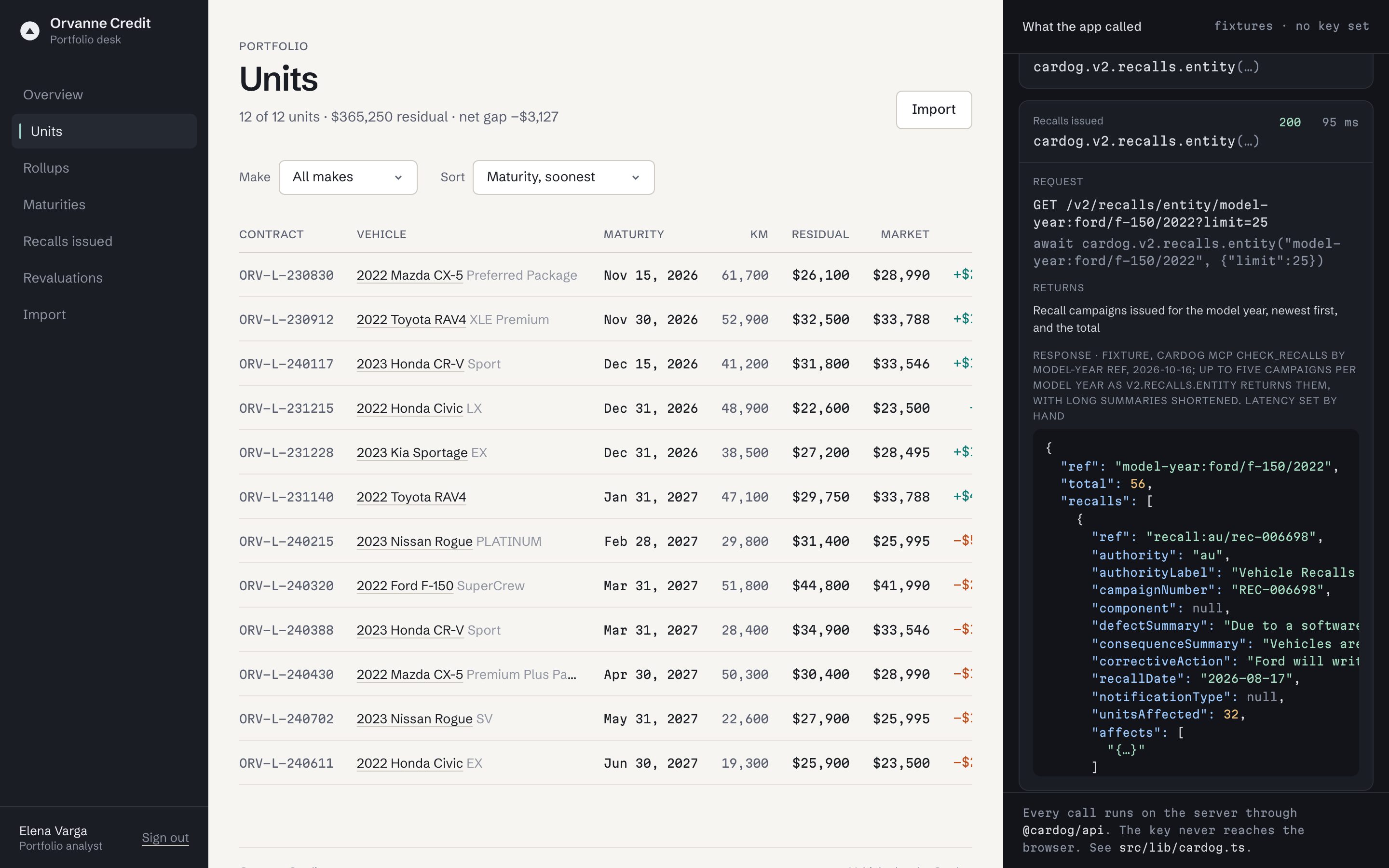
The overview and the units table read the latest run beside the one before it. Drift is the change in a unit's market median between the two; the exposure is the sum of the negative gaps only.
src/lib/portfolio.ts
export function book(opts: { runId?: string; lesseeEmail?: string } = {}): { units: BookUnit[]; current: ReturnType<typeof runs>[number] | null; previous: ReturnType<typeof runs>[number] | null } {
  const all = runs();
  const i = opts.runId ? all.findIndex((r) => r.id === opts.runId) : 0;
  const current = all[i] ?? null;
  const previous = i >= 0 ? (all[i + 1] ?? null) : null;
  const cur = marksFor(current?.id);
  const prev = marksFor(previous?.id);
  const rows = opts.lesseeEmail
    ? db.select().from(unit).where(eq(unit.lesseeEmail, opts.lesseeEmail.toLowerCase())).all()
    : db.select().from(unit).all();
  const units = rows
    .map((u): BookUnit => {
      const c = cur.get(u.id) ?? null;
      return {
        id: u.id,
        contractNo: u.contractNo,
        vin: u.vin,
        lesseeName: u.lesseeName,
        lesseeEmail: u.lesseeEmail,
        residual: u.residual,
        maturity: u.maturity,
        km: u.km,
        decodeOk: u.decodeOk,
        decodeError: u.decodeError,
        year: u.year,
        make: u.make,
        model: u.model,
        trim: u.trim,
        modelYearRef: u.modelYearRef,
        current: c && { ...c, gap: c.median == null ? null : c.median - u.residual },
        previous: prev.get(u.id) ?? null,
      };
    })
    .sort((a, b) => a.maturity.localeCompare(b.maturity) || a.contractNo.localeCompare(b.contractNo));
  return { units, current, previous };
}
src/lib/analytics.ts
export function driftOf(u: BookUnit): number | null {
  const a = u.current?.median;
  const b = u.previous?.median;
  return a != null && b != null ? a - b : null;
}
src/lib/analytics.ts
export function totals(units: BookUnit[]): Totals {
  const t: Totals = { units: units.length, valued: 0, residual: 0, market: 0, gap: 0, over: 0, under: 0, exposure: 0, drift: null };
  let drift = 0;
  let drifted = 0;
  for (const u of units) {
    const g = gapOf(u);
    if (g === null || u.current?.median == null) continue;
    t.valued++;
    t.residual += u.residual;
    t.market += u.current.median;
    t.gap += g;
    if (g >= 0) t.over++;
    else {
      t.under++;
      t.exposure += g;
    }
    const d = driftOf(u);
    if (d !== null) {
      drift += d;
      drifted++;
    }
  }
  t.drift = drifted ? drift : null;
  return t;
}
9. Roll the book up
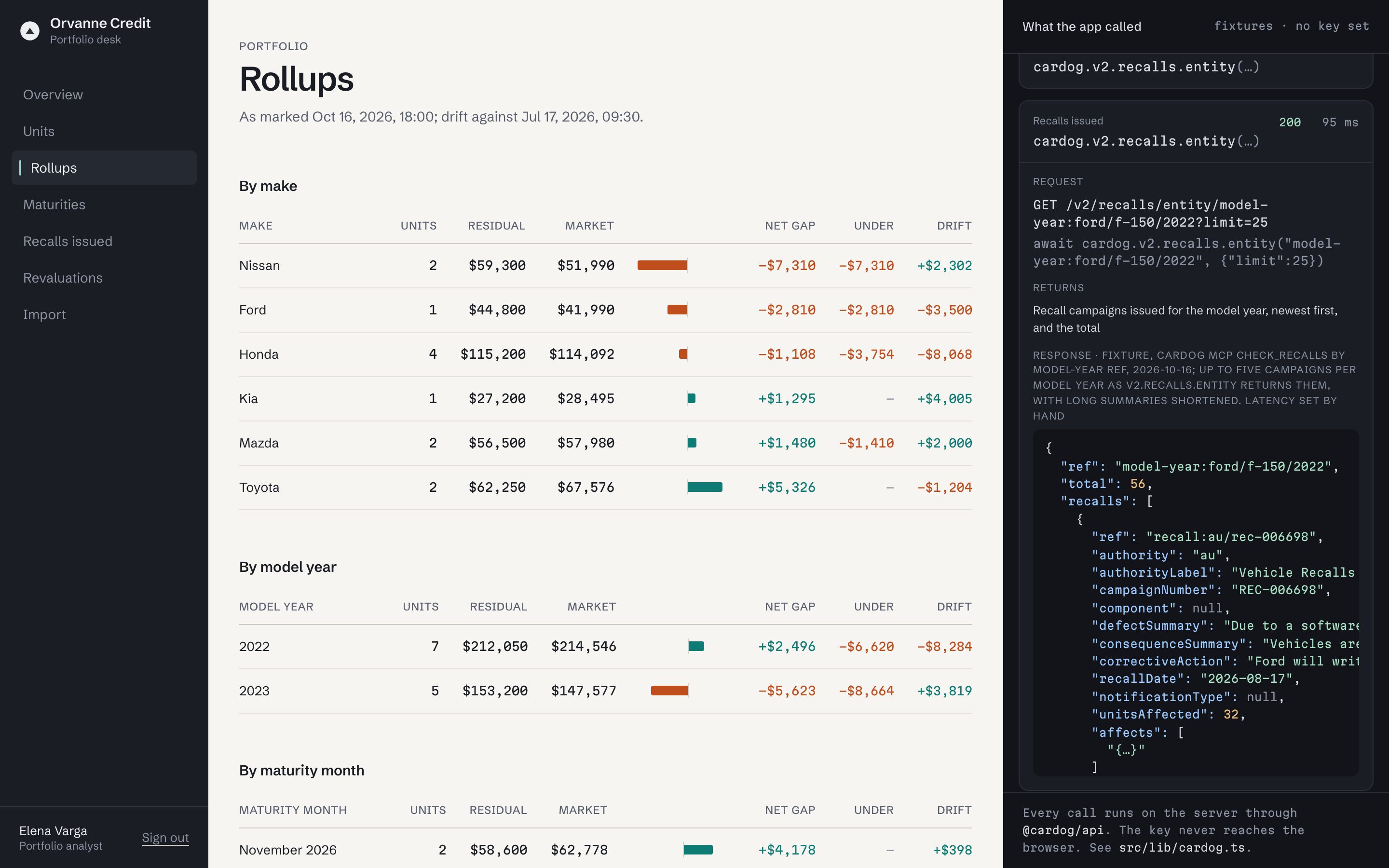
Group the book by make, model year and maturity month, with the net gap, the exposure and the drift for each group, and lay every lease out in the month it ends. None of this calls Cardog; it is computed from the stored marks.
src/lib/analytics.ts
export function rollup(units: BookUnit[], by: "make" | "modelYear" | "maturityMonth"): Rollup[] {
  const groups = new Map<string, { label: string; units: BookUnit[] }>();
  for (const u of units) {
    const [key, label] =
      by === "make"
        ? [u.make ?? "Not decoded", u.make ?? "Not decoded"]
        : by === "modelYear"
          ? [u.year ? String(u.year) : "—", u.year ? String(u.year) : "Not decoded"]
          : [u.maturity.slice(0, 7), monthLabel(u.maturity.slice(0, 7))];
    const g = groups.get(key) ?? { label, units: [] };
    g.units.push(u);
    groups.set(key, g);
  }
  const rows = [...groups.entries()].map(([key, g]) => ({ key, label: g.label, ...totals(g.units) }));
  return by === "make" ? rows.sort((a, b) => a.gap - b.gap || a.label.localeCompare(b.label)) : rows.sort((a, b) => a.key.localeCompare(b.key));
}
src/lib/analytics.ts
export function calendar(units: BookUnit[], from: Date) {
  const start = `${from.getFullYear()}-${String(from.getMonth() + 1).padStart(2, "0")}`;
  const last = units.reduce((m, u) => (u.maturity.slice(0, 7) > m ? u.maturity.slice(0, 7) : m), start);
  const months: { key: string; label: string; year: number; units: BookUnit[]; past: boolean }[] = [];
  // Whole calendar years, so every year reads as twelve cells.
  const earliest = units.reduce((m, u) => (u.maturity.slice(0, 7) < m ? u.maturity.slice(0, 7) : m), start);
  let y = Number(earliest.slice(0, 4));
  let mo = 1;
  const end = `${last.slice(0, 4)}-12`;
  for (let i = 0; i < 120; i++) {
    const key = `${y}-${String(mo).padStart(2, "0")}`;
    months.push({
      key,
      label: monthLabel(key, "short"),
      year: y,
      units: units.filter((u) => u.maturity.startsWith(key)).sort((a, b) => a.maturity.localeCompare(b.maturity)),
      past: key < start,
    });
    if (key >= end) break;
    mo++;
    if (mo > 12) {
      mo = 1;
      y++;
    }
  }
  return months;
}
10. Show the recalls issued for each model and year
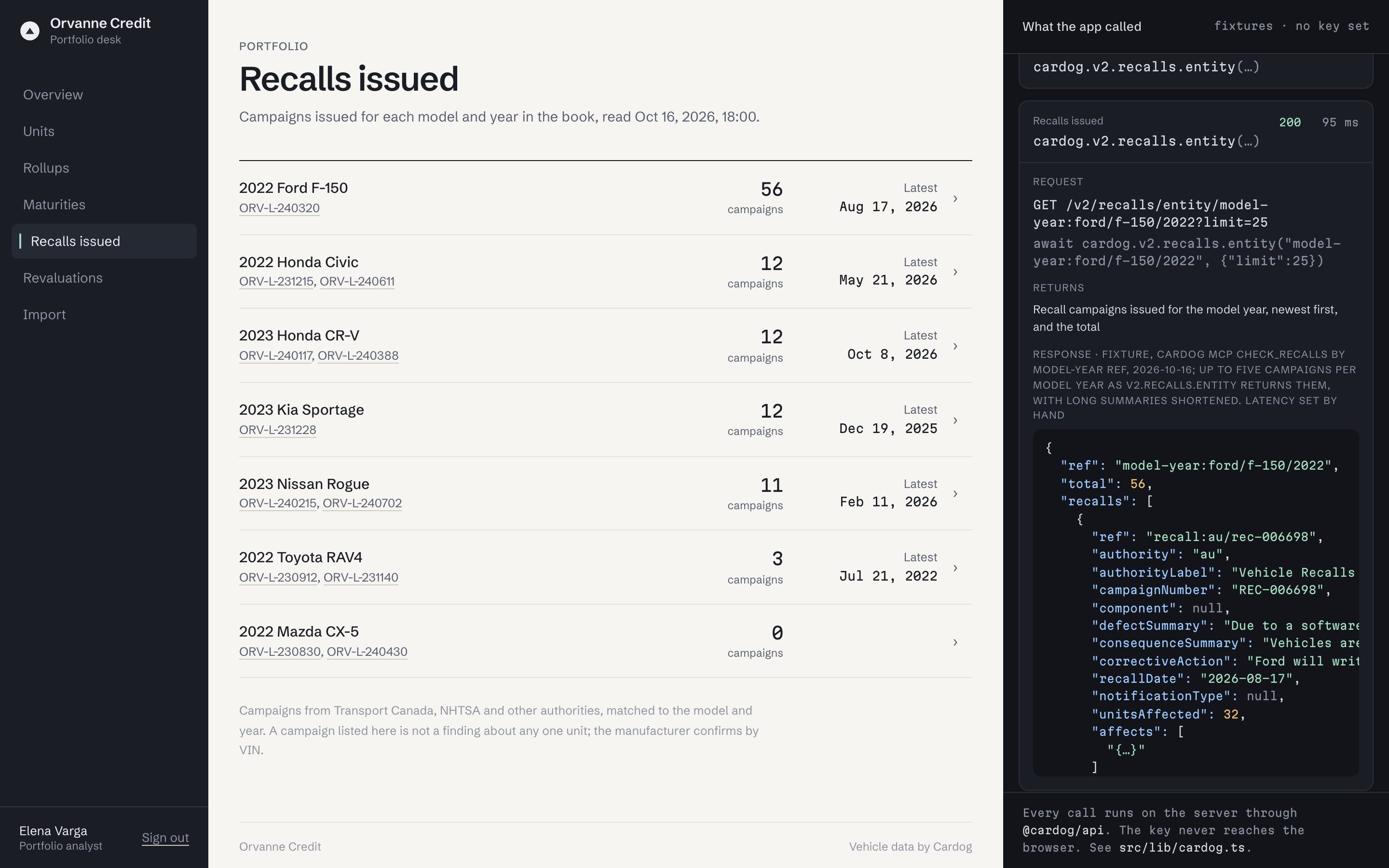
Each revaluation also reads the recalls issued for every model and year in the book, one read per model year, and holds them. The analyst sees them by model and on each unit, labelled by model and year. Lessees never see them.
SDK call: cardog.v2.recalls.entity(modelYearRef, { limit: 25 })
What comes back. Campaigns issued for the model year, newest first, and the total.
src/lib/cardog.ts
export function readModelYearRecalls(ref: string, step: string) {
  return run<ModelYearRecalls>({
    step,
    method: "cardog.v2.recalls.entity",
    args: [ref, { limit: 25 }],
    http: `GET /v2/recalls/entity/${ref}?limit=25`,
    returns: "Recall campaigns issued for the model year, newest first, and the total",
    fixture: () => fixtureRecalls(ref),
    live: (c) => c.v2.recalls.entity(ref, { limit: 25 }),
  });
}
src/lib/portfolio.ts
export function recallsFor(refs: string[]) {
  if (refs.length === 0) return new Map<string, { total: number; recalls: Recall[]; fetchedAt: Date }>();
  return new Map(
    db
      .select()
      .from(modelYearRecalls)
      .where(inArray(modelYearRecalls.ref, refs))
      .all()
      .map((r) => [r.ref, { total: r.total, recalls: r.recalls as Recall[], fetchedAt: r.fetchedAt }])
  );
}
11. Show the lessee their lease end
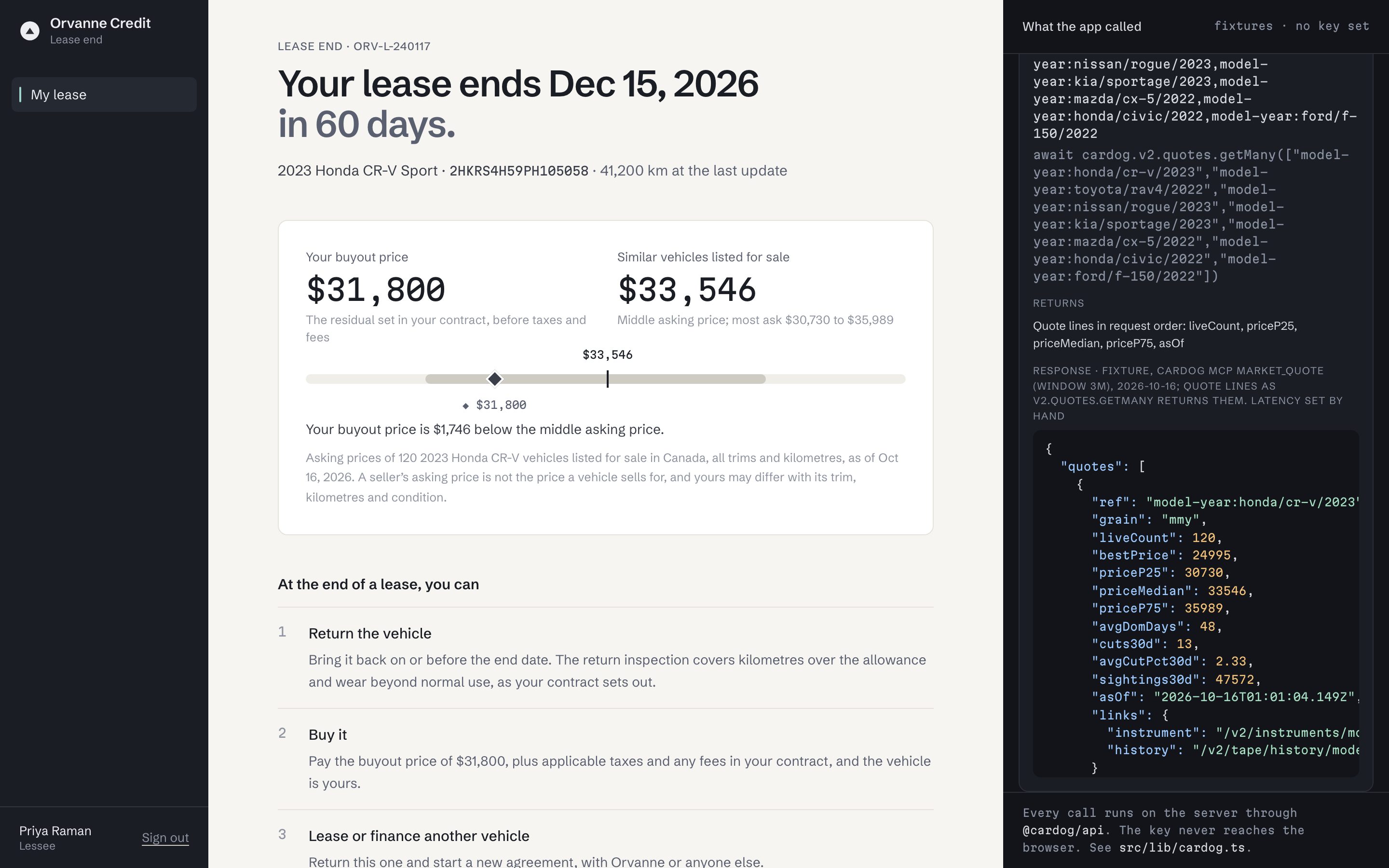
A lessee sees only their own lease: the date and days left, the buyout beside the middle asking price and the band for similar vehicles, one neutral sentence on the difference, and what they can do next, in the same words for every lease. The page makes no call of its own; it reads the latest run.
12. Deploy
The portfolio desk ships as one container with SQLite on a volume. Build the image, mount the volume, and set the key, the auth secret and the public URL in the host's environment. To revalue nightly, call the same revaluation from a scheduled job; the Cardog code does not change.
Dockerfile
# Orvanne portfolio: one container, SQLite on a mounted volume.
#   docker build -t orvanne-portfolio .
#   docker run -p 3027:3027 -v orvanne-data:/app/data \
#     -e CARDOG_API_KEY=... -e BETTER_AUTH_SECRET=... -e BETTER_AUTH_URL=https://your.host orvanne-portfolio
FROM node:22-bookworm-slim AS build
WORKDIR /app
RUN corepack enable
COPY package.json pnpm-lock.yaml ./
RUN pnpm install --frozen-lockfile
COPY . .
RUN pnpm build

FROM node:22-bookworm-slim
WORKDIR /app
ENV NODE_ENV=production
RUN corepack enable
COPY --from=build /app ./
VOLUME /app/data
EXPOSE 3027
CMD ["pnpm", "start"]
terminal
docker build -t orvanne-portfolio .
docker run -p 3027:3027 -v orvanne-portfolio-data:/app/data \
  -e CARDOG_API_KEY=your_cardog_api_key \
  -e BETTER_AUTH_SECRET=$(openssl rand -base64 32) \
  -e BETTER_AUTH_URL=https://portfolio.example.com \
  orvanne-portfolio
Next steps
- Market data: Quotes, comparables and the price history behind them.
- Feeds: Re-read a book of vehicles on a schedule.
- Loan collateral: Orvanne's other app: check the collateral on a new loan.
Was this helpful?