Mazda · 1990–2006
MPV Recalls
25 known recalls affecting the Mazda MPV (1990–2006). Enter your VIN to check if your specific vehicle is affected, or browse by model year below.
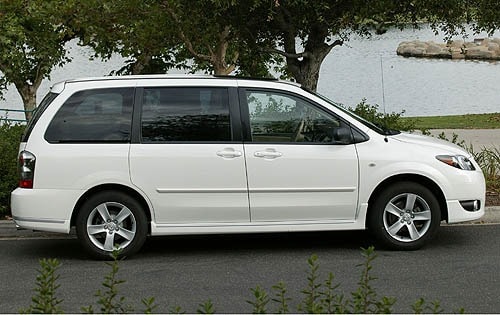
Mazda MPV Recalls
Summary
On certain vehicles, the passenger frontal airbag inflator could produce excessive internal pressure during airbag deployment. Increased pressure may cause the inflator to rupture, which could allow fragments to be propelled toward vehicle occupants, increasing the risk of injury. This could also damage the airbag module, which could prevent proper deployment. Failure of the passenger airbag to fully deploy during a crash (where deployment is warranted) could increase the risk of injury to the seat occupant. Correction: Dealers will replace the passenger frontal airbag inflator. Note: This recall supersedes recalls 2013-112 (Mazda Recall 6913D), 2014-245 (Mazda Recall 7714F), 2015-624 (Mazda Recall 9015L), 2016-259 (Mazda Recall 9416E) and 2017-011 (Mazda Recall 0617A).
Summary
Note: The recall for the 2005-2008 RX-8 models has been superseded by recall <a href="http://wwwapps.tc.gc.ca/Saf-Sec-Sur/7/VRDB-BDRV/search-recherche/detail.aspx?lang=eng&&rn=2018038">2018038 (Mazda Recall 2018A)</a>, and the recall for the 2005-2006 MPV models has been superseded by recall <a href="http://wwwapps.tc.gc.ca/Saf-Sec-Sur/7/VRDB-BDRV/search-recherche/detail.aspx?lang=eng&&rn=2018578">2018578 (Mazda Recall 2618F)</a>. On certain vehicles, long-term exposure to high absolute humidity and temperature, combined with high temperature cycling, could eventually degrade the propellant contained in the passenger frontal airbag inflator. This could cause the airbag to deploy with more force than normal. As a result, if the vehicle were involved in a collision that warrants airbag deployment, fragments could be propelled toward vehicle occupants, and the airbag assembly could be damaged, preventing proper function. These issues could increase the risk of injury. Correction: Dealers will replace the passenger frontal airbag inflator. Additional note: Canadian climate results in the propellant degrading slowly. The recall is being conducted as a precaution to address future risk, and is expected to replace airbag inflators before their function would be affected.
Summary
Note: The recall for the 2004 RX-8 model has been superseded by <a href="http://wwwapps.tc.gc.ca/Saf-Sec-Sur/7/VRDB-BDRV/search-recherche/detail.aspx?lang=eng&&rn=2018038">recall 2018-038 (Mazda Recall 2018A)</a>, and the recall for the 2004 MPV model has been superseded by recall <a href="http://wwwapps.tc.gc.ca/Saf-Sec-Sur/7/VRDB-BDRV/search-recherche/detail.aspx?lang=eng&&rn=2018578">2018578 (Mazda Recall 2618F)</a>. On certain vehicles, long-term exposure to high absolute humidity and temperature, combined with high temperature cycling, could eventually degrade the propellant contained in the passenger frontal airbag. This could cause the airbag to deploy with more force than normal. As a result, if the vehicle were involved in a collision that warrants airbag deployment, fragments could be propelled toward vehicle occupants, and the airbag assembly could be damaged, preventing proper function. These issues could increase the risk of injury. Correction: Dealers will replace the airbag inflator. Additional note: Canadian climate results in the propellant degrading slowly. The recall is being conducted as a precaution to address future risk, and is expected to replace airbag inflators before their function would be affected.
Summary
On certain vehicles, a defect in the ignition switch could cause an electrical short to develop over time. This could result in smoke and/or fire, increasing the risk of injury and/or damage to property. Correction: Dealers will replace the ignition switch.
Summary
Certain vehicles previously updated following an emission recall concerning the PCV hose may experience throttle icing during cold weather operation. As a result of misrouting of the PCV hose during the emission recall, moisture build-up inside the hose could freeze while the vehicle is parked. If the vehicle is then driven at constant highway speeds in extremely cold temperatures (-30 degrees Celsius or colder), the moisture in the blow-by gases may freeze in the throttle valve area. Under these conditions, even if the accelerator pedal is released while driving, engine speed may not decrease. Unwanted acceleration could result in a vehicle crash without prior warning. Correction: Dealers will inspect the previously replaced PCV hose for proper routing and reroute if necessary.
Summary
On certain vehicles, the liftgate stay dampers and stud bolts may rust and stick together, causing the stud bolds to break off. In the worst case, this condition may allow the liftgate to suddenly drop during opening or closing, injuring the operator. Correction: Dealers will replace the left and right dampers and stud bolts.
Summary
On certain vehicles equipped with a 2.5L V6 Duratec engine, while driving at a constant speed on the highway, it is possible that the engine speed will not decrease when releasing the accelerator pedal due to a frozen throttle valve. This condition occurs at ambient temperatures from -30 to -40 degrees Celsius. The vehicle can be brought to a full stop by depressing the brake pedal. Correction: Dealers will replace the intake manifold and PCV hose with modified parts which will change the layout of the PCV hose system.
Summary
On certain vehicles, the tire inflation pressure indicated on the vehicle certification label is not correct. Each of the labels includes tire inflation pressure information in kilopascals (KPA) and in pounds per square inch (PSI) for one of the three sizes of tires available on MPV's. In every case, the maximum tire inflation pressure specified in PSI is incorrect while the information provided in KPA is correct. The labels show the maximum tire pressure as 240 KPA / 32 PSI when it should be shown as 240 KPA / 35 PSI. Correction: Owners will be notified of the non-compliance by mail and will be provided with a corrected label that they can apply to their vehicle.
Summary
On certain vehicles, the cruise control actuator cable may be broken due to insufficient strength. Also included are certain 2000-2001 minivans built between March 31, 1999 and March 31, 2001, that have had the cruise control repaired and possibly had a defective cable installed during that repair. It is possible that the broken actuator cable may be out of position and could interfere with the operation of the accelerator cable, preventing a decrease in engine speed while driving, increasing the risk of a crash. Correction: Dealers will replace the actuator cable.
Summary
On certain vehicles, the front passenger-side airbag was improperly wired and may not provide adequate protection in the event of a crash. Correction: Dealer will install a short wiring harness kit.
Showing 1-10 of 25 recalls

Related Recall Checks
Check recalls for specific Mazda MPV model years