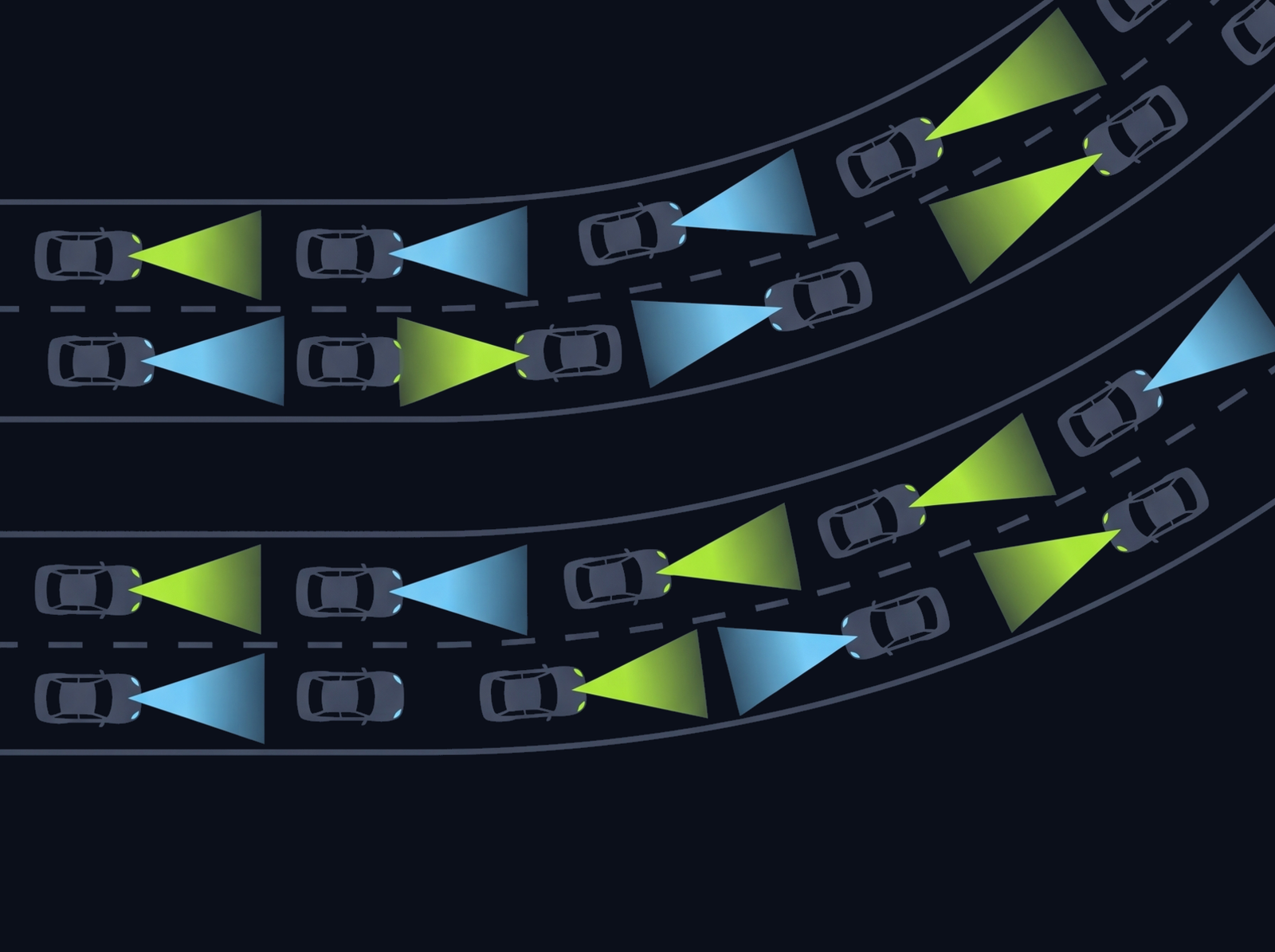
A new car's brochure lists what it carries. The fleet has no brochure. Of the cars already on Canadian roads, the ones that are driven, insured and inspected every day, nobody publishes how many can brake on their own, warn of a car ahead, or light a signal when someone sits in the blind spot. Sales figures cannot answer it, because sales say what is new and the fleet is everything that has not yet been scrapped.
So we counted it. Ontario publishes its vehicle population every year, by make code, model code and model year.1 Quebec publishes its vehicles in circulation the same way.2 We read each code to a named model, and joined every model year to the equipment record NHTSA publishes for it.3 In Ontario's 2025 file that covers 3,485,623 of the 3,917,347 passenger vehicles of model year 2018 or newer, 89.0% of them. The rest sit in small or ambiguous codes, and we left them out rather than guess.
Seven model years
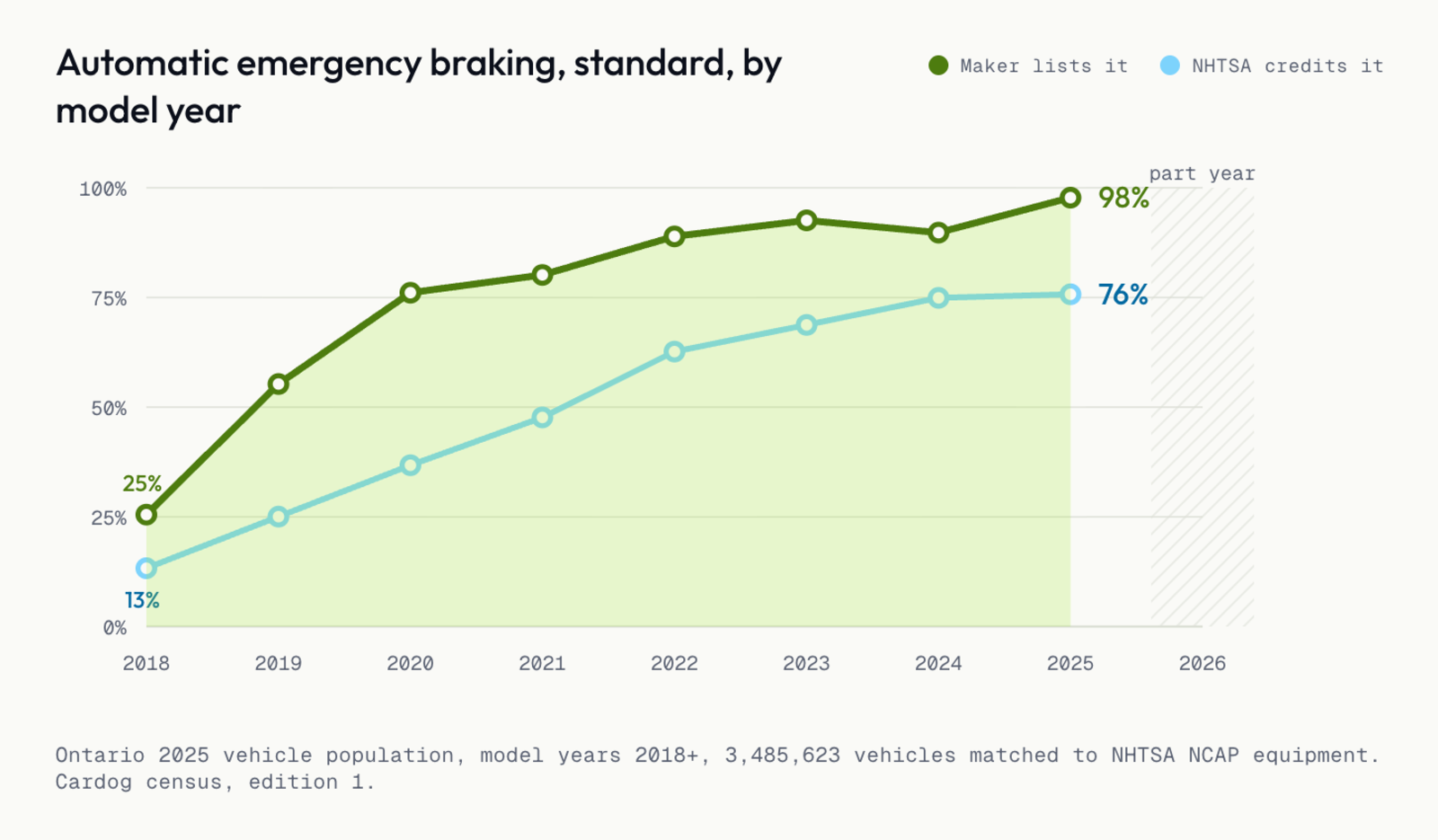
Of the Ontario vehicles built for model year 2018, 25% came from models whose maker lists automatic emergency braking as standard on every configuration. By model year 2025 it was 98%. Most of that change came in model years 2019 and 2020, as twenty makers delivered on a voluntary US commitment, announced in 2016, to make the system standard on nearly all light vehicles by September 2022.4
Blind spot monitoring is the exception. It rose from 6% of 2018 vehicles to 62% of 2025, and across the whole matched fleet it is standard on 37%. For 57% of matched vehicles it is listed as optional, or varies by trim: of the four systems, the one still most often sold as an extra.
Two answers
Every feature in the census carries two answers, because two public records describe the same equipment. The maker lists what it fits: standard, optional, or not offered. NHTSA credits a system only when it meets the agency's own criteria for that model year. A car can carry automatic braking and still not be credited with it.
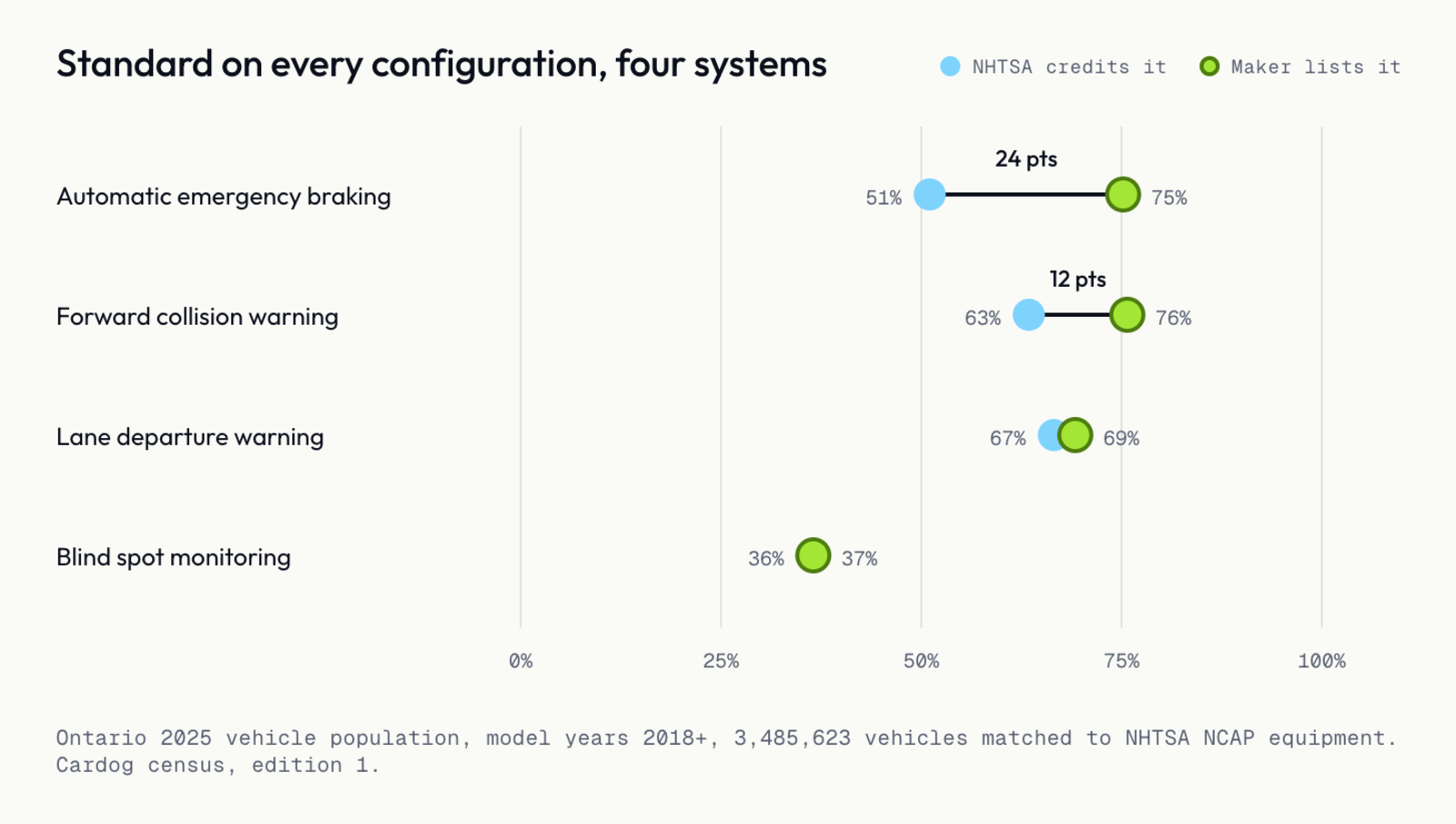
On lane departure warning the two records agree within two points. On automatic braking they are 24 points apart: 75% listed against 51% credited, across the same 3,485,623 vehicles. Neither number is wrong. To ask what is fitted, read what the maker lists. To ask what has met a test, read what the regulator credits. We publish both and say on every row whose answer it is.
What it is, and what it is not
The census is kept at model level, from US-market configurations. A Canadian base trim can differ from its US equivalent, and the census does not say what any one vehicle carries. Ontario's file is from 2025 and Quebec's from 2022, so each province is read on its own and never set against the other. Every share is a share of registered vehicles, not of kilometres driven.
Next, the Canadian trim
Makers publish their Canadian specifications trim by trim. We have collected 1,094 of those documents from 13 maker groups and are reading them into the same record, so that each model year carries the equipment of the trims actually sold here. The census will be counted the same way each time a province publishes its file, so a change in the fleet shows up as a change in the number, never as a change in the method.
The full report, with both provinces, all four systems by model year and the method, is here as a PDF: nine pages, open for anyone to read, share and check.
Sources
-
Ontario Ministry of Transportation, vehicle population data, 2025. Contains information licensed under the Open Government Licence – Ontario. ↑
-
Société de l'assurance automobile du Québec, Véhicules en circulation, 2022, CC BY 4.0. ↑
-
US National Highway Traffic Safety Administration, New Car Assessment Program, published equipment by model and model year: the manufacturer-reported columns and NHTSA's own determination. ↑
-
NHTSA and the Insurance Institute for Highway Safety, announcement of 17 March 2016: twenty automakers commit to make automatic emergency braking standard on new light vehicles by 1 September 2022. ↑