Edition 1/
The driver-assistance census, edition 1
What is on the road
Driver assistance on the passenger vehicles of Ontario and Quebec, model years 2018 and newer, counted from the provinces' own files.
- Kind
- Data edition
- Published
- Data as of
- Ontario 2025 and Quebec 2022 files
- Length
- 9 pages
Figures
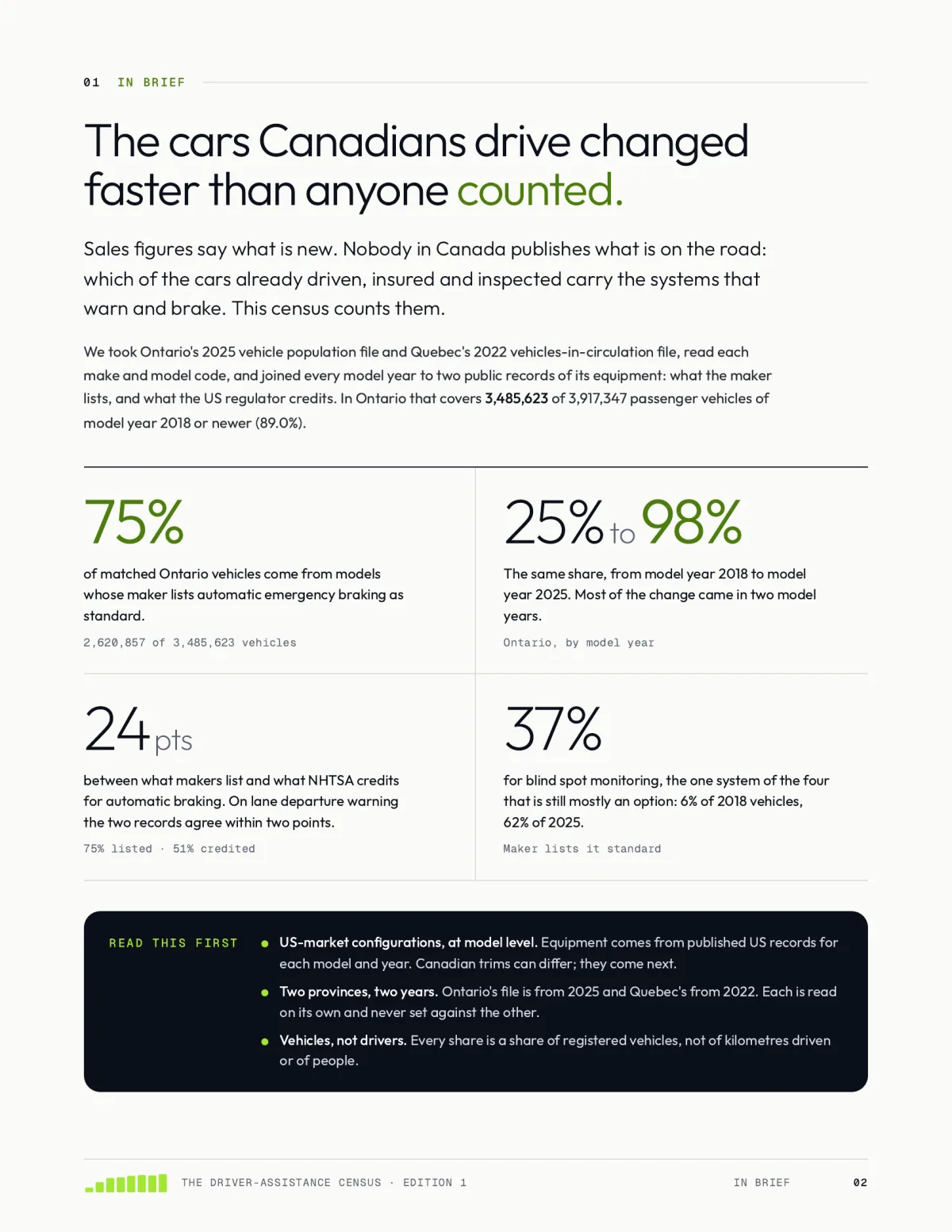
75%
of matched Ontario vehicles come from models whose maker lists automatic emergency braking as standard.
2,620,857 of 3,485,623 vehicles. Ontario vehicle population, 2025
25% to 98%
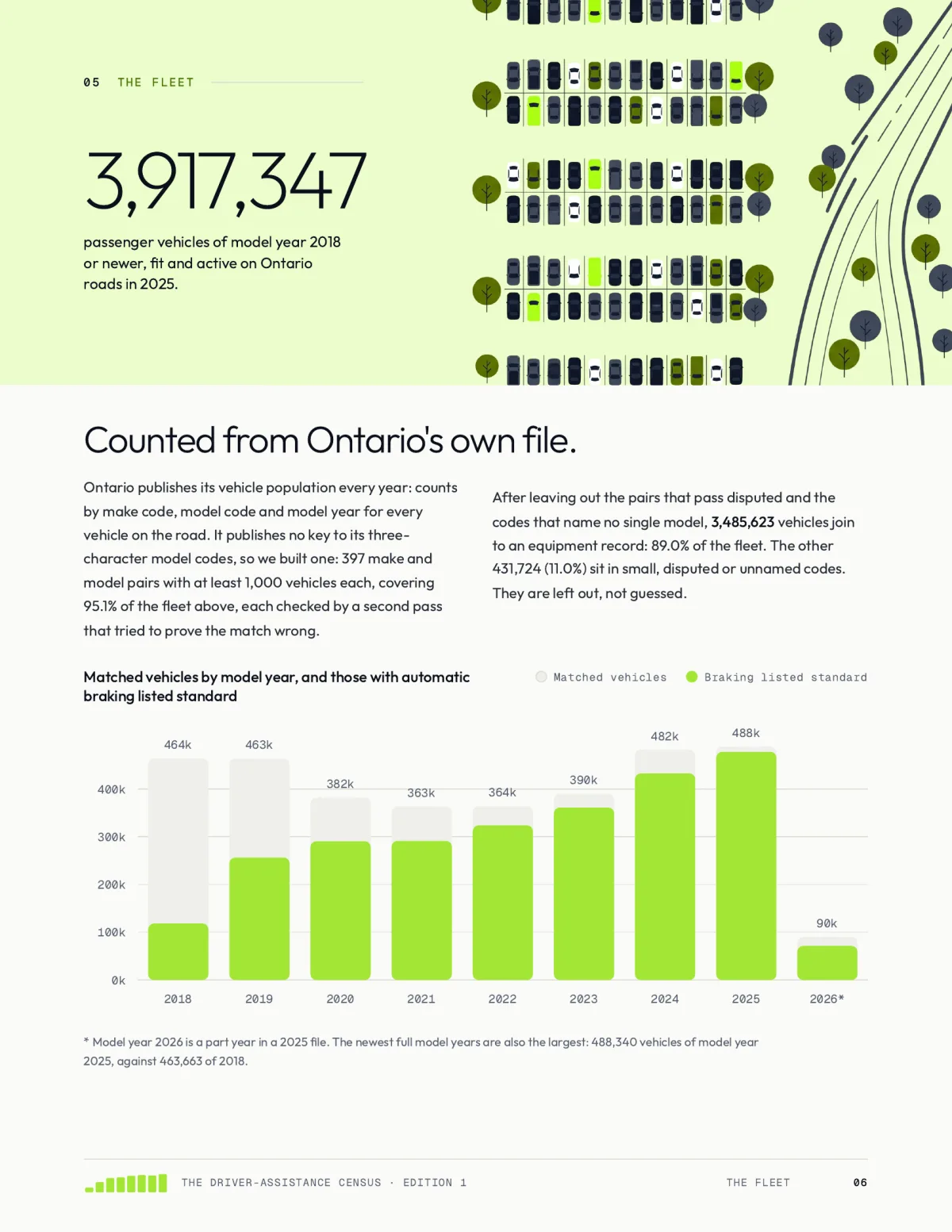
the same share, from model year 2018 to model year 2025. Most of the change came in two model years.
Ontario, by model year. Ontario vehicle population, 2025
24 pts
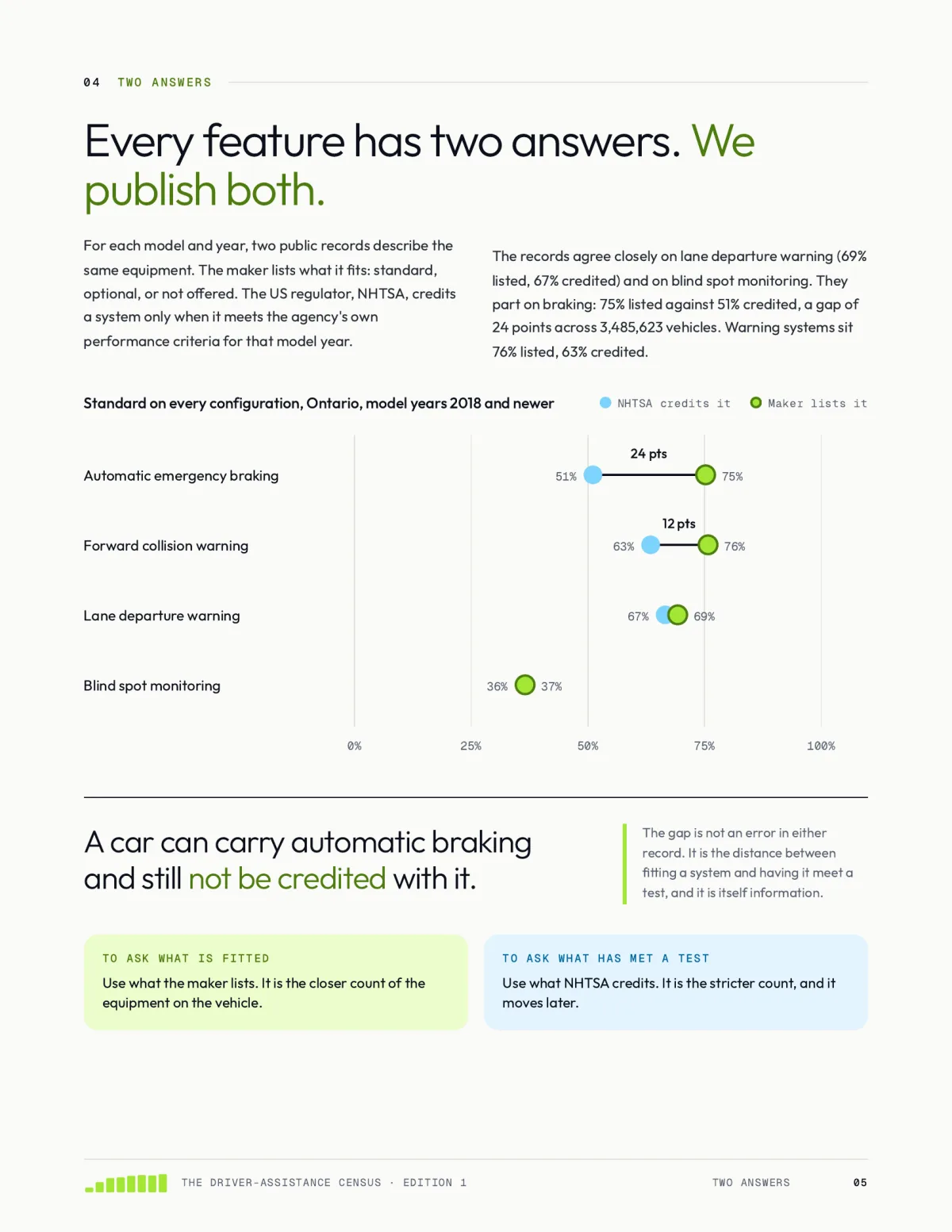
between what makers list and what the US regulator credits for automatic braking. On lane departure warning the two records agree within two points.
75% listed, 51% credited. Ontario vehicle population, 2025
37%
for blind spot monitoring, the one system of the four that is still mostly an option. 6% of 2018 vehicles, 62% of 2025.
Maker lists it standard. Ontario vehicle population, 2025
The answer
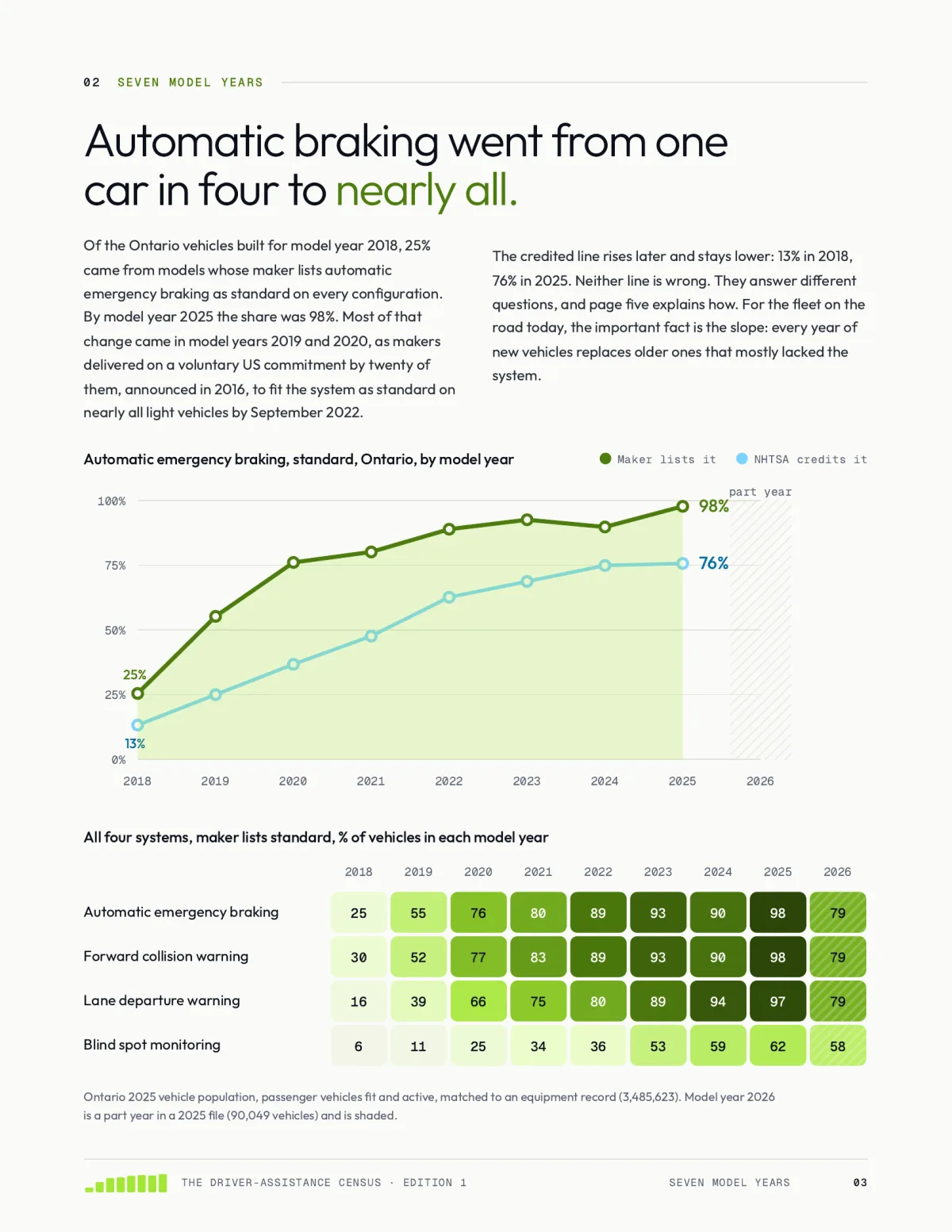
Of the 3,485,623 Ontario passenger vehicles of model year 2018 or newer that join to an equipment record, 75% come from models whose maker lists automatic emergency braking as standard on every configuration. The share rose from 25% of model year 2018 vehicles to 98% of model year 2025, with most of the change in model years 2019 and 2020. Blind spot monitoring is the one system of the four still mostly sold as an option: standard on 37% of matched vehicles. The US regulator's own record credits automatic braking on 51%, a gap of 24 points from what makers list.
Two answers, four systems
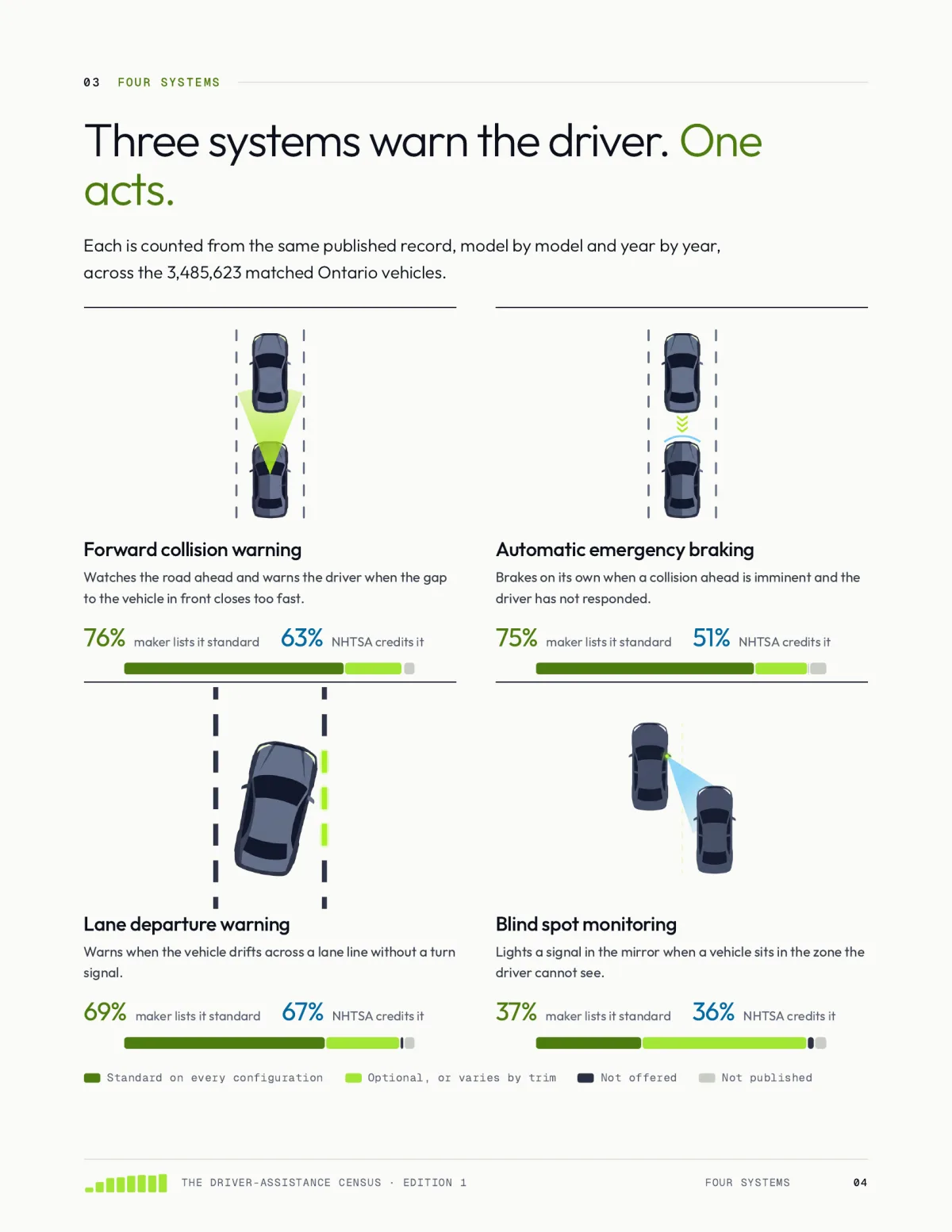
Standard on every configuration, Ontario, model years 2018 and newer: what the maker lists, and what the US regulator credits.
Automatic emergency braking75% listed, 51% credited
Forward collision warning76% listed, 63% credited
Lane departure warning69% listed, 67% credited
Blind spot monitoring37% listed, 36% credited
Maker lists it standardUS regulator credits it
By model year
All four systems, maker lists standard, % of vehicles in each model year.
| System | 2018 | 2019 | 2020 | 2021 | 2022 | 2023 | 2024 | 2025 | 2026 |
|---|---|---|---|---|---|---|---|---|---|
| Automatic emergency braking | 25 | 55 | 76 | 80 | 89 | 93 | 90 | 98 | 79 |
| Forward collision warning | 30 | 52 | 77 | 83 | 89 | 93 | 90 | 98 | 79 |
| Lane departure warning | 16 | 39 | 66 | 75 | 80 | 89 | 94 | 97 | 79 |
| Blind spot monitoring | 6 | 11 | 25 | 34 | 36 | 53 | 59 | 62 | 58 |
Ontario 2025 vehicle population, passenger vehicles fit and active, matched to an equipment record (3,485,623). Model year 2026 is a part year in a 2025 file (90,049 vehicles) and is shaded.
| System | 2018 | 2019 | 2020 | 2021 | 2022 | 2023 |
|---|---|---|---|---|---|---|
| Automatic emergency braking | 22 | 50 | 62 | 70 | 76 | 84 |
| Forward collision warning | 25 | 48 | 62 | 72 | 77 | 84 |
| Lane departure warning | 15 | 30 | 57 | 62 | 71 | 82 |
| Blind spot monitoring | 5 | 11 | 23 | 28 | 31 | 45 |
SAAQ vehicles in circulation, 2022: automobiles and light trucks, personal and institutional use, matched to an equipment record (1,798,490). Model year 2023 is a part year in a 2022 file (63,245 vehicles, shaded); model year 2024 (2 vehicles) is left off the charts.
Method
- The fleet. Ontario Ministry of Transportation vehicle population, 2025: passenger class, fit and active, model years 2018 and newer (3,917,347). SAAQ vehicles in circulation, 2022: automobiles and light trucks in personal and institutional use, model years 2018 and newer (1,827,192).
- The model codes. Ontario publishes no key to its model codes. We resolved its 397 largest make and model pairs to named models, checked each with a second, adversarial pass, applied its corrections and left out what it disputed. Quebec's names, shortened to five characters, were resolved the same way, with family entries mapped to the base model.
- The equipment. For each model and model year, the published New Car Assessment Program equipment: the column the maker reports, and the regulator's own determination. A model counts as standard only when every rated configuration lists the system as standard; any mix counts as optional or varies.
- Names. About a dozen Canadian model names are mapped to their US equivalents, such as Qashqai to Rogue Sport and RVR to Outlander Sport (24 of 1,782 Ontario rows).
- Shares. Every share is of matched vehicles in one province's file and one model year. The full-fleet count is printed beside it, so the share can always be read against the whole.
In Ontario, 3,485,623 of 3,917,347 vehicles join to an equipment record: 89.0% of the fleet. The other 431,724 (11.0%) sit in small, disputed or unnamed codes, and are left out, not guessed. In Quebec, 1,798,490 of 1,827,192 join (98.4%), across 348 models.
Limits
- Equipment describes the US-market configuration of each model, not the Canadian trim. A Canadian base trim can differ.
- The census is kept at model level. It does not say what any one vehicle carries.
- Backup cameras are left out: required on new vehicles since May 2018, and not published in the source for 99.6% of matched Ontario vehicles.
- It counts vehicles, not kilometres driven or the people in them.
- Ontario (2025) and Quebec (2022) are different snapshots and are not compared.
Sources
Data as of Ontario 2025 and Quebec 2022 files. Published October 26, 2026. Counts and shares computed by Cardog; neither province nor the US regulator endorses this report.
- Ontario Ministry of Transportation, vehicle population, 2025. Contains information licensed under the Open Government Licence – Ontario.
- Société de l'assurance automobile du Québec, Véhicules en circulation, 2022, CC BY 4.0.
- US New Car Assessment Program, published equipment by model and model year, public domain.
This edition
- Supersedes
- None. This is the first edition.
- Superseded by
- Not yet. Refreshed each time a province publishes its file, and counted the same way every year.
This edition is sealed: it is not edited after publication. A later one supersedes it, and this one stays readable here.
Questions
- What share of Ontario's vehicles have automatic emergency braking as standard?
- 75% of the 3,485,623 matched Ontario passenger vehicles of model year 2018 or newer come from models whose maker lists automatic emergency braking as standard: 2,620,857 vehicles. The US regulator credits the system on 51%.
- Why do the maker's list and the regulator's credit differ?
- The maker lists what it fits. The regulator credits a system only when it meets the agency's own performance criteria for that model year. The gap is the distance between fitting a system and having it meet a test, and it is widest on automatic braking: 24 points.
- Does the census say what my car has?
- No. The census is kept at model level, from US-market configurations, and does not say what any one vehicle carries. A Canadian base trim can differ from its US equivalent.
- Can Ontario and Quebec be compared?
- No. Ontario's file is from 2025 and Quebec's from 2022, so each province is read on its own and never set against the other.