Clutch vs Traditional Dealers: Cost Analysis for Canadian Car Buyers
Clutch vs Traditional Dealers: Cost Analysis for Canadian Car Buyers
The Canadian used car market presents buyers with a fundamental choice: the modern online-first approach offered by platforms like Clutch, or the traditional dealership experience that's dominated automotive retail for decades. While both paths lead to vehicle ownership, the cost structures differ dramatically—and the differences go far beyond the sticker price.
If you're comparing different platforms and marketplaces, check out our detailed analysis in CarGurus vs AutoTrader vs Clutch to understand how each platform approaches pricing and transparency.
Understanding the true cost of buying from Clutch versus traditional dealers requires examining not just purchase prices, but the full spectrum of expenses: hidden fees, financing costs, warranty coverage, delivery charges, and long-term ownership implications. For Canadian buyers, these differences can add up to thousands of dollars over the life of vehicle ownership.
This analysis uses real market data from both Clutch's current inventory and traditional dealerships across Canada to break down exactly what you'll pay through each channel. Whether you're shopping for a Honda Civic in Toronto or a Toyota RAV4 in Vancouver, understanding these cost differences helps you make an informed decision that matches your budget and priorities.
Quick Cost Summary: What You Need to Know
Clutch's certified used car model typically costs 5-12% more upfront than comparable vehicles at traditional dealers, but includes reconditioning, delivery, and transparent all-in pricing. Traditional dealers offer lower sticker prices but add fees that can total $1,500-$3,000 depending on the province and dealership.
Key findings from current market data:
- Average Clutch vehicle: $26,673 with 72,000 km, fully certified
- Comparable traditional dealer vehicle: $24,500-$25,800 (before fees)
- Total cost after fees often equalizes within $500-$1,500
- Financing rates vary but average 6.5-8.5% across both channels
- Delivery: $0-$500 (Clutch, included in Ontario) vs. $0 (traditional, pickup required)
The bottom line: Clutch typically costs slightly more for hassle-free convenience and quality assurance, while traditional dealers offer more negotiation flexibility but require more buyer diligence and time investment.
How Clutch Works: The Direct Certified Model
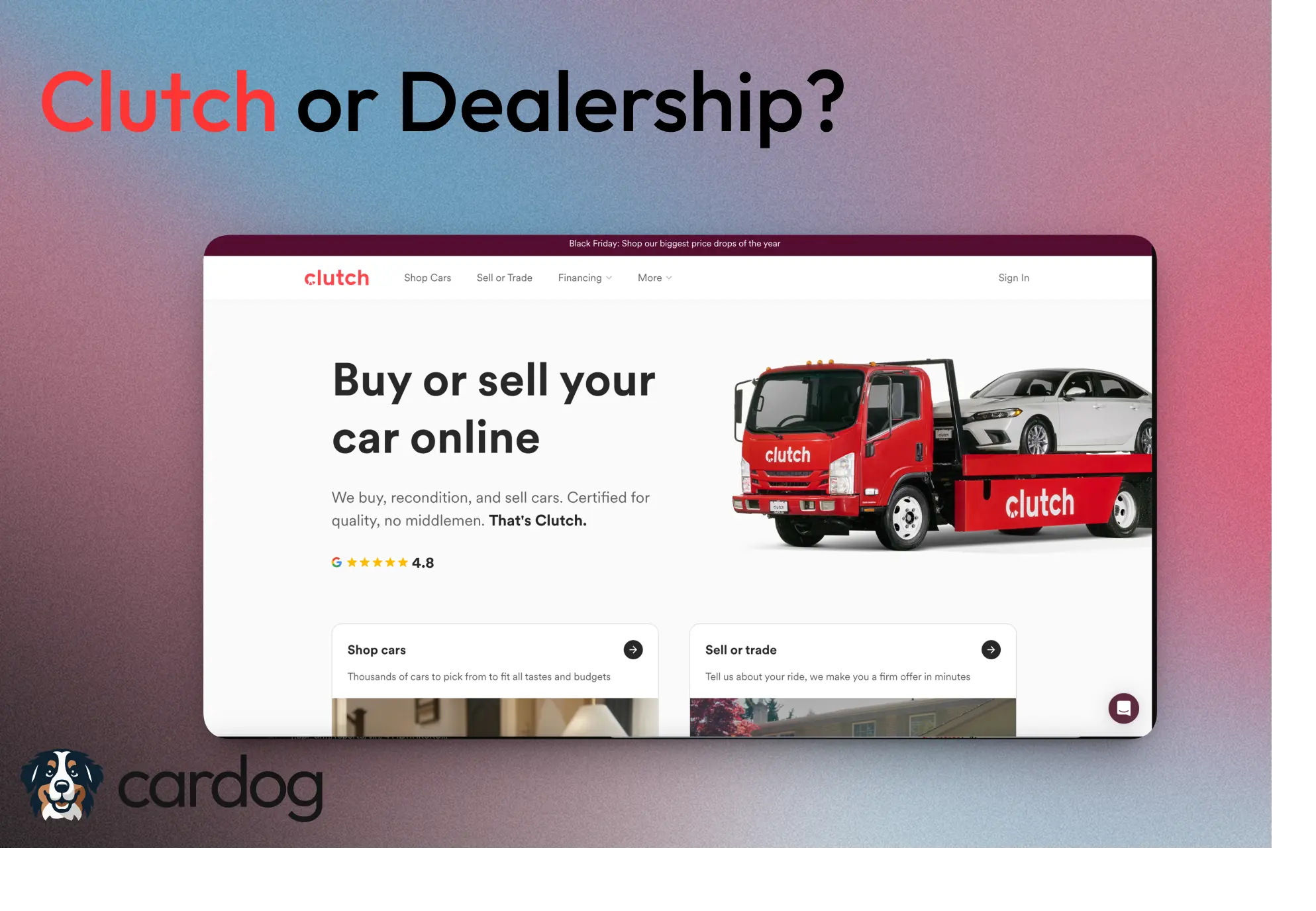
Clutch operates fundamentally differently from traditional dealerships. Rather than acting as an intermediary between buyers and sellers, Clutch purchases vehicles directly, reconditions them to certified standards, and sells them through an online-first platform with home delivery available.
The Clutch Buying Process
When you purchase from Clutch, you're buying from a single national retailer with standardized processes across their entire inventory. Every vehicle undergoes a comprehensive 210-point inspection and reconditioning process before listing. This includes mechanical inspection, cosmetic repairs, and replacement of worn components to meet Clutch's certification standards.
The buying experience happens almost entirely online. You browse inventory on Clutch's website or mobile app, review detailed vehicle information including inspection reports, and can arrange financing pre-approval before ever seeing the car. Once you've identified a vehicle, Clutch offers two options: home test drive and delivery (currently available in Ontario with expansion underway), or pickup at one of their facilities.
Current Clutch inventory includes 4,839 certified vehicles across 34 makes and 343 models. Popular selections reflect mainstream consumer preferences: Honda Civic (261 listings), Hyundai Elantra (184 listings), Honda CR-V (142 listings), and Toyota Corolla (127 listings). The average vehicle is priced around $26,673 with approximately 72,000 kilometres on the odometer.
Clutch's Cost Structure
Clutch's pricing model is built on transparency and simplicity. When you see a price listed, that's the price you pay—there's no negotiation, no hidden dealer fees, and no surprise charges at signing. The listed price includes:
- Purchase price of the vehicle
- Certification and reconditioning costs
- Ontario delivery (where available)
- Administrative processing
- 10-day money-back guarantee
- Basic warranty coverage
What you'll still pay separately are government-mandated costs that no seller can include: sales tax (HST/GST/PST depending on province), licensing fees, and registration. These are identical whether you buy from Clutch or a traditional dealer.
How Traditional Dealers Work: The Negotiation Model
Traditional dealerships operate on a fundamentally different business model. Most act as intermediaries, maintaining relationships with auction houses, trade-ins, and wholesale channels to source inventory. Some vehicles receive reconditioning, while others are sold "as-is" depending on the dealer's assessment of the vehicle and market conditions.
For more context on how traditional automotive marketplaces operate, see our guide on how AutoTrader works and explore CarGurus alternatives and AutoTrader alternatives for a comprehensive view of your options.
The Traditional Dealer Experience
When you visit a traditional dealership, you're entering a negotiation-based environment. The sticker price is rarely the final price—it's an opening offer in a back-and-forth process that can last hours. This process involves test drives, vehicle inspections (if you bring a mechanic), financing discussions, trade-in evaluations if applicable, and negotiation on both the vehicle price and additional products like extended warranties or protection packages.
Traditional dealers offer advantages that online platforms can't match: immediate vehicle access for inspections and test drives, face-to-face relationships with sales staff who can provide local market knowledge, ability to compare multiple vehicles in person at a single location, and established service departments for ongoing maintenance.
Inventory varies dramatically by dealer. A large-volume dealer might have 200-500 used vehicles on the lot at any time, while smaller independent dealers might maintain 20-50 vehicles. Quality, age, and condition vary widely—from certified pre-owned programs that rival Clutch's standards to as-is budget vehicles sold with no warranty.
Traditional Dealer Cost Structure
The traditional dealer cost structure is significantly more complex and often opaque. While the advertised price might appear lower than Clutch, additional fees add up quickly:
Common dealer fees in Canada:
- Documentation fee: $300-$695 (Ontario has no cap; some provinces cap this)
- Administration fee: $150-$400
- OMVIC fee (Ontario): $10
- Tire stewardship fee: $15-$25
- Air conditioning tax (some provinces): $100
- Dealer preparation/PDI: $0-$500 (sometimes included)
- Fuel charge: $50-$150
- Rust protection/paint protection (optional): $500-$1,500
- Extended warranty (optional): $1,000-$3,000
These fees can add $1,500-$3,000 to the final price before taxes. Some fees are legitimate costs of doing business, while others are profit centres for the dealership. Unlike Clutch's transparent pricing, you often don't see the full fee structure until you're at the financing desk ready to sign paperwork.
Cost Comparison: Real Market Data
To understand the true cost difference, we analyzed current market pricing for comparable vehicles across both channels. Here's what real buyers can expect to pay in late 2025:
| Cost Component | Clutch | Traditional Dealer |
|---|---|---|
| Average Sticker Price | $26,673 | $24,800 |
| Vehicle Condition | Certified, 210-point inspection | Varies (as-is to certified) |
| Documentation Fees | Included | $300-$695 |
| Admin Fees | Included | $150-$400 |
| Other Dealer Fees | Included | $200-$500 |
| Delivery/Pickup | $0-$500 (ON included) | $0 (pickup required) |
| Reconditioning Quality | Standardized nationwide | Varies by dealer |
| Warranty | Included basic coverage | Varies (often extra cost) |
| Money-Back Guarantee | 10 days | Rare (usually 24-72 hours if any) |
| Negotiation Required | No (fixed pricing) | Yes (expect 2-5% possible savings) |
| Time Investment | 1-2 hours online | 4-8 hours across visits |
| Total Pre-Tax Cost | $26,673-$27,173 | $26,950-$27,895 |
Key insight: While Clutch's sticker prices are 5-8% higher on average, the all-in cost difference narrows to just $500-$1,500 once dealer fees are included. For buyers who value time and convenience, Clutch often delivers better value even when the final dollar amount is similar.
Detailed Cost Analysis: Breaking Down Every Dollar
Purchase Price Differences
The sticker price is where traditional dealers appear to hold the advantage. Current market analysis shows comparable vehicles—similar make, model, year, and mileage—priced 5-12% lower at traditional dealers compared to Clutch.
Example: 2019 Honda Civic
- Clutch: $22,500 (certified, 68,000 km)
- Traditional dealer: $20,800 (as-is, 72,000 km)
- Traditional dealer (certified): $21,900 (71,000 km)
However, this gap narrows when you account for vehicle condition. Clutch's vehicles undergo comprehensive reconditioning, while "as-is" dealer vehicles may need immediate repairs. If the traditional dealer vehicle requires $800 in brake work and $400 in tire replacement—common items on vehicles around 70,000 km—the cost advantage evaporates.
Hidden Fees and Add-Ons
This is where traditional dealers' apparent price advantage often disappears. Canadian dealers add fees that aren't always disclosed in advertised prices:
Documentation and Administration Fees: Ontario has no cap on documentation fees, leading to charges of $595-$995 at some dealers. Other provinces cap these fees (BC caps at $599, Alberta at $525), but dealers often find creative ways to add additional charges.
Dealer-Installed Options: Paint protection, rust undercoating, nitrogen-filled tires, and fabric protection are common dealer add-ons. These products cost the dealer $50-$200 but sell for $500-$1,500. Many buyers don't realize these are optional and negotiate to remove them only late in the process.
Pre-Delivery Inspection: Some dealers charge $300-$500 for "dealer preparation" or "pre-delivery inspection" even on used vehicles. This fee compensates the dealer for cleaning and inspecting the vehicle—costs that Clutch includes in the listed price.
Real-world example from Ontario:
- Advertised price: $24,995
- Documentation fee: $695
- Admin fee: $295
- OMVIC fee: $10
- Tire stewardship: $20
- Fuel charge: $75
- Paint protection (presented as mandatory): $795
- Total added fees: $2,890
Final price before taxes: $27,885 (12.6% higher than advertised)
Clutch's pricing eliminates this fee layering. The price you see is the price you pay, aside from government taxes and registration—which are identical across all sellers.
Financing Costs
Financing represents the largest long-term cost for most buyers, and rates are similar across both channels.
Clutch financing: Rates range from 6.99% to 12.99% depending on credit profile, with most qualified buyers seeing 7.5-8.5%. Pre-approval is available online before you select a vehicle.
Traditional dealer financing: Rates range from 4.99% (promotional) to 12.99% depending on credit and dealer markup. Average rates are 7.0-8.5% for prime borrowers. Many dealers mark up financing rates—if approved at 6.5%, they might offer 7.5% and keep the difference.
Cost impact on a $25,000 vehicle over 60 months:
- At 6.99%: $4,603 interest | $493/month
- At 8.99%: $5,974 interest | $518/month
- Difference: $1,371 over the loan
Pro tip: Get pre-approved through your bank or credit union before shopping to establish a rate floor and prevent dealer markup.
Warranty and Protection Plans
Clutch warranty: Standard 90-day/3,000 km powertrain warranty covering engine, transmission, and drivetrain. Extended warranties available through insurance partners at competitive rates.
Traditional dealer warranties:
- CPO programs: 30 days to 3 months full coverage plus 1 year powertrain
- Independent dealers: Nothing (as-is) to 90-day powertrain
- Extended warranties: Often marked up 2-3x dealer cost ($1,200 cost sold for $2,500-$3,500)
Bottom line: For newer vehicles under 100,000 km, extended warranties rarely pay off statistically. Compare third-party providers rather than accepting the dealer's first offer.
Long-Term Ownership Costs
Depreciation: Both depreciate similarly once owned. Overpaying $2,000 at purchase means $2,000 more depreciation loss when you sell.
Maintenance quality: Certified vehicles need fewer repairs in the first 12-24 months. If Clutch replaces brakes and tires during certification, you avoid a $1,200 expense six months later.
Total Cost of Ownership Example (5-year ownership):
Clutch-purchased 2020 Honda Civic:
- Purchase + interest: $28,400
- Maintenance: $4,500 (minimal early repairs)
- Insurance: $7,500
- Total: $40,400
Dealer-purchased 2020 Honda Civic (as-is):
- Purchase + fees + interest: $29,000
- Maintenance: $5,800 (repairs needed earlier)
- Insurance: $7,500
- Total: $42,300
Clutch's better initial condition results in $1,900 lower cost over five years through reduced maintenance.
Which Model Offers Better Value?
The answer depends entirely on your priorities, financial situation, and risk tolerance. Neither Clutch nor traditional dealers offer universally superior value—the right choice varies by individual circumstances.
Choose Clutch If You Value:
Convenience and time savings: The entire purchase process happens online in 1-2 hours versus 4-8 hours across multiple dealer visits. For busy professionals or parents, this time saving alone justifies any small price premium.
Transparent pricing: Fixed pricing eliminates negotiation stress and ensures you're paying a fair market price without wondering if someone else got a better deal.
Quality assurance: Standardized 210-point inspection and reconditioning means you're getting a vehicle in known, documented condition. This reduces the risk of immediate post-purchase repairs.
Modern digital experience: If you prefer researching and buying online rather than in-person dealer visits, Clutch's platform offers a superior user experience.
Home delivery: For Ontario buyers (with expansion coming), having a vehicle delivered to your home for test driving and purchase is worth paying for if it saves you hours of travel to multiple dealers.
Choose Traditional Dealers If You Value:
Negotiation flexibility: If you're skilled at negotiating and willing to invest the time, you can often secure better pricing than Clutch's fixed rates—particularly on as-is vehicles where you're comfortable assessing condition yourself.
Maximum selection: While Clutch offers nearly 5,000 vehicles, traditional dealers collectively offer tens of thousands. If you're seeking something specific like a Mazda CX-5 in Montreal or Ford F-150 in Calgary, broader inventory access matters.
In-person evaluation: Some buyers need to see, touch, and thoroughly inspect a vehicle before committing. Traditional dealers offer immediate physical access for detailed inspection.
Established service relationships: Buying from a local dealer creates an ongoing relationship with their service department, which can be valuable for maintenance and warranty work.
Certified Pre-Owned programs: Manufacturer CPO programs at brand dealers often rival or exceed Clutch's certification standards while offering similar pricing—making them a competitive middle ground.
The Hybrid Approach
Many savvy buyers combine both channels: research pricing on Clutch to establish market benchmarks, then use that information to negotiate with traditional dealers. Armed with Clutch's transparent pricing, you can counter dealer add-ons by saying "this vehicle is listed for $X on Clutch, fully certified with delivery included—why should I pay $Y here?"
This approach gives you the benefit of Clutch's pricing transparency while maintaining access to traditional dealers' broader inventory and negotiation flexibility. Compare live market data for popular models like the Toyota Corolla or Hyundai Tucson to establish your baseline.
How Cardog Helps You Compare and Decide
Whether you're leaning toward Clutch's certified model or traditional dealer negotiation, making an informed decision requires comprehensive market intelligence—and that's where Cardog transforms the buying process.
Cardog acts as your AI-powered automotive analyst, aggregating real-time data from Clutch, traditional dealers, and private sellers across Canada. Rather than visiting multiple websites and spreadsheets to compare options, Cardog's platform provides instant market analysis for any vehicle you're considering.
Key capabilities:
- Cross-platform price comparison: See how Clutch pricing compares to traditional dealers for identical or similar vehicles in your area
- Fee breakdown analysis: Cardog flags typical dealer fees and helps you calculate true all-in costs, not just advertised prices
- Market value assessment: Understand if you're looking at a fair price, good deal, or overpriced listing based on real market data
- Vehicle history integration: VIN-level insights including accident history, ownership records, and maintenance predictions
- Financing cost modelling: Compare total cost of ownership across different purchase prices and interest rates
For buyers comparing Clutch to dealers, Cardog's intelligent search can identify which channel offers better value for your specific needs. Ask questions like "Should I buy this 2020 Honda Civic from Clutch for $23,500 or negotiate with a dealer?" and receive data-driven analysis incorporating fees, condition, and total cost projections.
Explore Cardog's market intelligence tools to make your next vehicle purchase with confidence.
Frequently asked questions