industry
What the BYD Seagull Will Actually Cost in Canada
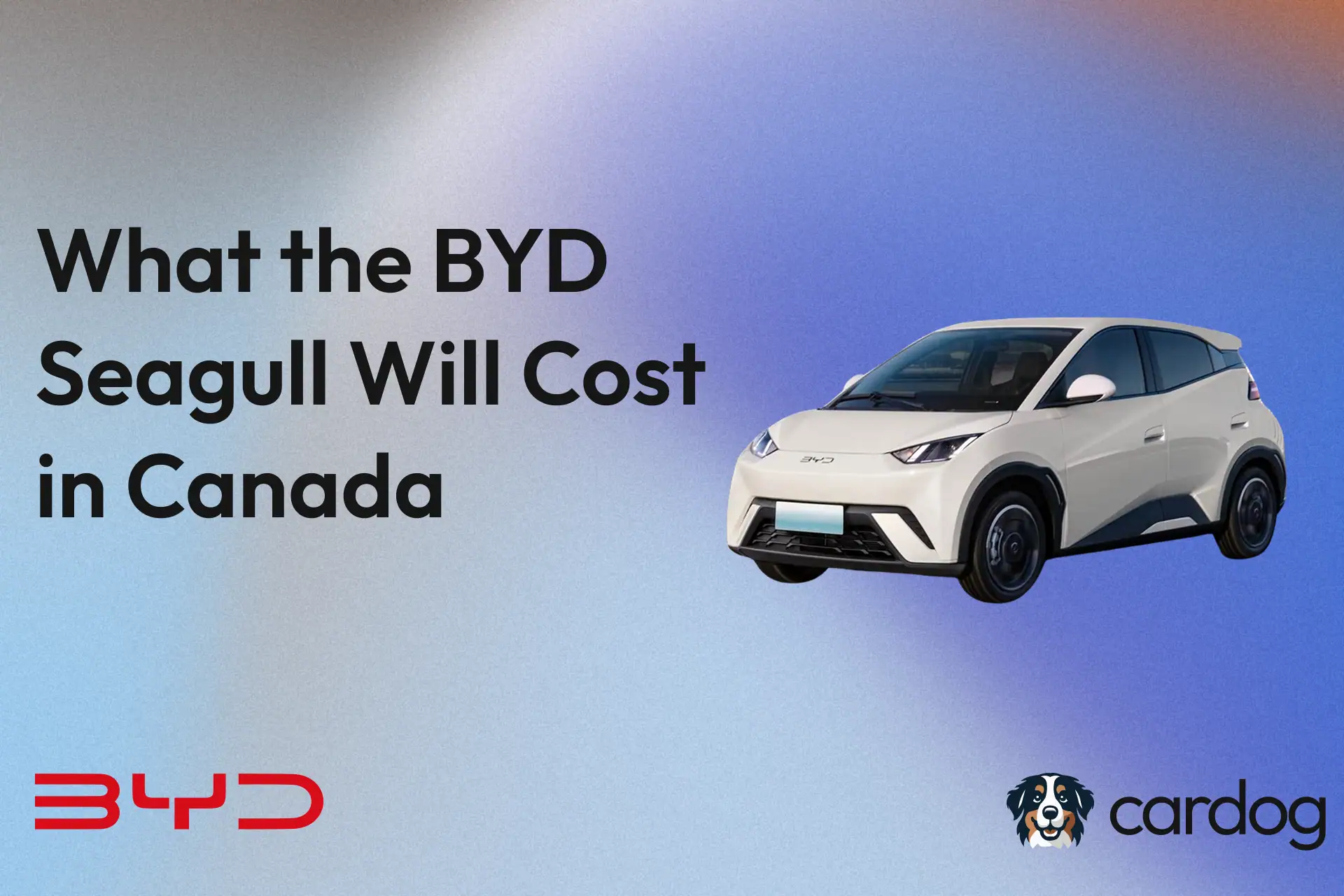
What the BYD Seagull Will Actually Cost in Canada
Update (February 26, 2026): The quota system is now official. Global Affairs Canada published Notice 1162 confirming the 6.1% tariff rate and 49,000 annual quota. Import permit applications open March 1, 2026.
The BYD Seagull starts at $7,800 USD in China. Headlines call it the "$10,000 EV that will disrupt the industry." Some coverage implies Canadians will soon buy EVs for under $15,000.
They won't.
We analyzed BYD's pricing across every market where they sell—China, Australia, UK, Germany, Thailand, Brazil—and built a model for what Canadian pricing will actually look like when vehicles arrive. The Seagull won't be $10,000. But it will still be the cheapest new EV in Canada by a significant margin.
The China Price Is Not Your Price
BYD's Chinese pricing reflects a brutally competitive domestic market where over 100 EV brands fight for share. In April 2025, BYD cut the Seagull's starting price to ¥56,800 ($7,800 USD)—a loss-leader move to maintain volume dominance.
Export markets are different. BYD charges more—sometimes dramatically more—when selling outside China.
| Model | China Price (USD) | Australia Price (CAD equiv.) | UK Price (CAD equiv.) | Export Markup |
|---|---|---|---|---|
| Seagull | $7,800 | $19,100 | N/A | +145% |
| Dolphin | $13,700 | $23,900 | $52,300 | +74–280% |
| Atto 3 | $15,400 | $31,900 | $45,000+ | +107–190% |
| Seal | $24,500 | $39,800 | $60,000+ | +63–145% |
Reuters analyzed BYD's global pricing and found they charge roughly 2x China prices on average in export markets. Australia is the cheapest; Europe is the most expensive (due to tariffs and VAT).
Canada will fall somewhere in between.
The Canadian Pricing Formula
To estimate Canadian prices, we need to account for:
- Base cost — China MSRP converted to CAD
- Shipping — RoRo vessel transport, China to Vancouver
- Tariff — 6.1% under the new quota system
- Compliance — Transport Canada homologation (amortized)
- Dealer margin — Standard automotive retail markup
Here's the math:
Shipping: $1,500–2,000 per vehicle
BYD operates its own car carrier fleet, which gives them cost advantages. But the China-to-Vancouver route still involves:
- RoRo freight: $1,000–1,500 USD
- Port handling and documentation: $200–400
- Insurance: ~0.5–1% of vehicle value
- Customs brokerage: $150–300
Realistic total: $1,500–2,000 CAD per vehicle
Tariff: 6.1%
Canada's new tariff-quota system dropped the rate from 100% to 6.1%—comparable to what Japanese and Korean imports face. This is the change that makes BYD's entry viable.
The quota allows 49,000 Chinese EVs annually, growing to 70,000 by year five. Critically, 50% of imports must be priced under $35,000 CAD. This effectively requires BYD to bring budget models first.
Dealer Margin: 15–18%
Canadian automotive retail typically runs 12–18% gross margin depending on segment. For a new brand building market share, expect margins at the higher end initially.
The Formula
Canadian MSRP ≈ (China price × 1.4 USD/CAD) + $1,500 shipping + 6.1% tariff + 16% dealer margin
This produces prices roughly 2.1–2.3x the China MSRP—consistent with BYD's pattern in other export markets.
Model-by-Model Canadian Pricing
BYD Seagull: $28,900–$35,900
The Seagull is BYD's entry-level city car. In China, it's smaller than a Honda Fit, with a 30–43 kWh battery offering 200–310 km of real-world range.
| Trim | China Price | Estimated CAD | Battery | Range (WLTP) |
|---|---|---|---|---|
| Essential | ¥56,800 ($7,800) | $28,900 | 30.1 kWh | ~200 km |
| Premium | ¥85,800 ($11,700) | $35,900 | 43.2 kWh | ~310 km |
Competitive context: The 2027 Chevrolet Bolt returns at $39,999 CAD. The Seagull undercuts it by $4,000–11,000 while offering a more modern interior and comparable range on the higher trim.
The catch: The Seagull is small. Really small. At 3,780 mm long, it's closer to a Fiat 500 than a Bolt. Canadian buyers expecting a "cheap Tesla" will find a city car better suited to urban commuting than highway road trips.
BYD Dolphin: $36,500–$42,900
The Dolphin is a compact hatchback—think Volkswagen Golf sized. This is likely BYD's volume play for Canada: big enough for suburban families, priced to compete directly with mainstream EVs.
| Trim | China Price | Estimated CAD | Battery | Range (WLTP) |
|---|---|---|---|---|
| Standard | ¥99,800 ($13,700) | $36,500 | 44.9 kWh | ~300 km |
| Premium | ¥129,800 ($17,800) | $42,900 | 60.5 kWh | ~420 km |
Competitive context: Tesla Model 3 starts around $42,000 CAD. The Dolphin Premium matches it on price while offering similar range in a hatchback format. The Standard trim undercuts every comparable EV on the market.
BYD Atto 3 (Yuan Plus): $47,900–$56,900
The Atto 3 is BYD's global bestseller—a compact crossover SUV that competes with the Hyundai Ioniq 5 and Kia EV6. It's the model most likely to appeal to Canadian suburban buyers.
| Trim | China Price | Estimated CAD | Battery | Range (WLTP) |
|---|---|---|---|---|
| Standard | ¥109,800 ($15,400) | $47,900 | 49.9 kWh | ~345 km |
| Premium | ¥139,800 ($19,600) | $52,900 | 60.5 kWh | ~420 km |
| AWD (2026) | ~¥160,000 ($22,400) | $56,900 | 74.9 kWh | ~520 km |
Competitive context: Hyundai Ioniq 5 starts around $50,000 CAD. The Atto 3 Standard undercuts it while offering similar specifications. The upcoming 74.9 kWh AWD variant would offer 520+ km range—competitive with anything in the segment.
BYD Seal: $53,900–$68,900
The Seal is BYD's answer to the Tesla Model 3—a mid-size sedan with performance aspirations. It's less likely to be a first-wave Canada model given the pricing overlap with established competitors.
| Trim | China Price | Estimated CAD | Battery | Range (WLTP) |
|---|---|---|---|---|
| Standard | ¥175,800 ($24,500) | $53,900 | 55 kWh | ~400 km |
| Premium | ¥199,800 ($27,900) | $61,900 | 65 kWh | ~500 km |
| Performance | ¥239,800 ($33,500) | $68,900 | 75+ kWh | ~550 km |
Competitive context: At these prices, the Seal competes directly with Tesla Model 3 Long Range and Model Y Standard. BYD's advantage is less clear here—Tesla's brand recognition and Supercharger network are significant in this segment.
What About the $35,000 Quota Requirement?
The Canada-China trade agreement requires that 50% of Chinese EV imports be priced under $35,000 CAD. This is a deliberate policy choice to ensure cheap EVs actually reach Canadian consumers rather than just premium models with higher margins.
For BYD, this means:
- Seagull — Both trims qualify
- Dolphin Standard — Qualifies
- Dolphin Premium — Does not qualify
- Atto 3 and above — Do not qualify
Expect BYD's initial Canadian lineup to emphasize the Seagull and Dolphin Standard. The quota math essentially mandates an affordable-first strategy.
Why Australia Prices Are Lower
BYD's Australian pricing is the lowest outside China. The Seagull (sold as Atto 1) starts at $23,990 AUD (~$19,100 CAD). Why?
- No tariff — Australia has no special duties on Chinese EVs
- Scale — BYD sold over 90,000 vehicles in Australia in 2024
- Competition — Aggressive pricing from MG, GWM, and other Chinese brands
- Established network — 90+ retail locations reduce per-unit distribution costs
Canada's 6.1% tariff, smaller initial volumes, and need to build dealer networks from scratch mean higher costs. Australian pricing is the floor, not the ceiling.
The European Warning
BYD's European pricing shows what happens when tariffs bite. The EU imposed a 27% total tariff on BYD vehicles in October 2024 (17% additional + 10% base).
Result: BYD Dolphin starts at €29,990 in Germany (~$45,500 CAD)—nearly double the Australian price.
BYD has responded by shifting focus to plug-in hybrids (not subject to EV tariffs) and accelerating their Hungary factory, which will produce tariff-free vehicles starting in 2026.
Canada's 6.1% tariff is closer to Australia than Europe. Prices will be higher than Australia but nowhere near European levels.
What This Means for the Canadian Market
The Seagull won't be $15,000. But $29,000 is still transformative.
No new EV in Canada currently starts under $35,000. The cheapest option—the Nissan Leaf—starts around $40,000 and is being discontinued. The returning Chevy Bolt will be $40,000.
A $29,000 Seagull would be:
- $11,000 cheaper than the Chevy Bolt
- $13,000 cheaper than the base Tesla Model 3
- The first genuinely affordable new EV for Canadian buyers
The Dolphin is the sleeper.
At $36,500, the Dolphin Standard offers 300 km range in a Golf-sized package. That's the price point where EV adoption goes mainstream—where a young family can buy an electric car without making a financial sacrifice.
Existing EVs will face pricing pressure.
When BYD arrives, every manufacturer will need to respond. Tesla has already cut prices repeatedly. Hyundai, Kia, and Volkswagen will need to decide whether to match or differentiate.
The biggest impact may be on the used EV market. Why buy a three-year-old Bolt for $25,000 when a new Seagull costs $29,000?
Timeline
Based on the Australian launch pattern and Canadian regulatory status:
| Phase | Expected Date |
|---|---|
| First imports (Seagull, Dolphin) | Q3 2026 |
| Dealer network expansion | Q4 2026 |
| Atto 3 availability | Q1 2027 |
| Volume sales | 2027 |
The 49,000 vehicle quota limits how fast BYD can scale. Don't expect Australian-style market dominance within three years. But even at quota-limited volumes, BYD will meaningfully expand affordable EV options for Canadian buyers.
The Bottom Line
The "$10,000 Seagull" is a China-only phenomenon. Canadian buyers will pay roughly 3x that price once tariffs, shipping, and margins are factored in.
But $29,000 for a new EV is still unprecedented in Canada. The Seagull won't disrupt the market the way breathless headlines suggest, but it will expand access to electric vehicles in ways that current options don't.
The math works. The regulatory pathway exists. The remaining questions are execution: Which dealers will carry the brand? How quickly can service infrastructure scale? Will Canadian winters expose battery limitations?
Those questions matter. But the pricing question—can BYD actually sell cheap EVs in Canada—has a clear answer: Yes, just not as cheap as China.
Pricing estimates based on BYD's published prices in China, Australia, UK, and EU markets; Reuters analysis of BYD export pricing patterns; Canadian tariff-quota terms announced January 2026; and standard automotive shipping and retail margin assumptions.