guides
VIN Decoder Guide: What Your Vehicle Identification Number Reveals
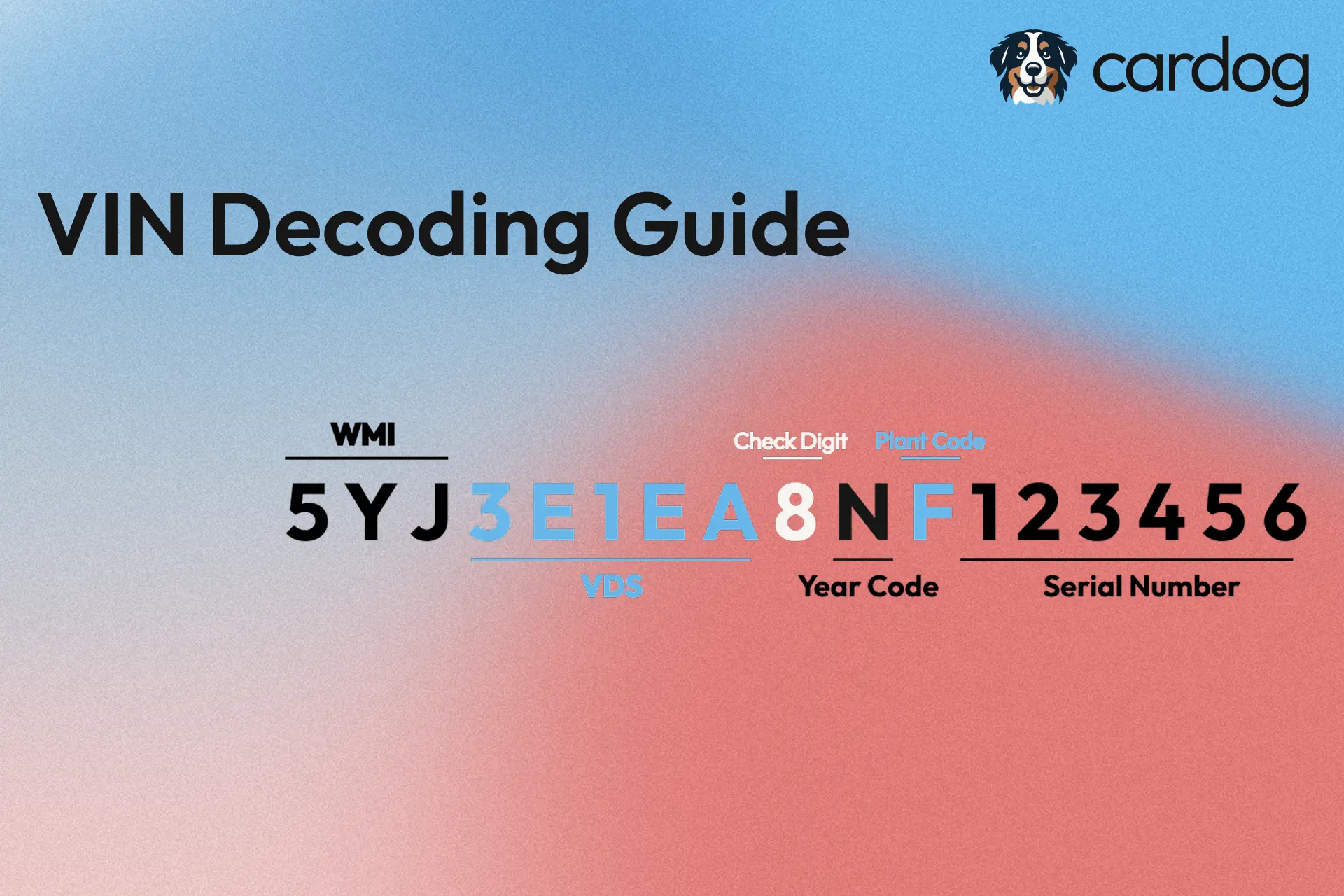
Every car, truck, and motorcycle built for the North American market since 1981 carries the same thing: a 17-character Vehicle Identification Number. It's not a random serial number. It's a structured, position-by-position record of who built the vehicle, where, when, and roughly how it was equipped — readable by anyone who knows where to look.
This guide shows you exactly that: what each position means, how to read the manufacturer code, how the built-in error check works, and — just as important — where a VIN's usefulness ends.
The short version
A VIN packs five kinds of information into 17 characters:
| What you learn | Where it lives |
|---|---|
| Country, manufacturer, and vehicle type | Positions 1–3 (WMI) |
| Body style, engine, trim, restraints, drivetrain | Positions 4–8 (VDS) |
| A math check that flags typos | Position 9 (check digit) |
| Model year and assembly plant | Positions 10–11 |
| The unit's serial number | Positions 12–17 |
A few rules hold for every VIN:
- It is always 17 characters — letters and numbers, not just digits.
- The letters I, O, and Q never appear anywhere in a VIN, because they're too easy to confuse with 1 and 0.
- Position meanings are fixed. The 10th character is always the model year; the 9th is always the check digit.
You'll find your VIN at the base of the windshield on the driver's side, on the driver's door-jamb sticker, and on your title, registration, and insurance card.
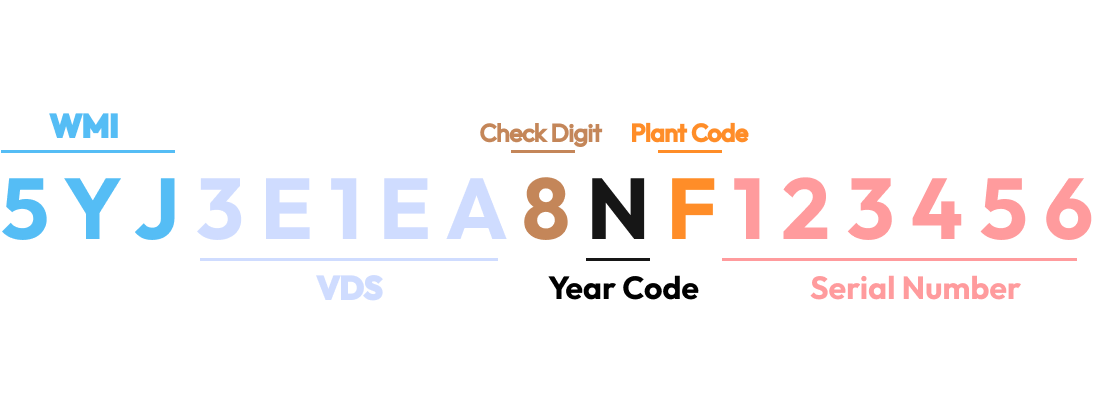
The three sections of a VIN
The standard splits the 17 characters into three blocks, each with a different job.
Positions 1–3 — World Manufacturer Identifier (WMI)
The first three characters are the WMI: who built the vehicle and where. This is the part most people get wrong, so here's how it actually breaks down:
- Position 1 — country/region of the plant. This single character tells you where the vehicle was assembled. It is not just a "region" with the country hiding in position 2 — the country is encoded right here in character one.
- Positions 1–2 together — the manufacturer. The first two characters as a pair are assigned to a specific automaker by the regional authority (SAE administers this for North America).
- Position 3 — the manufacturer's vehicle type or division (passenger car vs. truck vs. bus, or a specific brand division).
So in 1HG, the 1 means United States, 1H means Honda, and 1HG means a Honda passenger car built in the U.S. The three characters are read together as one code, not as three independent fields.
Position 1 — common country codes:
| Code | Country |
|---|---|
1 4 5 | United States |
2 | Canada |
3 | Mexico |
9 | Brazil |
J | Japan |
K | South Korea |
L | China |
S | United Kingdom |
V | France / Spain |
W | Germany |
Y | Sweden / Finland |
Z | Italy |
6 | Australia |
Some WMIs you'll see often:
| WMI | Maker (and where) |
|---|---|
1HG / 2HG / JHM | Honda — U.S. / Canada / Japan |
1FA / 1FT | Ford — car / truck (U.S.) |
1G1 / 1GC | Chevrolet — car / truck (U.S.) |
5YJ / 7SA | Tesla — Fremont / Austin |
LRW | Tesla — Shanghai |
4T1 / JTD | Toyota — U.S. / Japan |
KMH | Hyundai — South Korea |
WBA | BMW — Germany |
WDD / W1K | Mercedes-Benz — Germany |
WVW / 3VW | Volkswagen — Germany / Mexico |
One exception worth knowing: small manufacturers (fewer than 1,000 vehicles a year) get a
9in position 3, and their full identity spills into positions 12–14. So for low-volume makers, the WMI alone won't pin down the brand.
Positions 4–8 — Vehicle Descriptor Section (VDS)
This is where the vehicle's specs live. Each automaker designs its own code for these five positions and files it with NHTSA, so the same letter means different things for a Ford than for a Toyota. Decoded against the right manufacturer pattern, positions 4–8 reveal:
- Body style (sedan, SUV, pickup, coupe)
- Engine family and displacement
- Trim level or series
- Restraint/airbag configuration
- Drivetrain (FWD, RWD, AWD, 4WD)
Because these patterns are manufacturer-specific, there's no universal lookup table for the VDS — you need the maker's filing (or a decoder that has it) to read it correctly.
Position 9 — the check digit
A single calculated character that validates the whole VIN. It carries no vehicle information; it exists purely to catch typos. We break down the math further down.
Positions 10–17 — Vehicle Identifier Section (VIS)
The last eight characters cover when and the unit's identity.
Position 10 — model year. A 30-character cycle that skips ambiguous letters. Recent codes:
| Code | Year | Code | Year |
|---|---|---|---|
K | 2019 | P | 2023 |
L | 2020 | R | 2024 |
M | 2021 | S | 2025 |
N | 2022 | T | 2026 |
The codes repeat every 30 years (an A means 1980 or 2010), so the model year is read together with the rest of the VIN — a 1990s body style won't be confused with a 2020s one in practice.
Position 11 — assembly plant. A manufacturer-assigned code for the specific factory. Tesla, for example, uses F for Fremont, A for Austin, and B for Berlin.
Positions 12–17 — serial number. The unit's sequential build number, typically reset each model year at each plant.
Decode a VIN, character by character
Two worked examples — both with valid check digits — to show how the pieces fit.
Tesla Model 3 — 5YJ3E1EA0NF123456
| Pos | Char | Meaning |
|---|---|---|
| 1–3 | 5YJ | Tesla, built in the United States (WMI) |
| 4 | 3 | Model 3 |
| 5 | E | Sedan body |
| 6 | 1 | Restraint-system configuration |
| 7 | E | Electric propulsion |
| 8 | A | Single-motor (RWD) |
| 9 | 0 | Check digit |
| 10 | N | 2022 model year |
| 11 | F | Fremont, California plant |
| 12–17 | 123456 | Serial number |
Honda Civic — 2HGFC2F59KH123456
| Pos | Char | Meaning |
|---|---|---|
| 1–3 | 2HG | Honda passenger car, built in Canada (WMI) |
| 4–5 | FC | Civic line |
| 6 | 2 | Body configuration |
| 7 | F | Engine family |
| 8 | 5 | Trim / restraint configuration |
| 9 | 9 | Check digit |
| 10 | K | 2019 model year |
| 11 | H | Alliston, Ontario plant |
| 12–17 | 123456 | Serial number |
What a VIN can — and can't — tell you
A VIN is a factory spec sheet, not a life story. It's precise about how a vehicle left the line and silent about what happened after.
It reliably tells you:
- Make, model, model year, body style, and factory drivetrain
- Country of origin and assembly plant
- Open and completed safety recalls (via NHTSA and Transport Canada)
- Enough about the configuration to value the vehicle accurately
It does not tell you:
- Options and aftermarket changes — VINs encode standard equipment, not the upgraded stereo, towing package, or wheels a previous owner added.
- Maintenance and repair history — service quality and intervals don't live in the VIN.
- Condition — wear, unreported damage, and mechanical health need eyes and a mechanic.
- Accident or title history — the VIN is the key that unlocks those reports, but the events themselves come from insurance, registration, and police databases, not the number itself.
Check any VIN for open recalls free with Cardog's recall lookup tool, and get a configuration-aware price with the vehicle valuation tool.
Where to find your VIN
On the vehicle:
- Base of the windshield, driver's side — visible from outside; the primary spot police check.
- Driver's door jamb — a sticker with the VIN plus tire pressures and the build date (month/year).
- Engine block and frame rail — stamped directly into metal; locations vary by maker.
On paper: the title, registration, insurance card, service records, and (for newer cars) the window sticker.
When you're buying, confirm the VIN matches across every location. A windshield plate that disagrees with the door-jamb sticker or the title is a red flag — mismatched fonts, fresh rivets, or scratched characters can point to a swapped plate or a rebuilt-title vehicle.
Free vs. paid decoders
Free gets you the factory facts:
- NHTSA's decoder (
vpic.nhtsa.dot.gov/decoder) returns make, model, year, plant, and standard equipment at no cost. - Cardog's recall tool adds open-recall checks across U.S. and Canadian databases.
Paid history reports (Carfax, AutoCheck) use the VIN to pull what the number itself can't hold — accident claims, title brands (salvage, flood, rebuilt), odometer readings over time, and owner count. Buy one before any serious used purchase.
The check digit: how a VIN catches its own typos
Position 9 is a built-in error check, designed in an era when VINs were read aloud over the phone and typed by hand. The math:
- Convert each character to a number. Digits are themselves; letters map on a wrapping scale —
A–H= 1–8, thenJ–Rpick up at 1–9 again, thenS–Zcontinue. (SoJis 1, not 10.) - Multiply each position by a fixed weight:
8 7 6 5 4 3 2 10 0 9 8 7 6 5 4 3 2. Position 9 gets weight 0 — the check digit can't validate itself. - Sum the products and take the result modulo 11.
- The remainder is the check digit. A remainder of 10 is written as
X.
This catches every single-character substitution — change any one character and the math no longer lands on the printed check digit — plus the large majority of cases where two characters get swapped. It runs before any database lookup, so a fat-fingered VIN gets rejected instantly. (Credit-card numbers use a similar trick.)
For a full worked calculation, see our deep dive on what a VIN is and how it works.
Under the hood: where decoders get their data
Most VIN decoders are built on NHTSA's VPIC database. Before a vehicle can be sold in the U.S., its manufacturer files a "565 submittal" — a technical document that includes the VIN patterns for that model and year. The U.S. is unusual in publishing this data freely, which is why VPIC became the backbone of the industry.
But VPIC isn't the whole picture. Its coverage is thin exactly where modern buyers care most: EV specifics, exact trims, optional equipment, and vehicles built for markets outside the U.S. are often missing or incomplete. Manufacturers design their own VDS codes, so a decoder is only as good as the patterns it has collected. The best ones augment VPIC with manufacturer documentation and registry data to fill those gaps — which is exactly what our optimized Corgi VIN decoder is built to do.
How Cardog uses VINs
Every listing on Cardog is enriched from its VIN, so you compare vehicles on what they actually are — not just a make and model:
- Verified specs — drivetrain, engine, and trim resolved from the VIN, not the seller's description.
- Recall status — surfaced inline with links to the underlying NHTSA and Transport Canada notices.
- True comparables — pricing that accounts for configuration differences, so an AWD trim isn't averaged against a base FWD one.
- Market position — where each vehicle sits against similar builds, flagging genuine deals and overpriced listings.
Browse the explore pages to see VIN-aware filtering in action, or run any VIN through the recall lookup tool.
Frequently asked questions