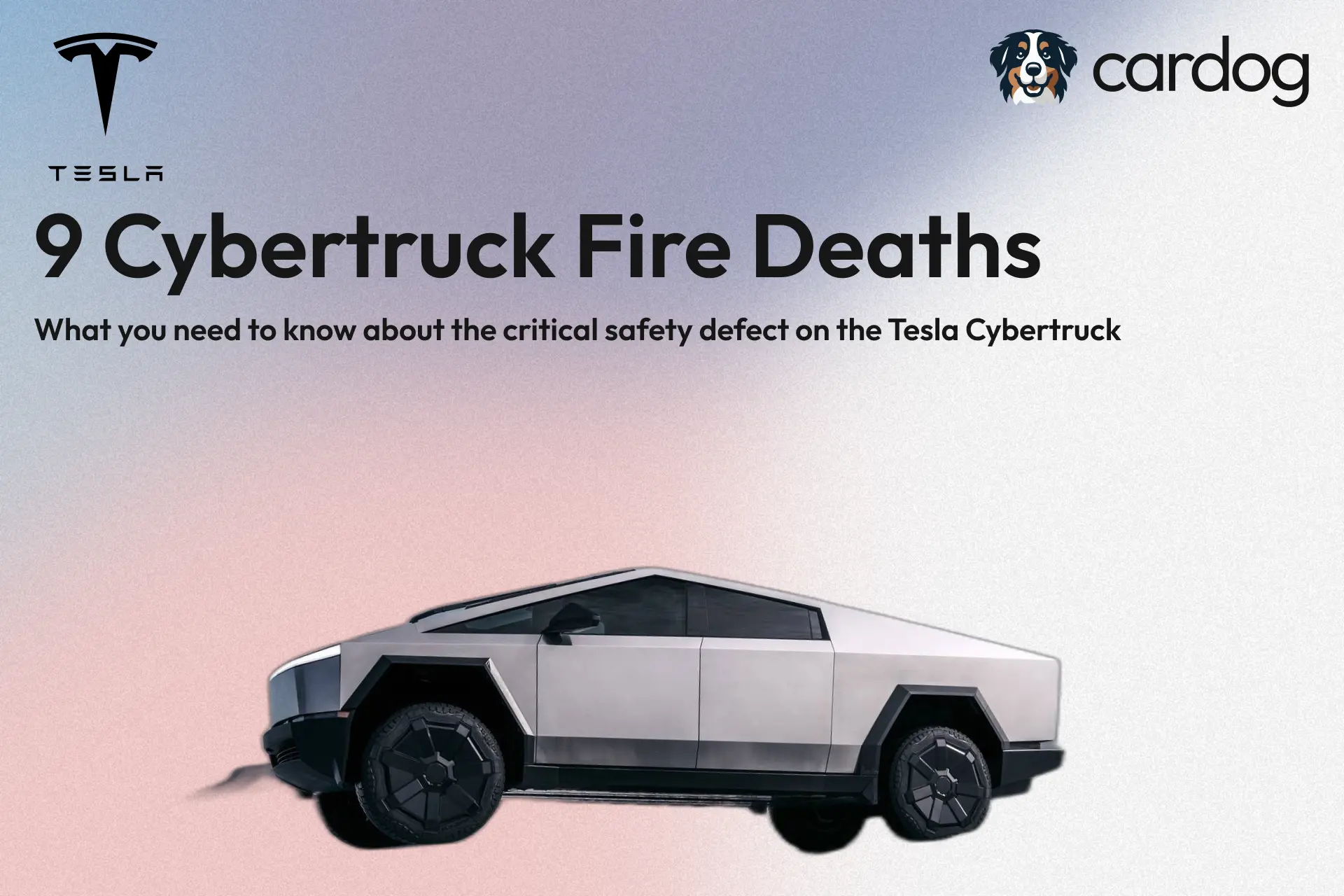
Tesla Cybertruck Door Failures: 9 Deaths Reported, Electronic Systems Trap Occupants During Fires
⚠️ CRITICAL SAFETY ISSUE
Problem: Tesla Cybertruck doors operate electronically via buttons. When the 12V auxiliary battery fails after a crash, these doors cannot open from inside or outside.
Manual Release: Rear doors have manual releases hidden beneath removable panels in the door pockets—not practical to locate in smoke, heat, and panic.
Consequence: Multiple NHTSA complaints describe occupants trapped inside burning vehicles after crashes, unable to escape.
The Tesla Cybertruck has been on sale since late 2023. Through December 2025, NHTSA's complaint database has recorded 9 deaths across 138 filed complaints. For context, the best-selling Ford F-150 2018 model year—with hundreds of thousands of vehicles on the road—has 4 deaths reported across 2,476 complaints filed over seven years.
This isn't about total sales numbers or statistical models. This is about a specific, recurring failure mode described in multiple complaints: occupants trapped inside burning vehicles because electronic door systems fail after crashes, and manual backup releases are either hidden, unknown, or inaccessible in emergency conditions.
We analyzed 2.15 million safety complaints filed with NHTSA from 2015 to present to understand how the Cybertruck's door design compares to other vehicles and whether this represents a systemic safety issue.
Cybertruck complaint summary (2024-2025):
- 138 total complaints filed
- 9 deaths reported (6.5% of complaints mention deaths)
- 27 complaints involve crashes
- 3 complaints involve fires
- First complaints filed: April 2024
The Failure Mode: What Actually Happens
From filed NHTSA complaints, a clear pattern emerges. Here's what happens in a Cybertruck crash involving fire:
1. Initial Impact The vehicle experiences a collision. Occupants may be conscious and uninjured from the crash itself.
2. Electrical System Failure The crash damages or disconnects the 12-volt auxiliary battery that powers the door opening mechanisms. This is the small battery that runs accessories—separate from the main high-voltage battery.
3. Door Systems Stop Working
- Interior electronic door buttons: Non-functional
- Exterior electronic door buttons: Non-functional (no exterior handles exist)
- Automatic door opening after crash: Non-functional
4. Fire Starts The high-voltage battery or other components catch fire. Occupants are conscious and attempting to exit.
5. Manual Release Problem The manual door releases exist but are effectively unusable:
- Front doors: Manual release is visible above the electronic button, but many occupants don't know it exists
- Rear doors: Manual release is hidden beneath a removable panel at the bottom of the door pocket—not feasible to find or use in smoke and heat
6. Rescuers Cannot Help Even if someone outside wants to help:
- No exterior door handles exist
- Electronic buttons on B/C pillars don't work without power
- The "armor glass" windows are extremely difficult to break
Real Complaint: Three Deaths in One Crash
From NHTSA Complaint ID [redacted], filed regarding a Cybertruck crash:
"On [DATE], [NAME] sat in the left rear-seat of a Cybertruck that was involved in a solo-vehicle collision. [NAME]'s impact injuries were minor. The truck caught fire. The right rear door remained mechanically openable, but its ordinary operation depended on low-voltage electronic buttons located inside the cabin and on the exterior pillar. Those buttons failed after the crash.
A man tried to rescue the occupants, but he could not open the doors because the buttons failed and the truck lacks exterior handles. The 'armor' glass made it difficult for the rescuer to break open the windows. The mechanical backup releases for the rear doors are concealed beneath the map pocket liner at the bottom of the doors — not feasible to find or use in the smoke, heat and chaos of a post-crash fire.
This obscure release left the rear seat occupants with no practical means of egress. [NAME] died of smoke inhalation and burn injuries because he was trapped inside the Cybertruck. Another occupant and the driver also died."
Three people died in a crash where at least one occupant survived the initial impact uninjured.
Another Complaint: Front Seat Survivor, Rear Seat Death
From a second NHTSA complaint describing a separate crash:
"[NAME] was a right rear passenger in a 2024 Cybertruck. The driver lost control and struck a tree with the driver side against a wall. The truck immediately caught fire. The operation of the doors was powered by a small battery pack which was no longer operational after the impact.
The design of the electric doors required passengers who are not familiar with the vehicle to find the location of a manual release hidden from view beneath a panel to remove that panel and pull the manual release mechanism. There are no instructions present to explain to a passenger how to access the manual release.
The truck has no exterior door handles. The only means to open the door from the outside was a button located at the base of the B&C pillars. When the electric system failed, that door release button became useless. A rescuer arrived but had no way to open the passenger side doors from the outside. The truck's 'armor glass' windows made forcing entry extraordinarily difficult.
The rescuer was able to break the passenger side window with repeated strikes and attempted to rescue [NAME] by extracting her through the front passenger window but was unsuccessful due to the heat from the fire. She was forced to retreat back to the rear seat. She survived the initial collision with no injuries and was fully conscious. She was unable to escape the Cybertruck and was killed due to smoke inhalation and thermal injuries."
Tesla's Defense: The Manual Release Exists
Tesla's position, as stated in owner's manuals and public communications, is that manual door releases exist and owners should familiarize themselves with their locations.
Front doors: The manual release is a mechanical lever located above the electronic door button. It's visible and relatively accessible.
Rear doors: From the Tesla Cybertruck owner's manual:
"The mechanical release for the rear doors is located under the mat at the bottom of the door pocket. Remove the mat, locate the mechanical release cable, and pull it forward to manually unlock and open the door."
Tesla argues this meets safety standards and provides adequate emergency egress.
The Problem with "Manual Releases Exist"
The complaints describe real-world emergency conditions where the manual release design failed:
1. Discoverability
Passengers unfamiliar with the vehicle—friends, family members, ride-share users—have no indication that a hidden release exists or where to find it. There are no visible instructions inside the vehicle.
2. Smoke and Fire Conditions
Even if you intellectually know the rear release exists, finding and operating it requires:
- Locating the door pocket mat at floor level while sitting or crouching
- Removing the mat (which may be covered in belongings, debris, or difficult to grip)
- Finding the cable mechanism underneath
- Pulling it forward with adequate force
This must happen while smoke fills the cabin, heat intensifies, visibility drops to zero, and panic sets in.
3. Passenger Position
Rear seat passengers must reach down to floor level, away from the door they're trying to open, to access the release. In a crash with injuries or restricted movement, this may be physically impossible.
4. Rescuer Access
The lack of exterior door handles means rescuers cannot help even if they want to. Breaking the reinforced "armor glass" takes repeated impacts with specialized tools. By the time entry is forced, occupants may have already succumbed to smoke inhalation.
Comparing to Other Vehicles
Traditional vehicles have mechanical door handles that work regardless of electrical system status. You pull the handle, the latch disengages mechanically, the door opens.
Many modern vehicles use electronic door systems, but with critical differences:
Tesla Model S/X/3/Y:
- Electronic primary release
- Visible mechanical release accessible without removing panels
- Rescuers can break standard automotive glass more easily
Other EVs (Rivian, Lucid, Polestar):
- Electronic doors with manual backups
- Backup releases marked with labels or illuminated indicators
- Standard automotive glass
The Cybertruck's unique combination:
- Electronic-only normal operation
- Hidden rear manual releases requiring panel removal
- No exterior handles at all
- Reinforced glass extremely difficult to break
- 12V battery vulnerable to crash damage
Death Rate Comparison
We analyzed NHTSA complaints for death reports by vehicle to understand how the Cybertruck compares:
Deaths per complaint (2015-2024 model years):
- Tesla Cybertruck (2024-2025): 0.0652 (9 deaths / 138 complaints)
- Tesla overall: 0.0217 (420 deaths / 19,310 complaints)
- Ford F-150 2018: 0.0016 (4 deaths / 2,476 complaints)
- Toyota overall: 0.0021 (46 deaths / 22,156 complaints)
- Ford overall: 0.0009 (67 deaths / 77,481 complaints)
Note: These are deaths REPORTED in complaints, not official fatality statistics. Not all deaths result in complaints, and not all complaints are verified.
The Cybertruck's death rate in complaints is 3x higher than Tesla's already-elevated overall rate, and 30x higher than Ford's overall rate.
To put this in perspective:
- 6.5% of Cybertruck complaints mention deaths
- 2.2% of Tesla overall complaints mention deaths
- 0.2% of Toyota complaints mention deaths
- 0.1% of Ford complaints mention deaths
This isn't a minor statistical variation—it's a pattern that suggests specific failure modes unique to the Cybertruck's design. The recurring theme in death complaints: occupants trapped due to door system failure during post-crash fires.
What Needs to Change
Several automotive safety experts and complaint filers have suggested improvements:
1. Visible Manual Release Instructions
Permanent labels or illuminated markings showing rear passengers where manual releases are located and how to use them.
2. Exterior Mechanical Handles
Backup mechanical handles accessible from outside when electronic systems fail, allowing rescuers to assist.
3. Automatic Door Unlocking After Crash
Many vehicles automatically unlock doors and lower windows after detecting a severe impact, even if electrical systems are damaged. This uses capacitors or backup power.
4. Standard Automotive Glass
Replace or supplement "armor glass" with glass that can be broken using standard emergency tools.
5. 12V Battery Protection
Better shielding or redundant power systems for the auxiliary battery that controls doors.
What Current Owners Should Do
If you own or regularly travel in a Cybertruck:
1. Know Your Manual Releases
Front seats: Locate the mechanical release lever above the electronic button. Practice using it so you can find it without looking.
Rear seats: Remove the door pocket mat and locate the mechanical release cable. Practice pulling it so you know the required force and motion.
2. Brief Every Passenger
Before anyone rides in your Cybertruck, show them:
- Where the manual releases are located
- How to remove the rear door pocket mat
- How to pull the rear door cable release
Make this part of your routine, like showing someone where the seatbelt buckle is.
3. Keep Emergency Tools Accessible
Store a spring-loaded window breaker within reach of all occupants. Position them where passengers can grab them even in smoke or darkness.
4. Consider Glass Film
Some owners have applied safety film to interior glass surfaces to make them breakable in emergencies while maintaining the "armor glass" exterior appearance. (Check if this affects warranty.)
5. Park Outside
Until Tesla addresses the fire risk concerns raised in multiple complaints, consider parking outside rather than in attached garages—especially if charging overnight.
Check Your Vehicle for Recalls
While this specific door design issue hasn't been officially recalled, other Cybertruck problems have triggered recalls. Check your VIN for active recalls:
- Go to Cardog's recall checker
- Enter your 17-character VIN
- Review active recalls and safety bulletins
- Verify completion status with your dealer
The database covers both NHTSA and Transport Canada recalls.
The Broader Issue: Electronic Everything
The Cybertruck represents an extreme case, but it's part of a broader trend: vehicles replacing mechanical controls with electronic systems. Door handles, gear selectors, window switches—more components now depend on electrical power.
This creates single points of failure in emergencies. When crash damage takes out a critical electrical system, multiple safety functions can fail simultaneously.
Industry standards haven't caught up: There's no federal requirement that electronic door systems must have easily accessible manual backups. There's no standard for how visible or usable those backups must be.
The Cybertruck's door system likely meets current federal motor vehicle safety standards. The complaints suggest those standards aren't sufficient.
The Bottom Line
Nine deaths across 138 complaints (6.5% death rate) for a vehicle available less than two years is statistically extreme. The Cybertruck's death rate per complaint is 30x higher than Ford's overall rate and 3x higher than Tesla's already-elevated rate.
The recurring pattern—occupants trapped by door system failures during post-crash fires—suggests a design problem, not random bad luck.
Tesla's argument that manual releases exist is technically correct but practically insufficient. Emergency egress systems must be:
- Discoverable by unfamiliar passengers
- Usable in smoke, heat, and panic conditions
- Accessible by rescuers from outside
- Reliable even when electrical systems fail
The current Cybertruck door design fails most of these criteria for rear passengers.
Until Tesla implements changes—either voluntarily or through regulatory action—Cybertruck owners and passengers should thoroughly familiarize themselves with manual release locations and procedures. In an emergency, knowing where that hidden cable is located might be the difference between life and death.
Analysis based on NHTSA complaint database (2.15 million complaints analyzed). All quoted complaints are filed with NHTSA and publicly accessible. Check any vehicle's safety complaints at cardog.app/tools/recalls.
Disclaimer: NHTSA complaints represent owner reports and are not verified by federal agencies. Not all reported deaths are officially attributed to vehicle defects. This analysis examines patterns in reported complaints to identify potential safety concerns.