Hyundai Files VIN Guide for Ioniq 5 Robotaxi—Built in Singapore, Bound for Las Vegas
Hyundai Files VIN Guide for Ioniq 5 Robotaxi—Built in Singapore, Bound for Las Vegas
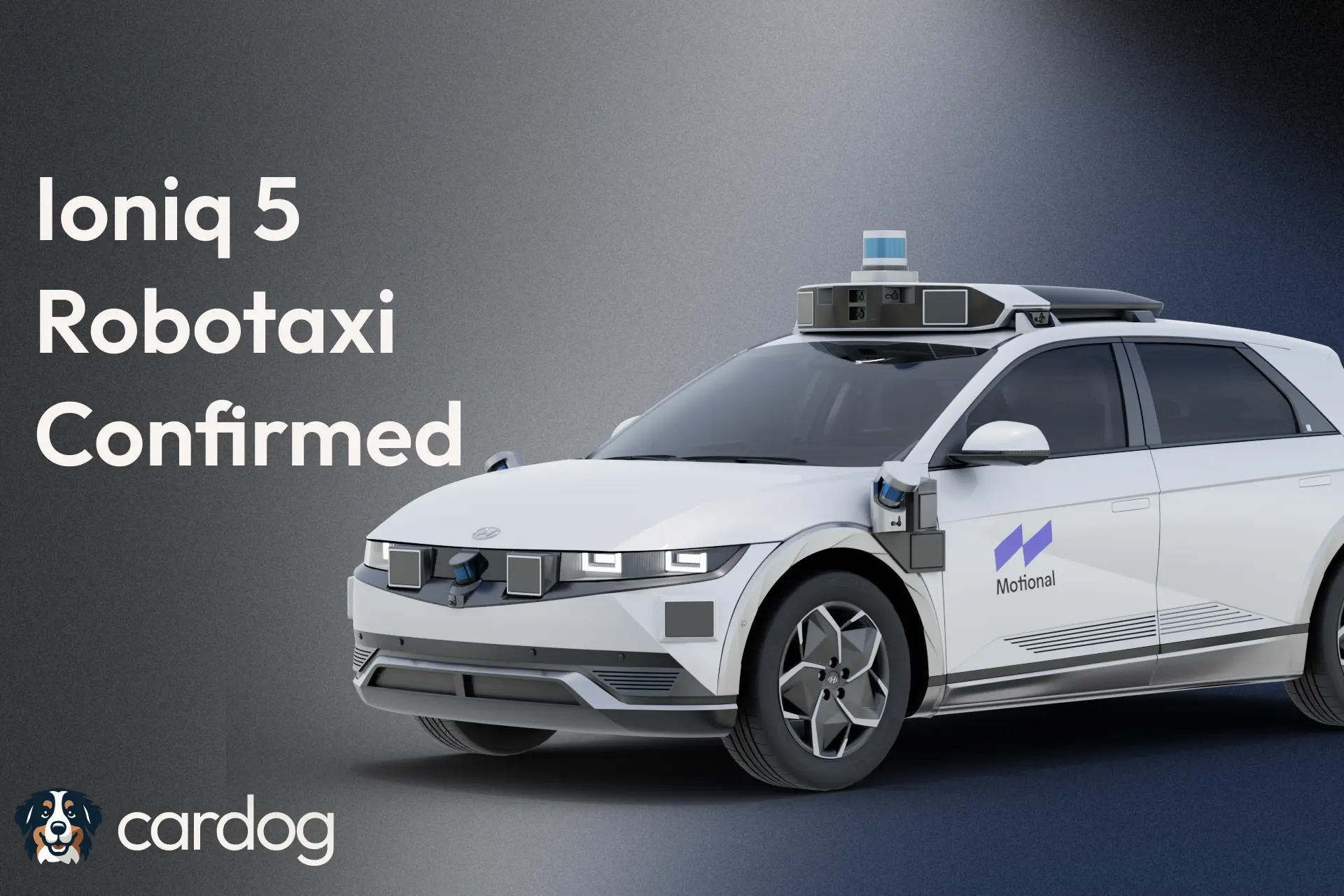
A VIN decoding guide submitted to NHTSA on September 26, 2025 confirms that Hyundai has registered a distinct Robotaxi variant of the 2026 Ioniq 5, built at its Singapore smart factory for deployment in the United States.
What the Filing Shows
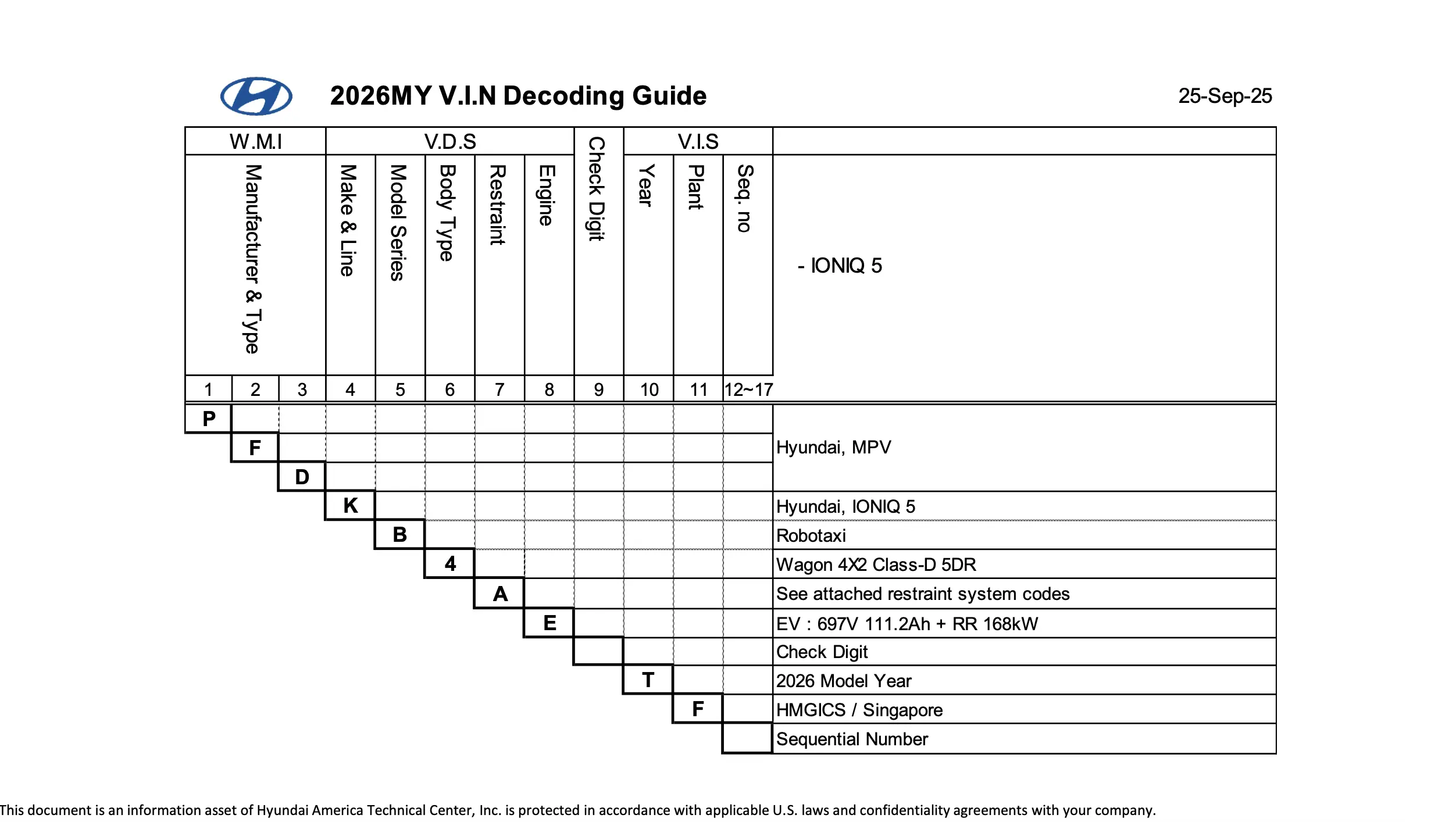
The document, submitted by Hyundai America Technical Center (HATCI) pursuant to 49 CFR 565, includes VIN position codes for the 2026 model year Ioniq 5. Position 5 (Model Series) includes code "B" designated specifically as "Robotaxi"—separate from the standard consumer Ioniq 5.
| VIN Position | Code | Meaning |
|---|---|---|
| 1–3 (WMI) | PFD | Hyundai, MPV |
| 4 (Make & Line) | K | Hyundai, Ioniq 5 |
| 5 (Model Series) | B | Robotaxi |
| 6 (Body Type) | 4 | Wagon 4X2 Class-D 5DR |
| 8 (Engine) | E | EV: 697V 111.2Ah + RR 168kW |
| 10 (Model Year) | T | 2026 |
| 11 (Plant) | F | HMGICS / Singapore |
The powertrain specification—697V system with 111.2Ah battery and 168kW rear motor—matches the standard Ioniq 5. The Robotaxi variant uses existing EV architecture with autonomous hardware integration.
Singapore Manufacturing
Plant code "F" designates HMGICS—Hyundai Motor Group Innovation Center Singapore—the company's smart manufacturing facility in the Jurong Innovation District.
HMGICS opened in November 2023 as Hyundai's testbed for advanced manufacturing. The 86,900 square meter facility uses cell-based production rather than traditional conveyor lines, with approximately 50% of tasks performed by 200 robots working alongside human operators.
The facility has capacity for 30,000 vehicles annually and currently produces the Ioniq 5, Ioniq 5 Robotaxi, and Ioniq 6.
Hyundai announced in 2023 that the Ioniq 5 Robotaxi would be manufactured at HMGICS and deployed for Motional's commercial services in the United States. The robotaxi was one of the first SAE Level 4 autonomous vehicles certified under U.S. Federal Motor Vehicle Safety Standards (FMVSS).
Motional Background
Motional is Hyundai's autonomous driving joint venture, originally formed in 2020 as a 50-50 partnership with Aptiv PLC at a $4 billion valuation.
In May 2024, Aptiv reduced its stake from 50% to 15% after announcing it would stop funding the venture. Hyundai purchased Aptiv's 11% common equity stake for $448 million and invested an additional $475 million in operating capital. With subsequent funding rounds, Hyundai now controls approximately 86% of Motional.
The company has logged over 130,000 autonomous rides in Las Vegas through partnerships with Uber, Lyft, and Via—all with human safety operators present.
Las Vegas Commercial Launch
At CES 2026, Motional announced plans to launch fully driverless Level 4 robotaxi service in Las Vegas by the end of 2026.
The timeline includes:
- Early 2026: Supervised pilot operations with safety operators, open to Motional employees
- Mid-2026: Public pilot service through ride-hailing partner (expected to be Uber or Lyft)
- Late 2026: Fully driverless commercial service without safety operators
Motional CEO Laura Major stated the company has rebuilt its autonomous system around a "Large Driving Model" approach—a hybrid architecture combining traditional rule-based software with end-to-end AI for motion planning.
The Ioniq 5 Robotaxi sensor suite includes 13 cameras, 11 radars, and 5 LiDARs for 360-degree perception.
Competitive Context
The robotaxi market in the United States is currently dominated by Waymo, which operates fully driverless services in San Francisco, Los Angeles, Phoenix, and Austin, with plans to expand to over two dozen cities by the end of 2026.
GM's Cruise suspended operations in late 2023 following a pedestrian incident and remains sidelined. Tesla has announced robotaxi intentions but has not launched commercial service.
At CES 2026, Nvidia announced a robotaxi partnership with Mercedes-Benz targeting Q1 2026 launch.
Motional's competitive positioning emphasizes factory integration—the autonomous hardware is installed on Hyundai's Singapore production line rather than retrofitted after manufacturing—which the company claims improves scalability and cost efficiency compared to competitors.
Long-Term Strategy
Hyundai has stated that robotaxi deployment is "stop number one" in a broader autonomy strategy. The company intends to feed Motional's operational data, AI models, and driving experience into its software-defined vehicle (SDV) architecture for eventual integration into consumer vehicles.
Hyundai's in-house software unit 42dot is developing a separate autonomous system called Atria AI for the company's SDV platform, scheduled for deployment on a "pace car" in Q3 2026.
The VIN filing indicates the Robotaxi variant is now a production-registered vehicle type for the U.S. market, distinct from the consumer Ioniq 5 and subject to separate tracking in federal safety databases.
Source: 2026MY V.I.N Decoding Guide submitted to NHTSA by Hyundai America Technical Center, Inc., dated September 26, 2025.