How to Import a BYD into Canada
How to Import a BYD into Canada
You can't. Here's why - and what I found when I tried to understand the system.
At Cardog, we build software that helps people understand vehicles - VIN decoders, market data, that sort of thing.
In late 2025, I tried to test a simple workflow: import a Chinese electric vehicle into Canada. BYD. The world's largest EV manufacturer. They make the Seal, the Dolphin, the Seagull - cars that outsell Tesla in China and are spreading across Europe, Australia, Southeast Asia.
I entered a valid BYD VIN into the Registrar of Imported Vehicles - Canada's federal portal for processing vehicle imports.
Error. Unknown vehicle.
I tried another BYD. Same thing. NIO. XPeng. Nothing worked.
That's when I started filing Access to Information requests.
Over three months, I filed 15 ATIs. I asked for policies, databases, agreements, surveillance plans, budget documents, VIN decoder guides, manufacturer applications. I asked who's in charge and under what authority.
What I found is that Canada's vehicle safety system doesn't work. It was never designed for what's happening now. And the Canadian government can't explain its own process.
This is everything I learned.
I — The Portal
The Registrar of Imported Vehicles
Every vehicle entering Canada goes through the Registrar of Imported Vehicles (RIV). You enter a VIN. The system tells you what the car is - make, model, year, specifications. It checks whether the vehicle meets Canadian standards. Basic stuff.
I entered a valid BYD VIN.
The system couldn't decode it.
I filed ATI request A-2025-00674 asking what database Transport Canada uses for VIN decoding.
The answer came from Stephanie Claros, a manager in TC's Access to Information office:
TC relies on vPIC data for VIN breakdown information.
vPIC is the Vehicle Product Information Catalog. It's run by NHTSA - the U.S. National Highway Traffic Safety Administration. It's an American database, built for American vehicles, maintained by the American government.
See, vPIC is quite familiar to us at Cardog. We built Corgi on top of it. It powers over 1 million VIN decodes per day and is completely free and works fully offline.
Canada doesn't have its own VIN database. We use America's.
And America's doesn't cover Chinese manufacturers.
What Happens When vPIC Doesn't Have It
I asked the obvious follow-up: What happens when vPIC doesn't have the information?
We might use another online source or ask the manufacturer directly.
They Google it. Or they call the company they're supposed to be regulating and ask nicely.
I filed A-2025-00713 specifically asking about TC's reliance on American databases - vPIC, NHTSA's complaint database, the Fatality Analysis Reporting System (FARS). I asked for formal agreements, internal policies on US data reliance, risk assessments, and procedures for handling vehicles present in Canada but absent from US databases.
The response was one page:
"No records were found."
Transport Canada has no formal agreement with NHTSA for data sharing. No internal policy on relying on American data. No risk assessment for what happens when that data doesn't exist. No documented procedure for handling vehicles the Americans don't track.
They've been using American data for decades. Nobody wrote down why or what to do when it fails.
II — The Carfax Emails
A Subscription to Virginia
On February 20, 2026, I received 23 pages of internal Transport Canada documents in response to ATI A-2025-00674.
I expected policy documents, maybe a contract with a data provider. What I got was email chains.
In January 2021, Trevor Lehouillier - the data owner for TC's complaint database - confirmed internally that Transport Canada subscribes to Carfax.
Carfax. The American company. Headquartered in Centreville, Virginia. The one that runs TV ads about used car histories.
The Canadian government pays Carfax for vehicle data.
The Cold Email
It gets better.
In October 2021, Jeremy Hamilton - Transport Canada's Head of Recalls - sent a cold email to Carfax:
We are working on a regulatory project relating to VIN-based recall information. Would Carfax be interested in discussing a potential partnership?
The head of recalls for the Canadian government was cold-emailing an American company asking for help.
The Outage
In November 2023, Carfax had an outage with their British Columbia data provider. TC staff emailed each other about it:
Keep this in mind when running reports.
When Carfax goes down, Transport Canada is affected. The Canadian government's ability to track vehicle safety depends on the uptime of an American company's data feed from a BC provider.
III — Barbara Browne and the 74 Pages
The Three Characters
Every car sold in Canada needs a World Manufacturer Identifier - the first three characters of every VIN. WMI codes are how you know a vehicle was made by Toyota or Ford or BYD. Without a WMI, you can't build a valid VIN. Without a valid VIN, you don't have a car. Can't register it, can't insure it, can't recall it.
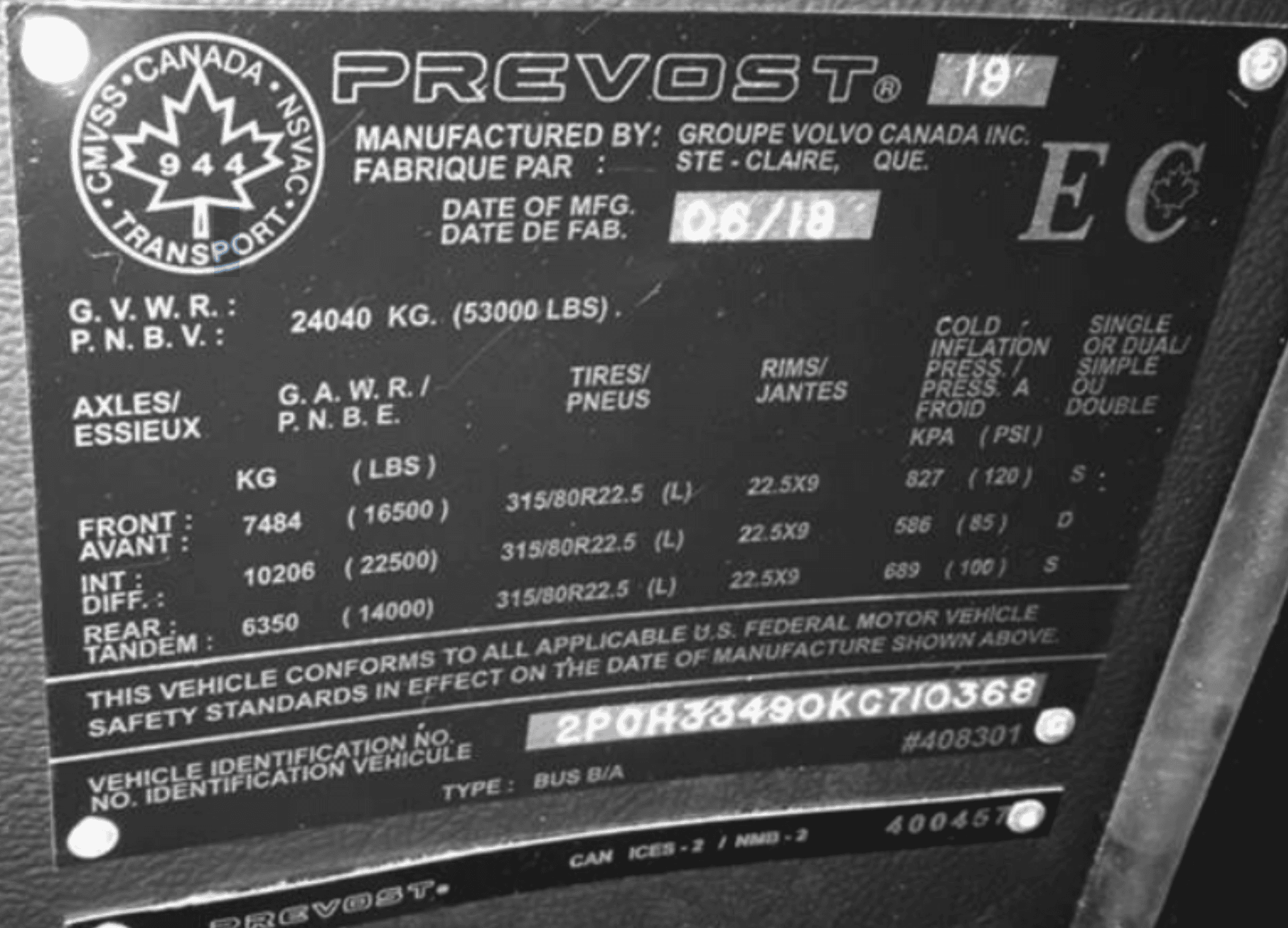
I filed an ATI asking who assigns WMI codes in Canada and under what authority.
What I received was 74 pages of Transport Canada losing its mind.
I'm going to walk you through the emails in chronological order. These are real government communications, released under Access to Information request A-2025-00724. I have the PDFs.
November 14, 2023: The Question
It starts with Jeremy Hamilton, Acting Chief of Importation and Audit Inspection at Transport Canada. He sends an email to Nathalie Peloquin, Director of Motor Vehicle Regulation Enforcement.
Subject line: "CVMA - Hosting the WMI database."
Hello Nathalie,
I had a call with Brian Kingston and Barbara Browne at the CVMA this afternoon about the world manufacturer identifier (WMI) database that they host.
Background: While I don't have the entire history, a long time ago, the CVMA agreed to be the coordinator for issuing WMIs and hosting the WMI database. TC has always accepted and reviewed applications, then sent the info to the CVMA to issue a WMI.

Jeremy Hamilton doesn't have the entire history. Nobody does. That's the problem.
November 14, 2023: The First Search
That same afternoon, Nathalie Peloquin forwards Jeremy's email up the chain to Melanie Vanstone and Stacey Coburn. She flags it as a potential discussion item for director-level meetings.
She quotes the regulation that embeds this arrangement:
MVSS Section 115, subsection 11 contains the following line about WMI issuance:
(11) Manufacturers of vehicles in respect of which this section applies shall apply to the Canadian Vehicle Manufacturers' Association for the characters referred to in paragraphs 3(a) and (g) that uniquely identify the manufacturer, make and class of vehicle.
The regulation literally tells manufacturers to contact CVMA - a private trade association - to get their codes. It's in the law.
But why? Who decided this? Under what authority was a lobbying group given control of market access?
Nathalie starts looking:
Note that Jeremy is also trying to find if there are any TC-CVMA procedures - but we don't think anything exists, but to our knowledge, at this point, nothing exists. Jeremy has been scanning old versions of the reg (now dating back to 1998) and the same text appears there too.
Nothing exists.
November 16, 2023: Reaching Out to the Executive Director
Two days later, Nathalie emails Ibrahima Sow, the Executive Director of Road Safety and Vehicle Regulations. She's escalating.
Given that CVMA is a private entity, there would have been an official decision (BN to Minister) and possible an MOU and/or contractual agreement signed with TC for the administration of the program. Would you and your group have anything on file for this?
Could someone search and provide me with an answer by Monday end of the day? Do we have background info, decision, RIAS, MOU or anything that we could use to understand how this became a legal requirement? As you can see this is time sensitive.
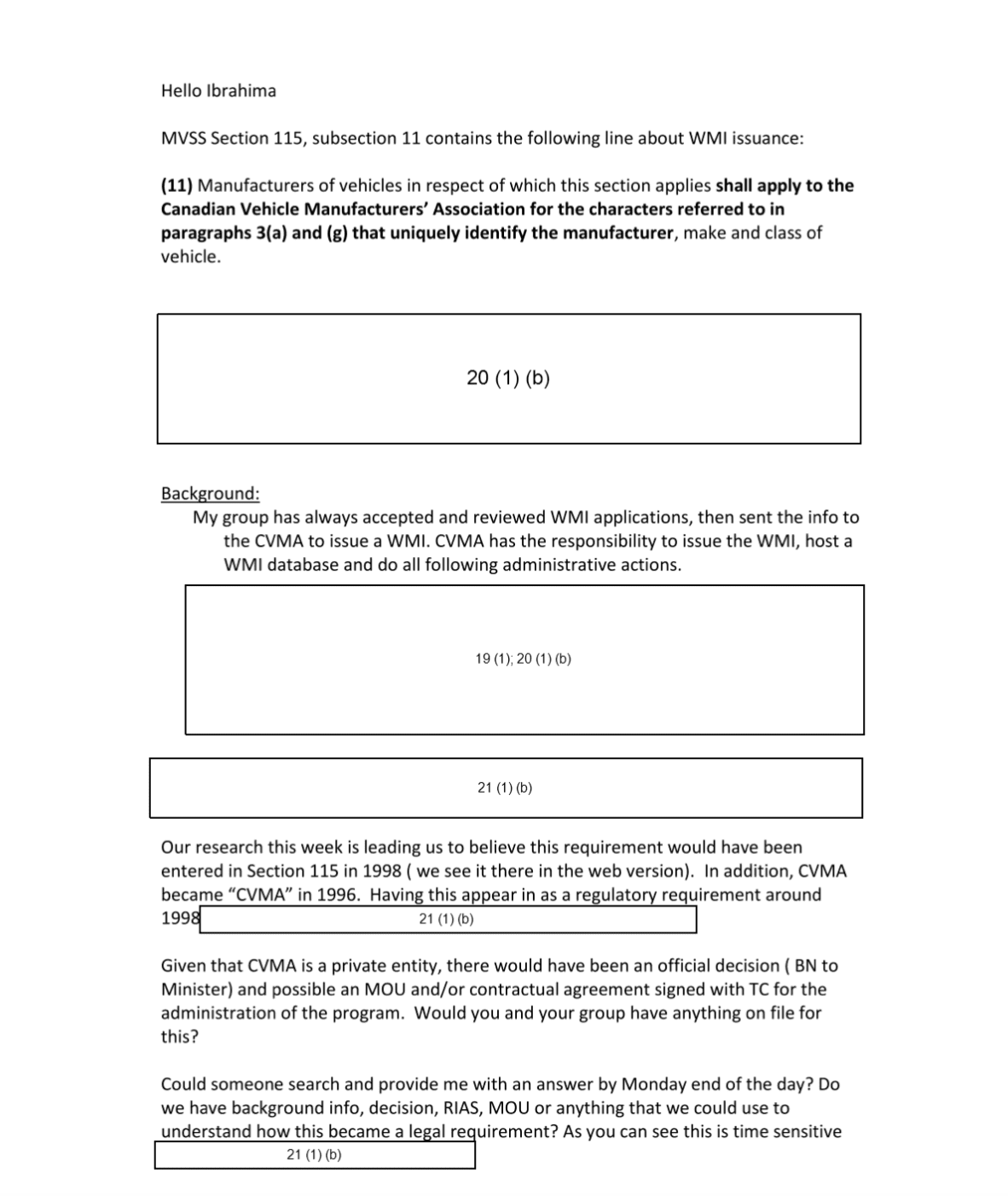
Time sensitive. They need to understand their own regulatory framework.
Ibrahima's response:
Hi Nathalie
I am copying Anthony on this. I am not sure we have anything on this. But Anthony will check.
At first glance, did anybody from your team look in rdims for BNs? If anything on RIAS that could perhaps be found via Legal.
Will check and revert
The Executive Director of Road Safety and Vehicle Regulations is not sure they have anything on this.
November 16, 2023: The RDIMS Search
Nathalie reports back to Melanie and Stacey:
Hello Melanie and Stacey
We have looked on our side and talked to Nadine. Unfortunately, there is no background or additional information that can be found.
We are assuming that the existence of a contractual agreement or MOU would date back to anytime between 1996 and 1996. This assumption is based on the fact that CVMA became 'CVMA' in 1996. The earlier mention in the reg of them administering this program appears to be 1998.
A MOU or contractual agreement with a private entity would have been reviewed by Legal I believe. They keep their files for a long time, maybe Rachel should be consulted? In addition, Ibrahima may be aware of some background, a MOU or decision to add this to the Regulation would (should?) have been kept somewhere by the regulatory group.
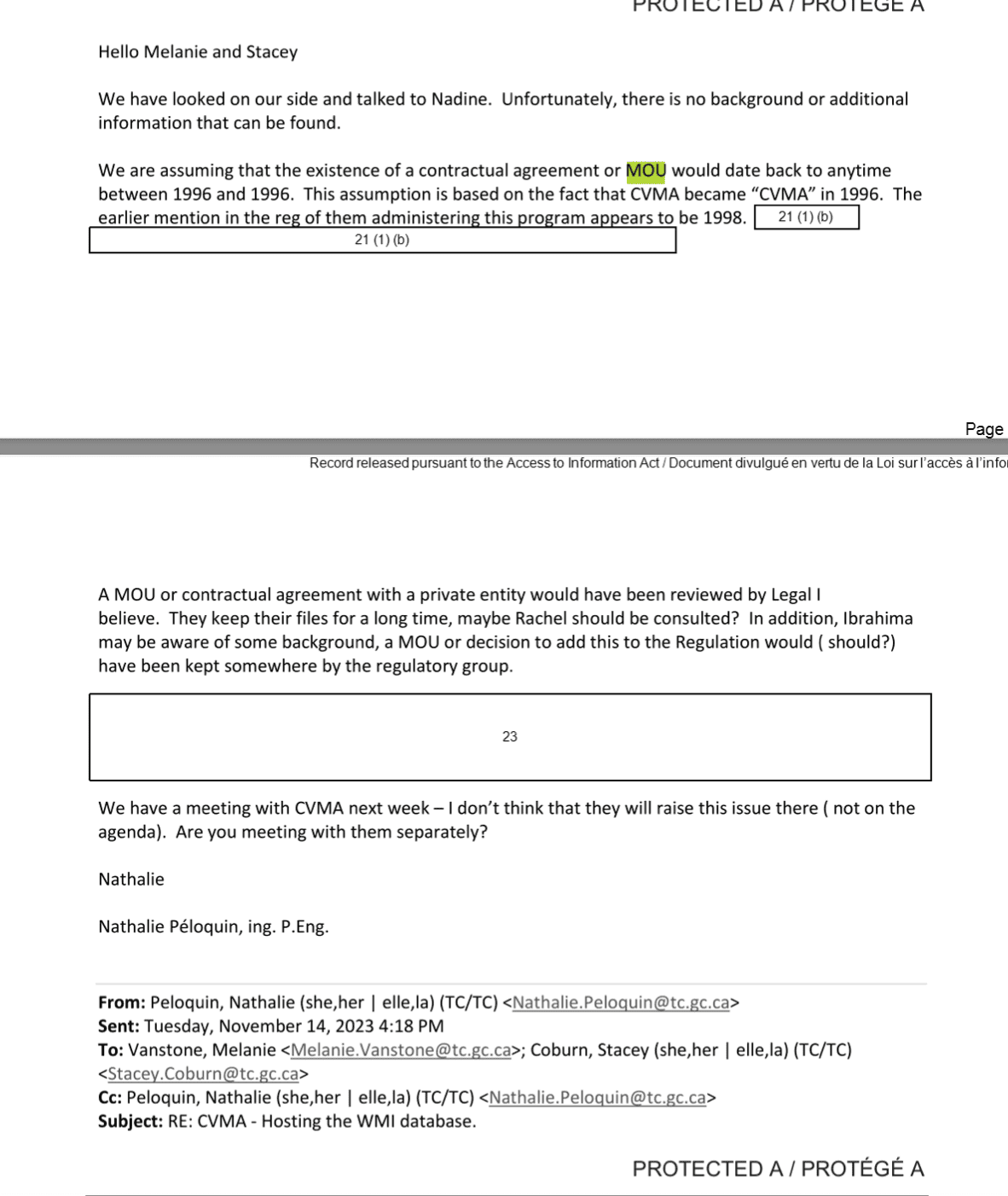
"Should have been kept somewhere." It wasn't.
November 20, 2023: The Canada Gazette Archives
Anthony Jaz, from the regulatory team, reports his findings:
Nathalie,
We looked through the Canada Gazette archives and found that this issue, who gives out WMI, dates back to at least 1982 (see SOR/DORS/82-753). At that time, the CVMA was called the 'Motor Vehicle Manufacturer's Association'. The requirement to contact them was in the regulations.
The Canada Gazette, Part I (SOR/DORS/97-532) publication referenced below, amended the 'Motor Vehicle Manufacturer's Association' to 'Canadian Vehicles Manufacturers' Association'. With the comment administrative next to the change. All this amendment did was update their name, there was no change to the requirements.
At this moment it has been at least 40 years that the CVMA has had this responsibility, and we will look in our paper archives later this week if we can find anything earlier than 1982.
Forty years. The CVMA has controlled WMI assignment for forty years. And nobody can explain why.
Nathalie asks the obvious question:
That's great info Anthony. Thanks
You could not find any TC-CVMA MOU that would highlight the roles and responsibilities?
Anthony's response:
We have to look in our paper docs and maybe even pull out archives to see if there is anything, since in 1982 it was already in place, and it could have been earlier.
They're going to check the paper archives.
November 21, 2023: Summary to Leadership
Nathalie summarizes the situation for senior leadership:
Hello Melanie and Stacey,
See below and update for Anthony and Ibrahima.
In short:
- This requirement has been in the regs since at least 1982 (and maybe earlier).
- No MOU could easily be found.
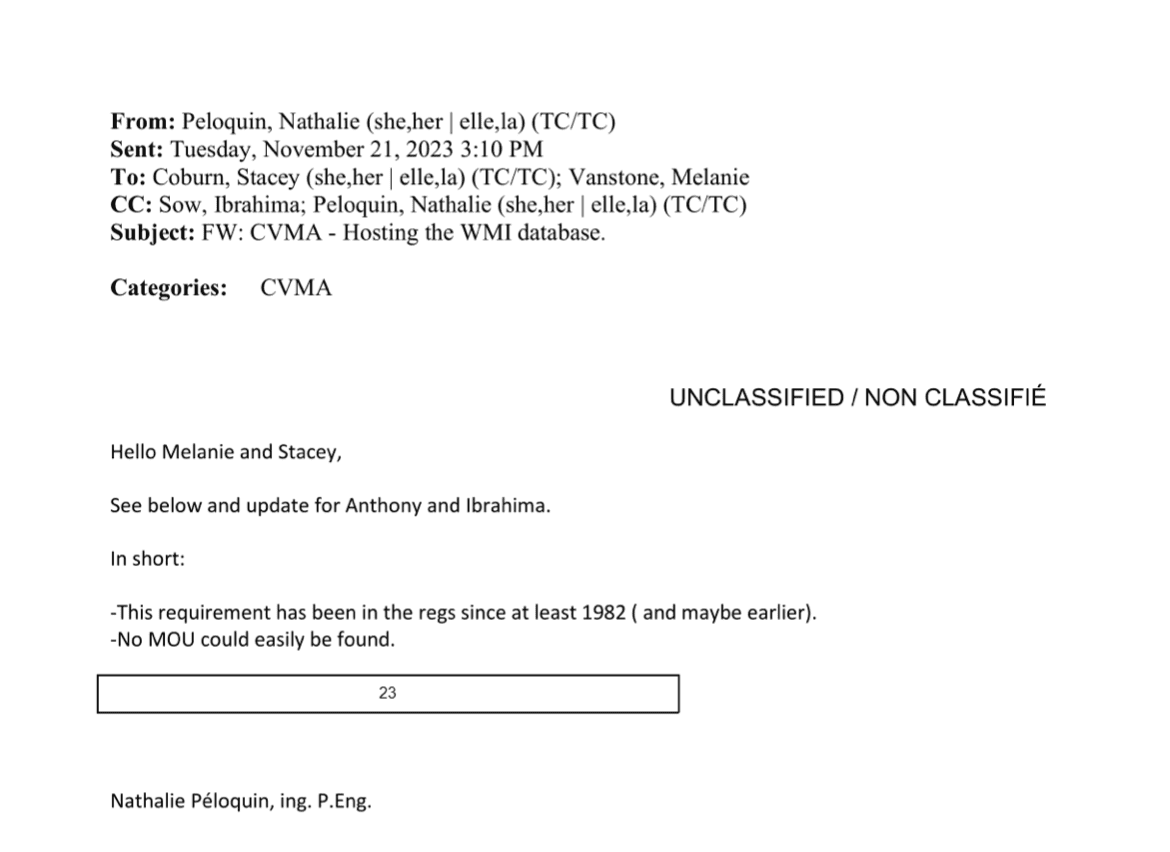
No MOU could easily be found. Forty years of regulatory authority delegated to a private trade association, and there's no document explaining why.
November 22, 2023: Drafting an Email to CVMA
Nathalie prepares a message for senior leadership to send to CVMA's Brian Kingston. She asks the team for input:
Hello Ibrahima and Jeremy and Anthony
After my bilat with Melanie, I have prepared this message for her to send to Brian.
I would appreciate your feedback by tomorrow noon in track changes.
Anthony, you had proposed to bring items from storage to see if a MOU exist - when do you think that this can be done? I expect that CVMA will want to reach out to speak to Melanie quickly after getting this email we would need to know if a MOU was signed between TC and them.
They're preparing to ask CVMA to explain the government's own regulatory framework.
November 24, 2023: The Filing Cabinet Search
Marie Williams-Davignon, Senior Regulatory Development Engineer, reports on her physical search:
Anthony,
I looked through the filing cabinet this afternoon to try and find something that would help with this discussion and found nothing worth noting.
It looks like when the work was done to create the system, it was already established that CVMA, or their former name Motor Vehicle Manufacturer's Association, would be administering the WMI system. I found one sentence that seems to imply that this was based on recommendations by the provinces, but I'm not 100% sure.
I also looked through RDIMS digital files under VIN and CVMA and found nothing there either. I also tried to search their old name and came up empty handed.
I find it hard to believe that there wasn't something drafted for this as there is something for the RIV and a standing contract. I wonder where that is stored, maybe this one is there too?
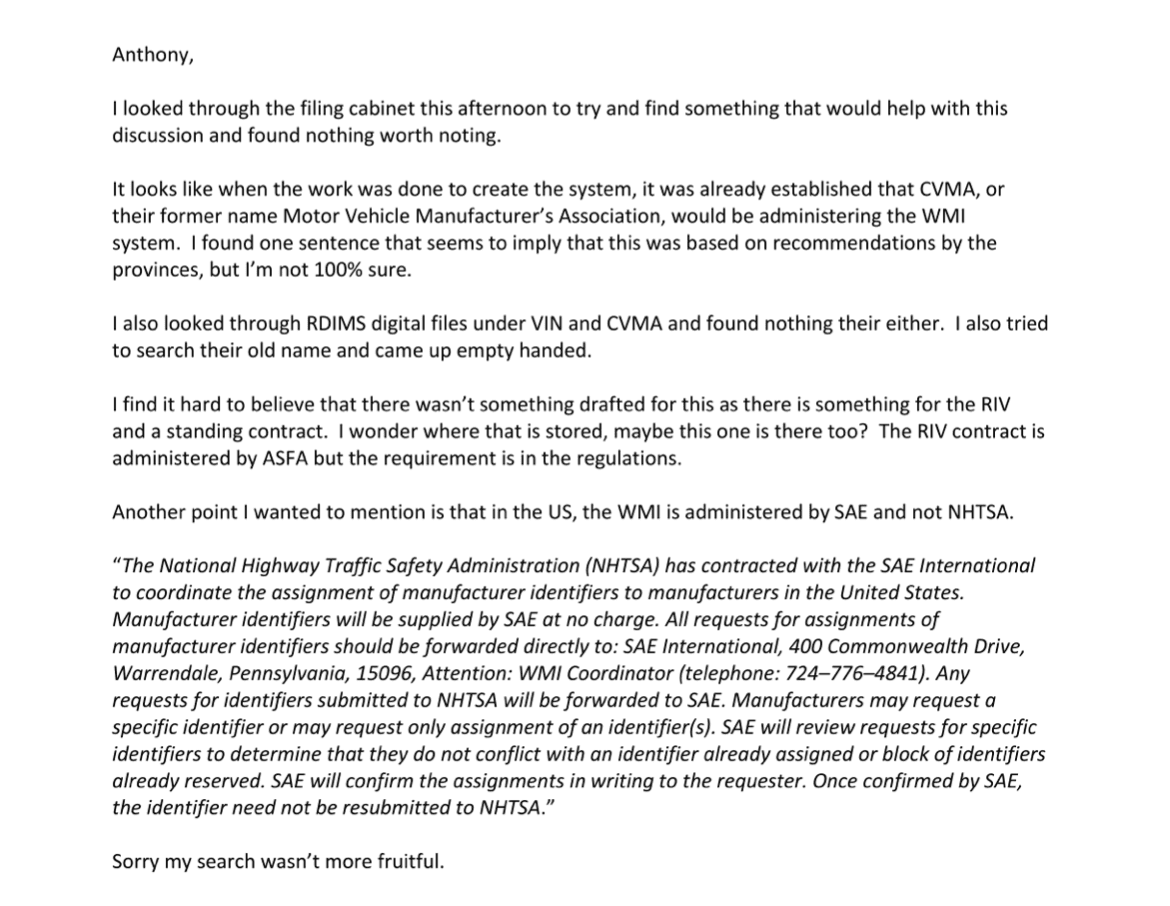
"I find it hard to believe that there wasn't something drafted for this."
There wasn't.
She also notes something interesting about the US system:
Another point I wanted to mention is that in the US, the WMI is administered by SAE and not NHTSA.
The National Highway Traffic Safety Administration (NHTSA) has contracted with the SAE International to coordinate the assignment of manufacturer identifiers to manufacturers in the United States.
In the US, there's a contract. NHTSA contracted with SAE. It's documented.
In Canada, CVMA just... does it. No contract. No documentation. Nobody knows why.
January 12, 2024: "We Have Exhausted All Our Locations"
Two months later. The search is over.
Anthony Jaz sends the final report to Nathalie:
Nathalie,
We have exhausted all our locations of digital files, paper files, and the archives, and have not found anymore information regarding CVMA issuing the VIN's as per regulation 115.

Marie Williams-Davignon confirms:
Good morning Anthony,
As a follow up to my search and our discussion yesterday, I also called up the VIN file from the Records group and there is no information in there about the CVMA requirement regarding subsection 115(11).
As for the CVMA file, the Records group informed that there are no physical Records and that all the saved files are in RDIMS.
The Records group has no physical records. RDIMS has nothing. The archives have nothing. The filing cabinets have nothing. The Canada Gazette shows it's been this way since at least 1982. Nobody knows why.
June 5, 2024: The Lawyers Get Involved
Six months after the search began, the file goes to legal.
An email from Marie-France Taschereau, Legal Counsel at Department of Justice:

The email is marked "PROTECTED B SOLICITOR-CLIENT PRIVILEGE".
The content is fully redacted under Section 23 of the Access to Information Act - solicitor-client privilege.
Whatever the lawyers found - or didn't find - we can't see it. Three full pages are withheld.
The Department of Justice lawyers were reviewing a file about why a trade association controls manufacturer access to the Canadian market. The conclusions are secret.
The Operations Manual: How It Actually Works
The same ATI release included Transport Canada's internal operations manual - the Standard Operating Procedures for ASFAB (Automotive Safety Fabrication and Assembly Branch). This is how they actually process WMI applications.
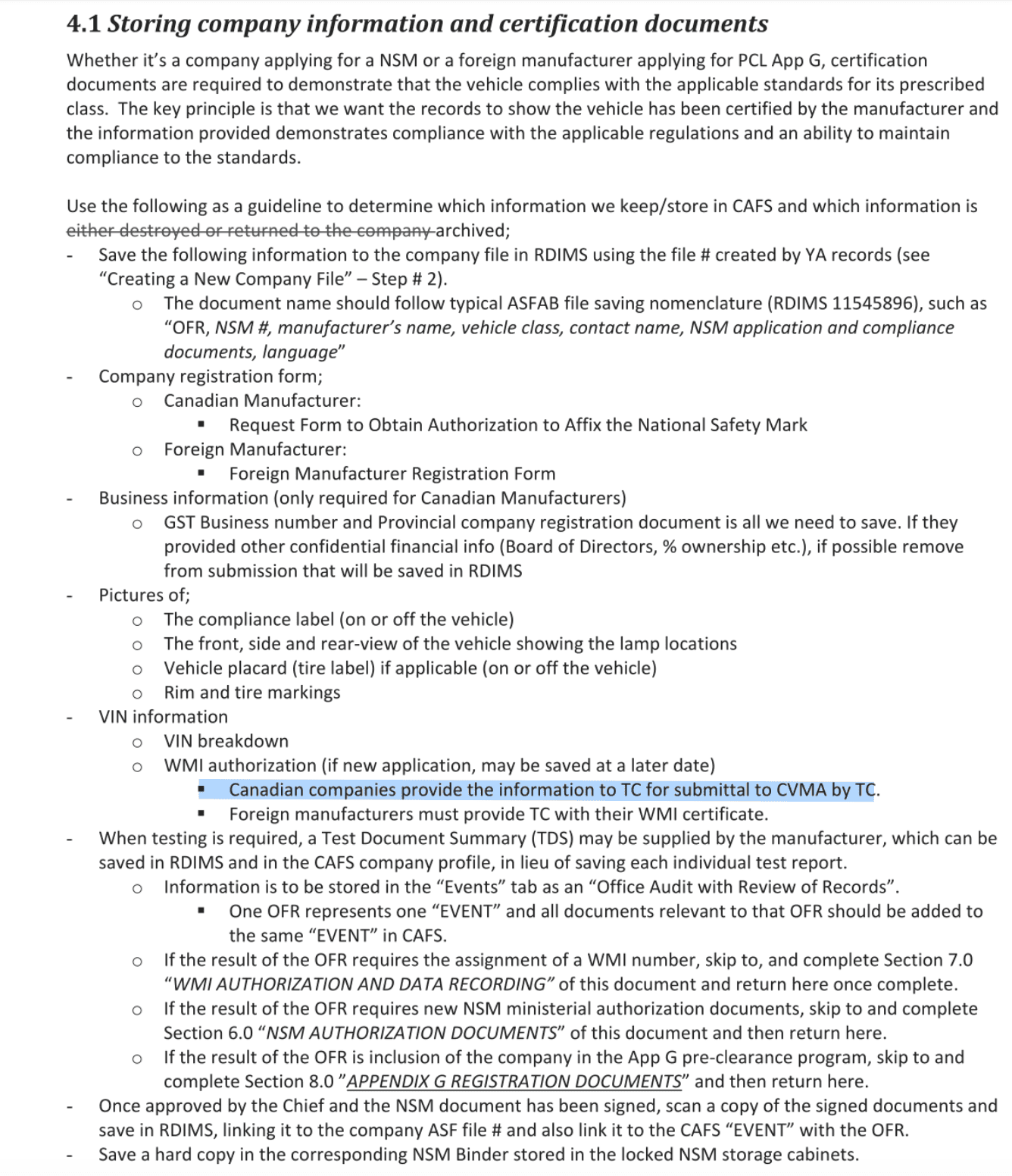
From Page 53 of the operations manual, Section 7.0 "WMI Authorization & data recording":
In the case of a company that has applied for a new NSM, the request for a World Manufacturer Identifier (WMI) code should have been completed as it is included in all NSM application guidelines...
Scan the completed WMI application form and e-mail a copy to CVMA (currently [REDACTED]@cvma.ca), requesting the company name be issued a WMI.
When CVMA replies, they will provide a copy of the letter they mailed to the company, listing the company's assigned WMI code. This typically takes up to a week to process.
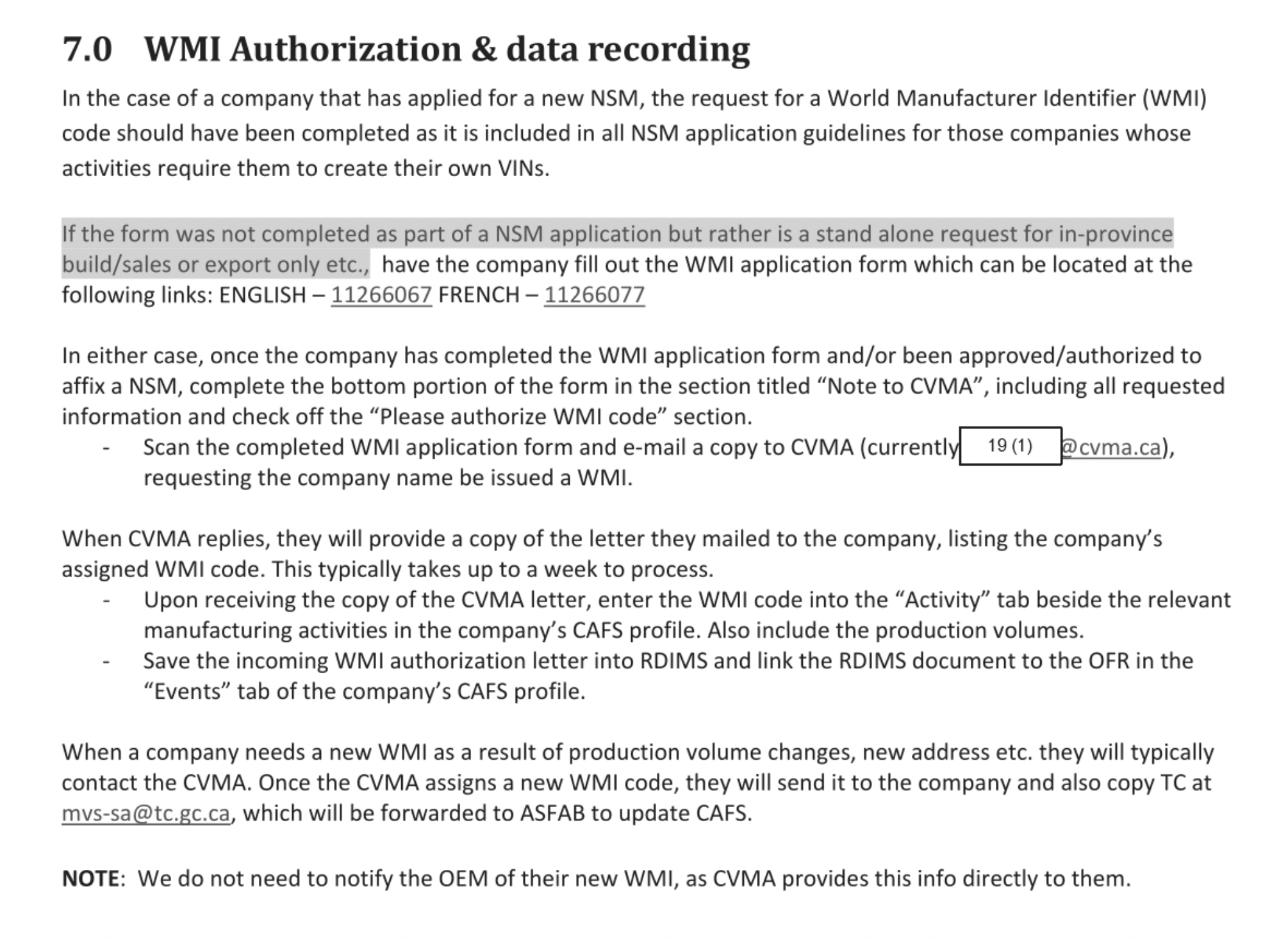
The process is documented. Transport Canada receives a WMI application from a manufacturer. They forward it to Barbara Browne at CVMA. Barbara processes it, checks the SAE database, assigns a code, and mails a letter to the company. TC waits. When CVMA notifies TC, they enter the code into CAFS.
That's the system. The government forwards applications to a private trade association and waits for a response.
CAFS: The Compliance Audit Filing System
The operations manual includes screenshots of CAFS - the Compliance Audit Filing System that tracks all 2,200+ regulated vehicle manufacturers in Canada.
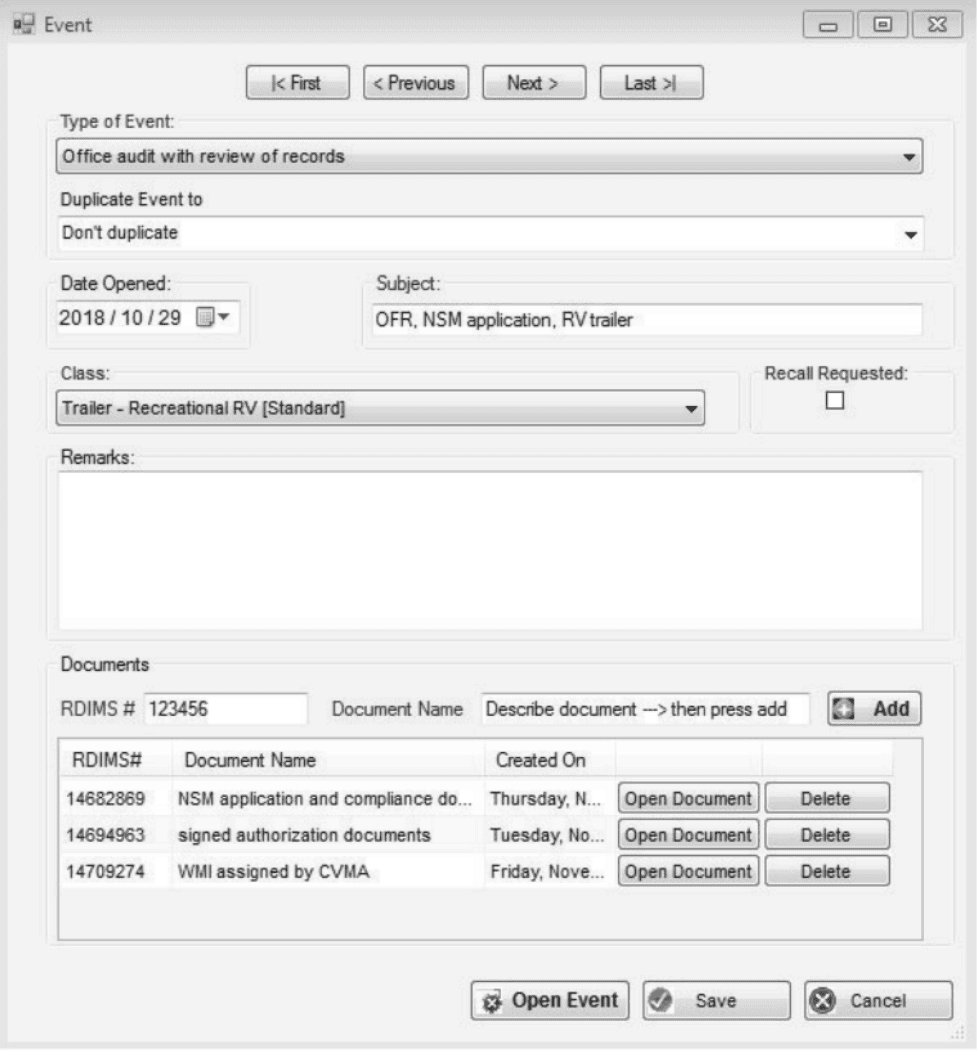
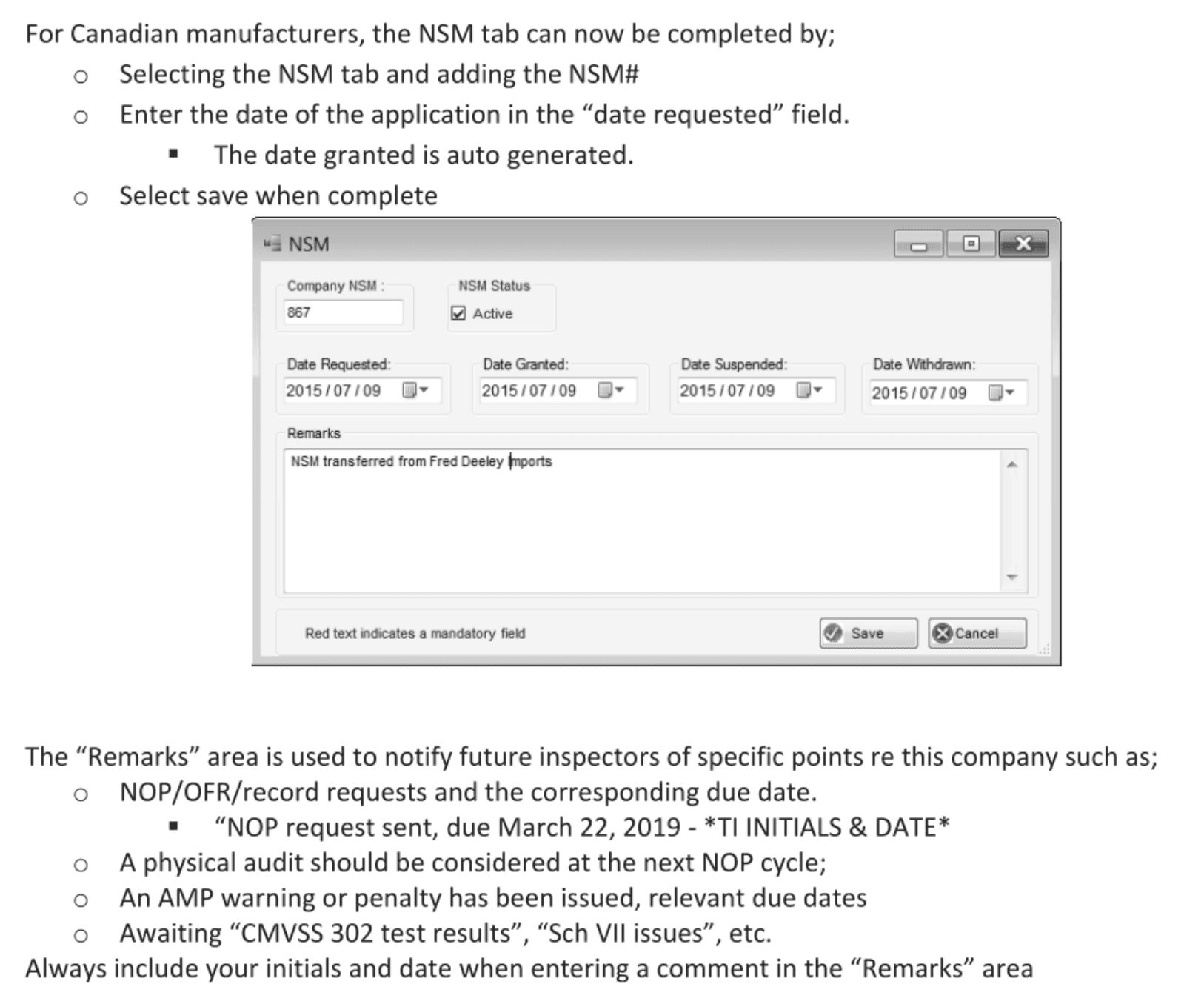
Look at these interfaces. Grey buttons. Dropdown menus. This is what manages vehicle safety for 26 million registered vehicles in Canada.
The manual notes:
CAFS is the primary repository of ASFAB's OEM enforcement oversight activity.
And from the infrastructure section:
CAFS... Status: Runs on Citrix. The interface looks like Windows XP.
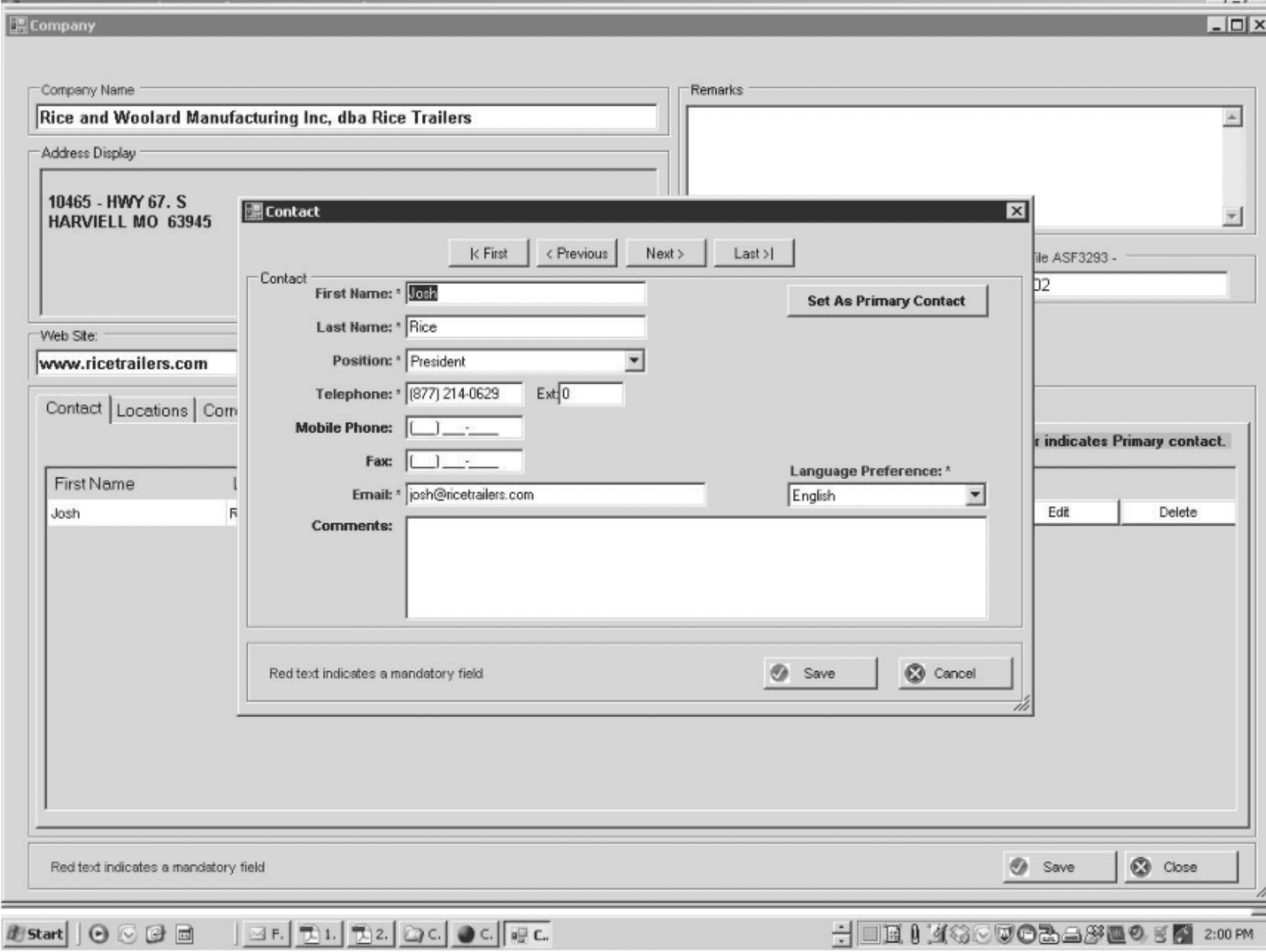
They're investigating moving away from Citrix. It's on the 2025/26 priority list. Along with "Increase size of rate comments textbox."
Barbara Browne
Throughout these documents, one name keeps appearing: Barbara Browne.
From the operations manual:
When a company needs a new WMI as a result of production volume changes, new address etc. they will typically contact the CVMA. Once the CVMA assigns a new WMI code, they will send it to the company and also copy TC at mvs-sa@tc.gc.ca, which will be forwarded to ASFAB to update CAFS.
And when a company changes its name:
Their WMI, registered with CVMA needs to be updated. We must notify the CVMA by emailing Barbara Browne ([REDACTED]@cvma.ca)

Barbara Browne is the WMI Coordinator at CVMA. She's also listed as Executive Assistant and Office Manager.
I obtained a 2016 CVMA letter showing her signature. The footer is watermarked with the association's members:
FCA Canada Inc. | Ford Motor Company of Canada, Limited | General Motors of Canada Company.
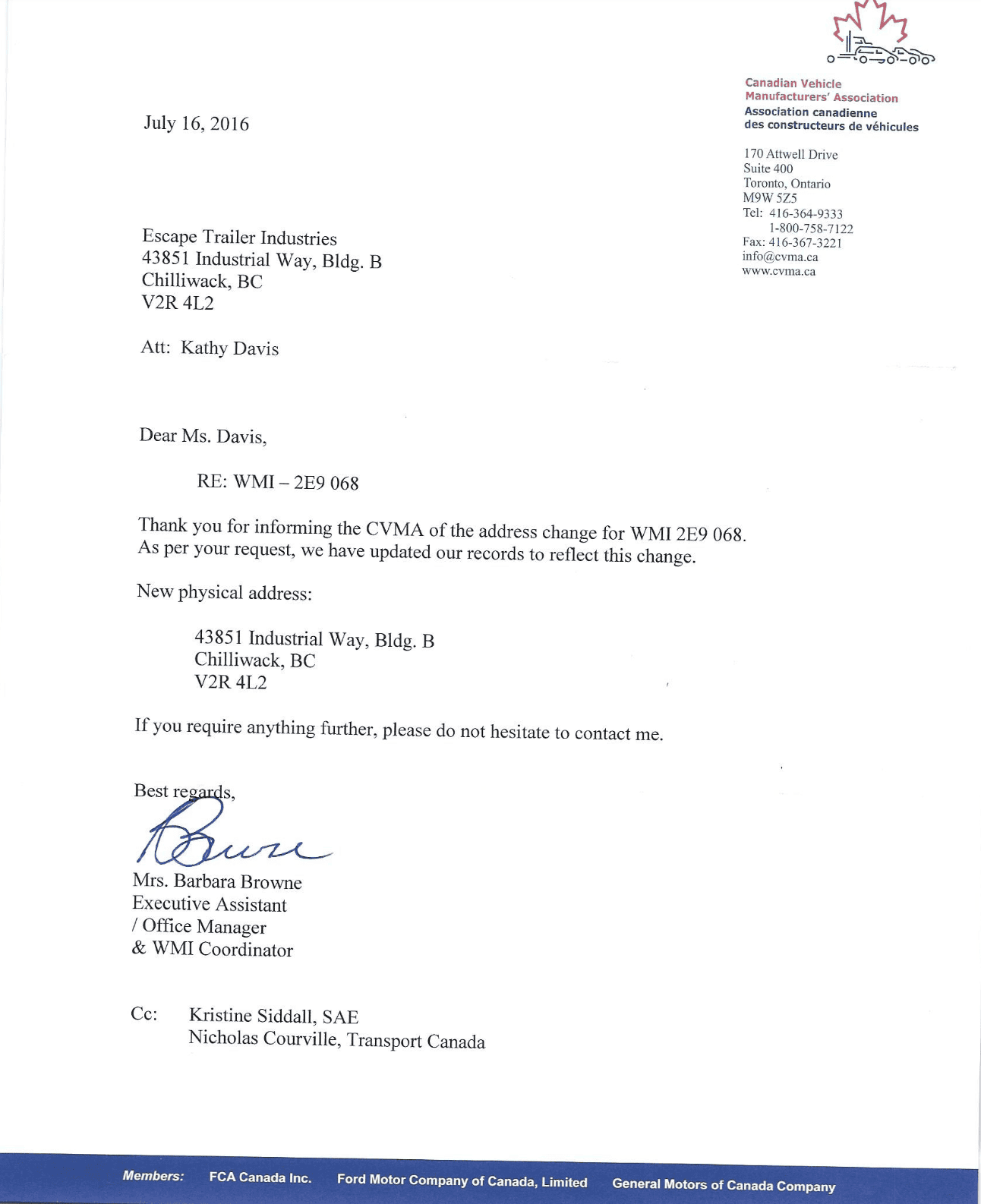
Barbara Browne is not a government employee. She has no statutory authority. She works for the lobbying group of GM, Ford, and Stellantis.
But if you want to sell cars in Canada, you need Barbara to send you a letter.
The Conflict
Let me spell this out:
- CVMA represents the Big Three: GM, Ford, Stellantis
- BYD, NIO, and XPeng are competitors to the Big Three
- Canada has given $13+ billion in subsidies to Big Three plants
- The Big Three's trade association controls which manufacturers can get the codes necessary to sell vehicles in Canada
- Chinese EV companies that want to compete need approval from their competitors' lobbying group
Transport Canada searched for a year - digital files, paper files, archives, Canada Gazette records back to 1982. They called in the Executive Director. They consulted Legal. They brought in Department of Justice lawyers.
They found nothing.
No MOU. No contract. No delegation of authority. No explanation.
Somewhere in the 1980s, someone made a decision. Nobody wrote it down. Everyone forgot why. And now it's embedded in regulation, administered by a trade association, and the government can't explain its own process.
IV — The Missing Manufacturers
The Spreadsheet
I filed ATI A-2025-00715 asking for National Safety Mark applications - the certifications that allow manufacturers to sell vehicles in Canada.
I got a spreadsheet. Every NSM application from January 2024 to February 2026. 276 entries.
I searched for BYD. Nothing.
NIO. Nothing.
XPeng, Geely, Zeekr, Li Auto, SAIC, Chery. Nothing, nothing, nothing, nothing, nothing, nothing.
Not one major Chinese EV manufacturer has applied for a National Safety Mark in the past two years.
The Appendix G Contradiction
But BYD is on Appendix G. That's the official registry of vehicles admissible for import to Canada. They're approved.
How do you get approved to import vehicles without applying to certify them?
I asked Transport Canada. I'm still waiting for an answer.
No VIN Documentation
I filed A-2025-00718 asking for VIN decoding guides - the technical documents manufacturers are required to submit showing how to read their VINs. Position 4 means this, position 5 means that.
The response was four words:
"No records were found."
Transport Canada has no VIN documentation from BYD. None from NIO. None from XPeng, Geely, Zeekr, Li Auto, SAIC, or Chery.
These companies are approved to import vehicles. Canada has no idea how to identify them.
No Compliance Auditing
I filed A-2025-00719 asking for the index of CMVSS 115 VIN files - the documents showing how each manufacturer structures their VINs to comply with Canadian Motor Vehicle Safety Standard 115.
NIL response. But this one came with a note:
TC does not audit CMVSS 115 compliance in standalone manner.
Transport Canada doesn't audit VIN compliance. They don't check if manufacturers are following the rules. There's no index because nobody's keeping track.
V — The Systems
What Transport Canada Actually Runs
Through A-2025-00731, I obtained 40 pages of internal documentation about TC's vehicle safety databases. Here's what exists:
PCDB - Public Complaints Database
- Owner: Trevor Lehouillier
- Function: Consumer safety complaints (intake through web form at https://wwwapps.tc.gc.ca/Saf-Sec-Sur/7/PCDB-BDPP/fc-cp.aspx?lang=eng)
- Contains: VIN, vehicle info, injury data, investigation links
VRDB - Vehicle Recalls Database
- Owner: Louis-Philippe Lussier
- Function: Recall tracking, manufacturer reporting
- Contains: Recall campaigns, completion rates, affected VINs
CAFS - Compliance Audit Filing System
- Function: Manufacturer compliance tracking, WMI codes
- Status: Runs on Citrix. The interface looks like Windows XP.
- Contains: 2,200+ regulated manufacturers
TVIS - Technical Verification Information System
- Function: Technical document verification, digital signatures
FTMS - Field Testing Management System
- Function: Compliance testing management
ACTIVE - (Name unknown)
- Function: Manufacturer technical docs, investigations, Technical Service Bulletins, deaths/injuries/fires, audit trails
The Data Lake
There's also something called the Data Lake. I found it referenced in the database documentation:
dev_safety_security_multimodal_road_safety/
├── bronze_pcdb/          # Raw PCDB tables (daily refresh)
├── bronze_vrdb/          # Raw VRDB tables
├── silver_active/        # Processed analytics views
└── information_schema/
Big lake. Shallow water.
The Proposed VIN Tool
The same document release included something from 2020: a diagram called the "MVSOP IT Solution." It shows how TC's various databases were supposed to connect - complaints, recalls, investigations, manufacturer documents.
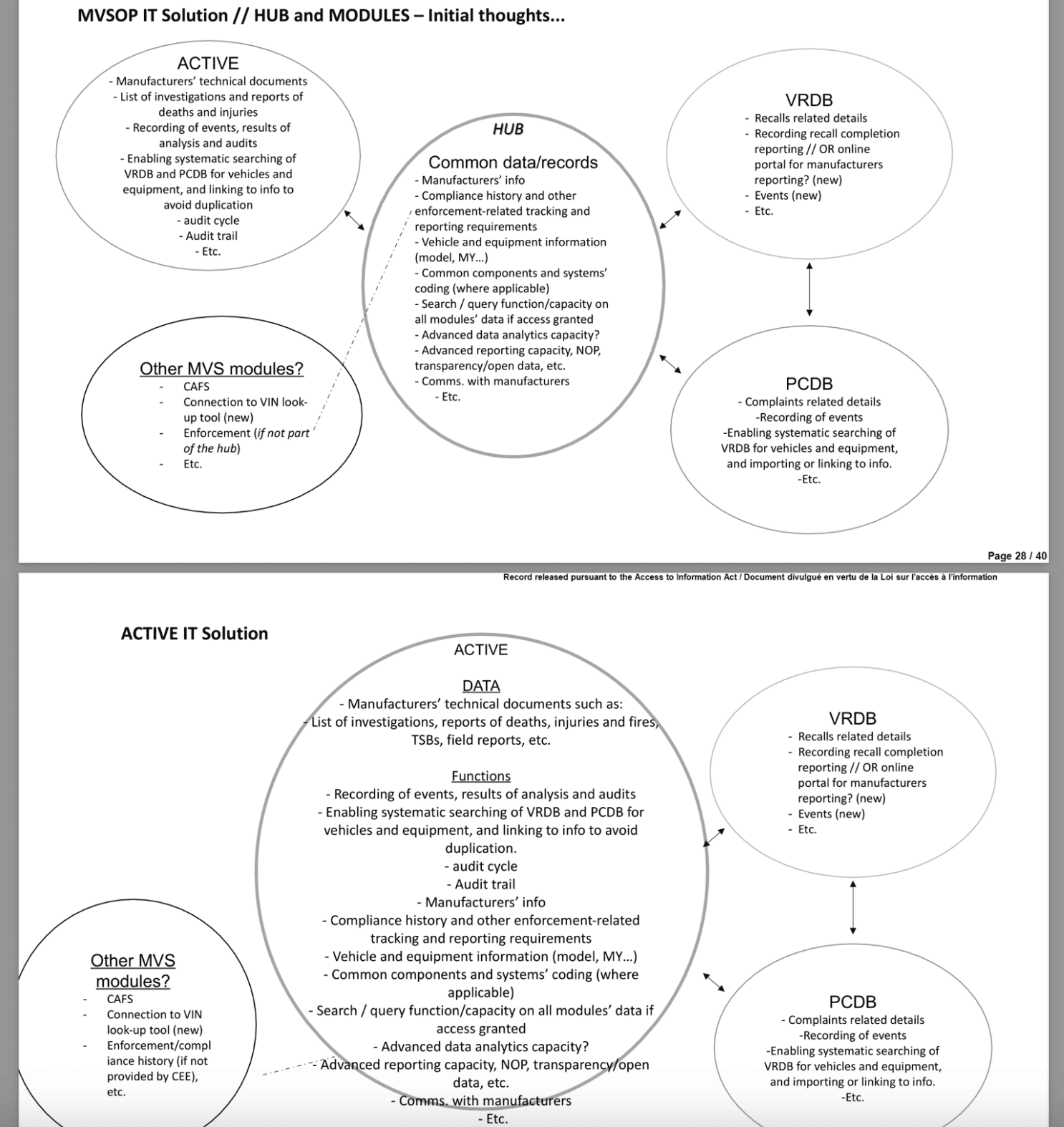
In the corner, one module is labeled:
Connection to VIN look-up tool (new)
It's 2026. The VIN lookup tool doesn't exist. Six years later, it's still labeled "new" in planning documents. It was never built.
VI — The Budget
Sixty-Five Thousand Dollars
From the 731 release, I got an email from Nathalie Peloquin, Director of Motor Vehicle Regulation Enforcement, dated May 6, 2025:
This is the beginning of the new fiscal year and as for previous years, ASFA is in need to develop a BAP with you to support the maintenance and improvements of our aging databases.
As for the previous year, I have a side budget of about $65,000 in OOC and I will look for you to provide me with a costing of the items that will need to proceed this year.
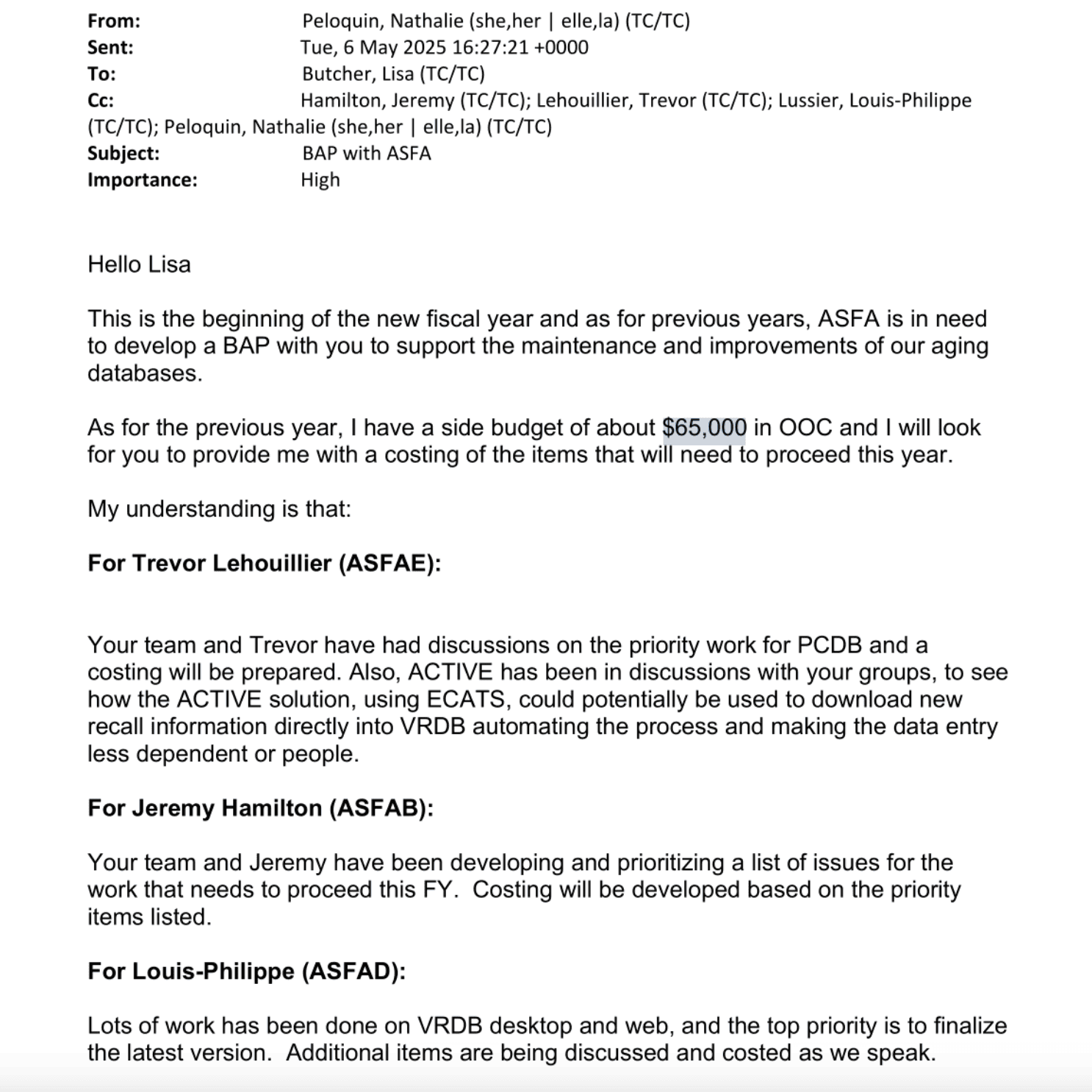
Sixty-five thousand dollars.
That's Transport Canada's entire IT allocation for maintaining their vehicle safety databases - the systems that track complaints, process recalls, store manufacturer filings, and supposedly keep unsafe vehicles off Canadian roads.
Sixty-five thousand dollars. For 26 million registered vehicles.
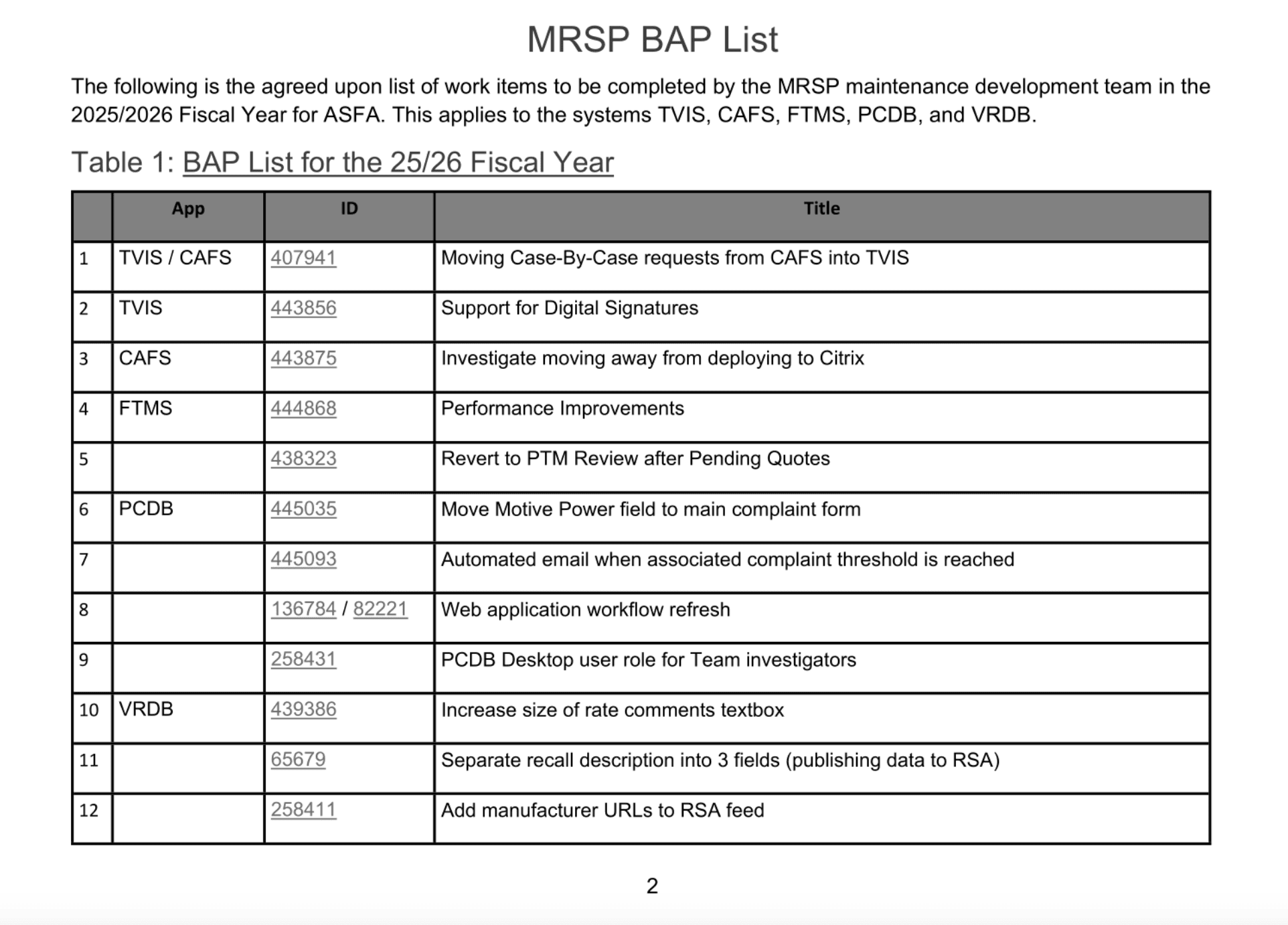
The Priority List
The 2025/26 priority list tells you everything:
| System | Priority Item |
|---|---|
| TVIS/CAFS | "Moving Case-By-Case requests from CAFS into TVIS" |
| TVIS | "Support for Digital Signatures" |
| CAFS | "Investigate moving away from deploying to Citrix" |
| FTMS | "Performance Improvements" |
| PCDB | "Move Motive Power field to main complaint form" |
| VRDB | "Increase size of rate comments textbox" |
VII — The Surveillance Gap
Forty-Nine Thousand Vehicles
In January 2026, Canada announced a quota system for Chinese electric vehicles. 49,000 units per year. BYD, NIO, XPeng - all eligible. It was framed as managing the flow of imports while protecting the domestic industry.
I filed A-2025-00728 asking for the post-market surveillance plans.
Compliance testing protocols. Defect monitoring strategies. Consumer complaint tracking specific to Chinese EVs. Inspection frameworks. Resource allocations. Briefing materials prepared for the Minister.
The response:
"No records were found."
Forty-nine thousand vehicles per year. Zero oversight plan.
The Testing Gap
I analyzed Transport Canada's published compliance testing results. Physical tests where they verify vehicles meet safety standards.
From 2016 to present: 1,026 tests total.
Tests on vehicles from Chinese manufacturers: Zero.
Canada is preparing to admit 49,000 Chinese EVs per year. Every one of those vehicles will be self-certified by the manufacturer. None will be tested by Canadian regulators.
VIII — The Recall Scenario
What Happens When a BYD Catches Fire
This is not speculation. Every step of this failure is documented in my ATI releases.
Step 1: Identify the Defect
A BYD catches fire. Multiple reports come in. Transport Canada opens an investigation. They need to identify every affected vehicle in Canada and notify the owners.
Step 2: Try the American Database
They try NHTSA's database. NHTSA doesn't track Chinese vehicles sold outside the US. No data.
Step 3: Try Carfax
They try Carfax - the service they subscribe to. Carfax doesn't cover Chinese manufacturers. No data.
Step 4: Look for VIN Documentation
They try to look up how to decode BYD VINs so they can identify which model years and production runs are affected.
There isn't any. A-2025-00718 confirmed it: "No records were found."
Step 5: Contact the Manufacturer
They try to contact BYD headquarters in Shenzhen. It's 3 AM there. Nobody answers.
Step 6: Issue the Recall Anyway
They issue a recall notice with incomplete information. They can't identify all affected vehicles. They can't notify all owners. They don't know how many are on Canadian roads.
Step 7: Track Completion
They try to track recall completion rates. Manufacturers are supposed to report how many vehicles have been repaired. But TC's systems can't decode the VINs being reported. The completion data is meaningless.
Every gap in this chain is documented. The NIL responses prove the absences. The email chains prove the confusion. The budget proves no one's coming to fix it.
IX — The Contradiction
Two Answers, One Week Apart
On February 5, 2026, Transport Canada's Access to Information office told me - in writing - that TC has the authority to require VIN data from manufacturers under subsection 115(9) of the Canadian Motor Vehicle Safety Standards.
On February 12, 2026, the Minister's office told me - in writing - that "no authority exists under the Motor Vehicle Safety Act to compel such reporting."
Same department. Opposite answers. One week apart.


I asked for clarification. As of this writing, nobody has explained which answer is correct.
If 115(9) gives TC the authority to require VIN data, why don't they require it?
If no authority exists, why did the ATIP office say it does?
The Canadian government cannot agree with itself about its own powers.
X — The People
Who I Found
Through 15 ATI releases and 74 pages of internal emails, I identified the people who run this system:
Transport Canada
| Name | Role |
|---|---|
| Nathalie Peloquin | Director, Motor Vehicle Regulation Enforcement - controls the $65K budget, led the WMI search |
| Jeremy Hamilton | A/Chief, Importation and Audit Inspection - started asking questions about CVMA, cold-emailed Carfax |
| Trevor Lehouillier | PCDB Data Owner - confirmed Carfax subscription |
| Louis-Philippe Lussier | VRDB Data Owner - manages recall database |
| Ibrahima Sow | Executive Director, Motor Vehicle Safety - "I am not sure we have anything on this" |
| Anthony Jaz | Regulatory team - searched Canada Gazette back to 1982 |
| Marie Williams-Davignon | Senior Regulatory Development Engineer - searched filing cabinets, "found nothing worth noting" |
| Lisa Butcher | Manager, Multimodal and Road Safety Apps |
| Liliana Morse | IT Technical Advisor, EBIDA - manages Data Lake |
| Maya Jaffary | Data Steward |
| Stephanie Claros | ATIP Manager - answered my requests |
| Marie-France Taschereau | Legal Counsel, Department of Justice - redacted pages |
CVMA
| Name | Role |
|---|---|
| Barbara Browne | Executive Assistant, Office Manager, and WMI Coordinator - signs the letters that let manufacturers sell cars in Canada |
| Brian Kingston | CVMA leadership - spoke with Jeremy Hamilton in November 2023 |
These are not bad people. They're working within a system that was never designed for what it's being asked to do. Jeremy Hamilton spent months trying to understand why CVMA handles WMI codes. He couldn't find an answer because there isn't one.
The system wasn't built. It accumulated.
XI — The Timeline
| Date | Event | Source |
|---|---|---|
| ~1982 or earlier | Someone decides CVMA (then "Motor Vehicle Manufacturer's Association") handles WMI codes | Canada Gazette SOR/DORS/82-753 |
| 1996 | CVMA renamed from "Motor Vehicle Manufacturer's Association" | Canada Gazette |
| 1997 | Regulation updated to reflect new name - "administrative" change only | SOR/DORS/97-532 |
| Jul 2016 | Barbara Browne WMI letter example | CVMA document |
| 2020 | MVSOP IT Solution proposes "VIN lookup tool (new)" | A-2025-00731 |
| Jan 2021 | TC confirms Carfax subscription | A-2025-00674 |
| Oct 2021 | Jeremy Hamilton cold-emails Carfax | A-2025-00674 |
| Nov 14, 2023 | Jeremy Hamilton asks "Why does CVMA handle WMI?" | A-2025-00724 p.1 |
| Nov 16, 2023 | Nathalie Peloquin: "there is no background or additional information that can be found" | A-2025-00724 p.3 |
| Nov 16, 2023 | Ibrahima Sow: "I am not sure we have anything on this" | A-2025-00724 p.7 |
| Nov 20, 2023 | Anthony Jaz: "it has been at least 40 years" | A-2025-00724 p.10 |
| Nov 24, 2023 | Marie Williams-Davignon: "found nothing worth noting" in filing cabinets | A-2025-00724 p.24 |
| Jan 12, 2024 | Anthony Jaz: "We have exhausted all our locations" | A-2025-00724 p.23 |
| Jun 5, 2024 | DOJ lawyers reviewing file - pages redacted | A-2025-00724 p.27-30 |
| May 2025 | Nathalie Peloquin: "$65,000 budget" | A-2025-00731 |
| Jan 2026 | Chinese EV quota announced (49,000/year) | Public |
| Feb 2026 | 15 ATI responses received | Personal |
| Feb 5, 2026 | ATIP says 115(9) allows VIN requirement | |
| Feb 12, 2026 | MinO says "no authority exists" | |
| 2026 | VIN lookup tool still doesn't exist | A-2025-00731 |
XII — The NIL Responses
What Doesn't Exist
ATI law requires the government to search for responsive records. A "NIL response" means they searched and found nothing. These absences are as important as the documents I received.
A-2025-00668 - Policy on mandatory VIN reporting No policy exists.
A-2025-00670 - Policy on publishing VIN/complaint data No policy exists.
A-2025-00671 - TC/NHTSA data sharing agreements No formal agreements exist.
A-2025-00673 - Manufacturer confidentiality claims No claims on file.
A-2025-00713 - NHTSA database usage, vPIC, FARS, risk assessments No records on US data reliance. No risk assessments. No policy for handling gaps.
A-2025-00718 - VIN decoding guides from manufacturers No documentation from Chinese OEMs.
A-2025-00719 - Index of CMVSS 115 VIN files No index exists. "TC does not audit CMVSS 115 compliance in standalone manner."
A-2025-00728 - Post-market surveillance for Chinese EV quota No plan exists for 49,000 vehicles/year.
Eight separate searches. Eight confirmed absences.
XIII — How to Actually Import a Vehicle
| Step | What's Required | Who Controls It | Chinese OEMs |
|---|---|---|---|
| 1. WMI Code | First 3 VIN characters | Barbara Browne @ CVMA | None have applied |
| 2. NSM Application | Safety mark certification | Transport Canada | Zero applications 2024-2026 |
| 3. CMVSS 115 | VIN decoding guide | Nobody audits | No documentation on file |
| 4. Appendix G | Import approval | Transport Canada | BYD listed (somehow) |
| 5. RIV Processing | VIN decode at border | vPIC (American database) | Not in database |
| Outcome | Import blocked |
Actual answer: You can't.
Forty-nine thousand Chinese EVs per year. Zero documented process for admitting them.
XIV — What Should Happen
I'm not a policy expert. I build software. But based on three months of reading government documents, here's what seems obvious:
1. Canada needs its own VIN database.
Relying on NHTSA made sense when most vehicles came from the US, Japan, and Europe. That's no longer true. A sovereign vehicle registry should be able to identify vehicles sold in its own market.
2. WMI assignment needs a legal basis.
Either TC should handle it directly, or there should be a formal delegation with oversight. Having a trade association control market access for its members' competitors is indefensible.
3. The budget needs to reflect the responsibility.
Either fund the system or admit it doesn't exist.
4. VIN documentation should be mandatory before import approval.
If a manufacturer can't explain how to decode their VINs, their vehicles shouldn't be on Appendix G.
5. Surveillance plans should exist before quotas are announced.
49,000 vehicles with no oversight framework is policy theater.
6. The DOJ conclusions should be released.
Three pages of the WMI file are redacted under solicitor-client privilege. If the lawyers found something - or found nothing - Canadians should know.
Conclusion
I didn't set out to expose this. I just wanted to know why Canada's vehicle import system couldn't identify a BYD.
I have the emails. I watched Transport Canada staff spend two months searching digital files, paper files, and archives. I read Marie Williams-Davignon's note: "I find it hard to believe that there wasn't something drafted for this." I read Anthony Jaz's final report: "We have exhausted all our locations."
There wasn't anything drafted. There isn't anything now.
The documents are all public now. If you're a journalist, a regulator, an insurer, a dealer, or just someone who bought a car in Canada and assumed somebody was in charge - I'm sorry.
Nobody is.
please contact me at hello@cardog.app if you have any questions or feedback.
Appendix: ATI Release Index
| Request | Date | Pages | Subject | Finding |
|---|---|---|---|---|
| A-2025-00668 | Feb 11 | 1 | VIN reporting policy | No policy exists |
| A-2025-00669 | Feb 27 | 3 | Complaint statistics | 4,307 complaints in 2025 |
| A-2025-00670 | Feb 5 | 1 | VIN/complaint publication | No policy exists |
| A-2025-00671 | Feb 5 | 1 | TC/NHTSA agreements | No agreements exist |
| A-2025-00673 | Feb 18 | 1 | Confidentiality claims | No claims on file |
| A-2025-00674 | Feb 20 | 23 | Data providers | Carfax subscription; cold emails |
| A-2025-00713 | Feb 13 | 1 | NHTSA database usage | No records; no risk assessment |
| A-2025-00715 | Mar 10 | ~10 | NSM applications | 276 entries; zero Chinese OEMs |
| A-2025-00718 | Feb 2026 | 1 | VIN decoder guides | No Chinese OEM documentation |
| A-2025-00719 | Feb 19 | 2 | CMVSS 115 index | No index; "TC does not audit" |
| A-2025-00724 | Mar 10 | 74 | WMI authority | Barbara Browne; no legal basis; DOJ involved |
| A-2025-00728 | Feb 24 | 1 | Chinese EV surveillance | No plan for 49K quota |
| A-2025-00729 | Mar 10 | 10 | Vehicle theft | MinO questions |
| A-2025-00731 | Feb 26 | 40 | TC databases | $65K budget; CAFS; schemas |